





Planning an In-Lite Garden Lighting System
A connected lighting system, from the first cable to the finishing touch
In lite is a modular outdoor lighting system for paths, planting, patios, walls and garden features. Rather than choosing unrelated lights, you build a coordinated scheme with compatible fittings, a transformer and a shared cable network. Start with the areas you want to enjoy after dark, then choose the lights that suit them. You can add more later, provided the transformer and cable layout have enough spare capacity.
Most fittings in this range use the low voltage HUB system explained below. Mains powered wall and pendant lights, and rechargeable table lamps, have different requirements and do not connect to it in the same way.
Starting a new lighting scheme?
Choose the actual lights first, then plan their power and cable.
Adding a part to an existing system?
Match the model and connection before choosing a spare or accessory.
Looking for a table lamp?
Compare rechargeable lamps and cabled lanterns; their power needs differ.
How the In lite system fits together
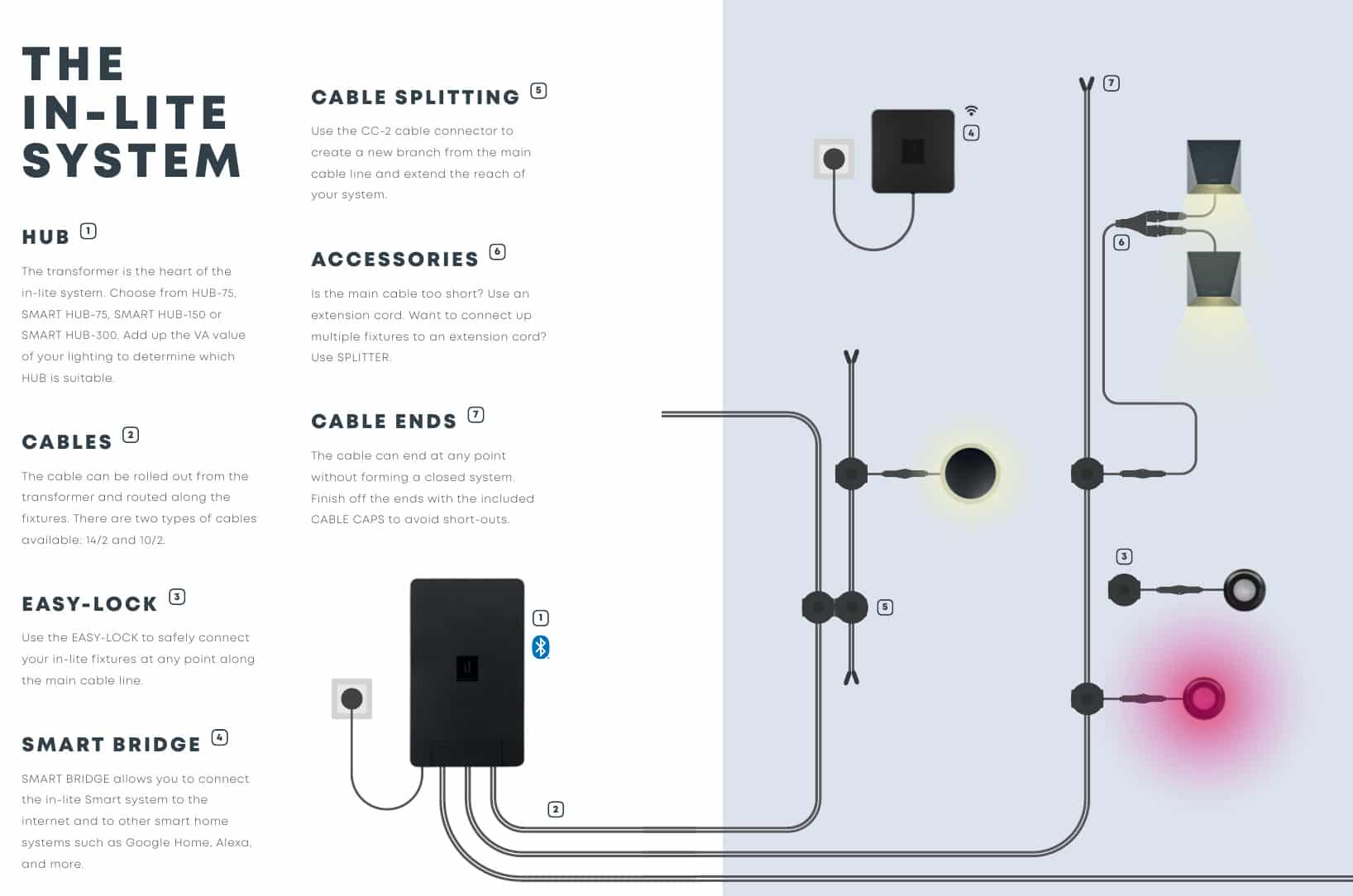
Explore the seven parts of the system
- HUB transformer: the heart of the system, supplying the compatible garden lights from a mains connection. Choose a HUB or SMART HUB by adding up the fittings’ VA loads and checking the capacity of each output.
- Main cable: route compatible 14/2 or 10/2 system cable from the transformer past the planned light positions. Cable type, distance and load must work together.
- EASY LOCK connectors: connect each suitable fitting to the main cable where you need it. Check the product’s included items before buying extra connectors.
- SMART BRIDGE: an optional addition to a compatible smart system for internet access and supported smart home integrations.
- Cable branches: use a CC2 connector where the main cable needs to branch towards another part of the garden.
- Extensions and splitters: use the correct fixture leads and splitters to reach or group nearby fittings.
- Cable ends: finish exposed ends with the appropriate cable caps. The cable does not need to return to the transformer as a closed loop.
What does smart lighting add?
A SMART HUB and the In lite app let you organise compatible lighting into zones, schedules and scenes. Suitable SMART TONE lights also offer colour adjustment and individual control. A standard light does not automatically become dimmable or colour changing simply because it is connected to a SMART HUB.
For remote access and integration with supported platforms such as Google Home, Amazon Alexa, Apple Home and Matter, add SMART BRIDGE to a compatible SMART HUB system. Check the specific hub and light combination before ordering: SMART HUB 300 has exclusions, including HYVE, FUSION, DB LED and LIV WALL.
Choose your lights, then complete the system
Browse spotlights for trees and features, path and planting lights, recessed lights for paving and decking, or wall and ceiling lights. Then add the matching transformer, cable and installation accessories. Not sure what belongs on your shopping list? Send us a sketch and the areas you want to light and we can help you check the components.
For light along steps and benches, explore decorative and linear lighting. For a lamp you can move around the table, compare portable and table lighting, checking whether the selected model is rechargeable or cabled.
View our frequently asked questions below the products.
Price range: £10.55 through £20.14 (inc VAT)
Price range: £66.12 through £800.11 (inc VAT)


Choose compatible components before ordering
Add the VA load of every selected fitting and check both the total HUB capacity and the load on each output. A complete light is not necessarily a complete garden installation: system cable and the transformer are usually separate.
SMART HUB 300 has specific exclusions, including HYVE, FUSION, DB LED and LIV WALL. Mains wall and pendant lights must not be connected to a low voltage HUB. Check the selected voltage and configuration on each product page.
In-Lite Garden Lighting Buying Guide & FAQs
Plan the effect before choosing the fittings
Outdoor lighting works best when it solves a clear job: guiding someone along a route, making a step easier to read, lighting a dining area or revealing a favourite tree. Start with those jobs, then choose the light type. A large lumen figure is not automatically better; beam direction, mounting position, surface colour and viewing angle all affect the finished result.
Plan the transformer, cable and fittings together
The transformer, cable, connectors and fittings must be planned together. Use the transformer and smart-control range to choose the correct capacity and control method, and the cable and connector range to complete the circuit. Keep a record of every fitting and its VA load so future additions can be assessed properly.
Frequently asked questions
What do I need to create an In-Lite 12V lighting system?
You normally need a suitable In-Lite HUB or SMART HUB transformer, enough compatible system cable, the chosen 12V fittings and any splitters, extension leads or installation accessories required by the layout. Most fittings include an EASY-LOCK connector, but check each product’s Included Items section rather than assuming.
How do I choose an In-Lite transformer?
Add together the VA ratings of every fitting on the planned circuit, then choose a transformer with sufficient capacity and sensible room for realistic future additions. Choose a standard HUB for straightforward timed or light-sensor control, or compare SMART HUB models where app-based zones and wider smart-control options are useful.
Why should I calculate VA rather than watts?
The transformer is rated in VA and the product data provides a VA load for system planning. Wattage describes real power consumed by the LED, while VA also reflects the electrical load presented to the transformer. For this system, total the published VA figures.
Can I add more lights later?
Yes, expansion is one of the advantages of the system, provided the transformer has spare VA capacity and the cable layout can accept the extra fittings. Keep the original plan and load calculation so additions are made deliberately rather than by guesswork.
Can In-Lite lights be installed by a homeowner?
Many 12V fittings and EASY-LOCK connections are designed to make garden-side installation straightforward, but the transformer still needs the correct mains supply and installation conditions. Any 100–230V fitting or new mains electrical work should be handled by a suitably qualified person.
What colour temperature is best for a garden?
Warm white light—commonly around the upper 2000K to low 3000K range in this catalogue—usually suits planting, timber and brick. Cooler or tuneable light can suit contemporary materials or changing scenes. Compare Kelvin values within the filters and avoid mixing temperatures accidentally unless the contrast is intentional.
What does an IP rating tell me?
The IP rating describes protection against solids and water under defined test conditions. It does not make every fitting suitable for submersion. Use a product specifically designed and rated for underwater use, such as the In-Lite SUB, where the light will operate beneath the water surface.
How far apart should garden lights be?
There is no universal spacing. It depends on beam shape, mounting height, surface reflectance and the effect you want. Mark positions temporarily and test the scene after dark before fixing every fitting permanently.
How do I reduce glare from outdoor lights?
Keep the source out of normal sightlines, aim spotlights carefully and use the compatible shield, shutter, honeycomb or diffuser. A lower-output fitting in a better position often looks more comfortable than a powerful fitting aimed directly towards people.
Can I use In-Lite lighting around a pond?
Yes, but distinguish between lighting beside water and lighting underwater. Use suitable outdoor fittings around the pond, protect cable routes from damage and select the purpose-built IP68 SUB for submerged illumination. Transformers and non-submersible connections must remain in their specified installation locations.
What is the difference between a spotlight and a recessed uplight?
A spotlight is easy to aim and reposition in a border, making it useful for trees, sculptures and changing planting. A recessed uplight produces a cleaner, integrated finish in paving or decking but needs a correctly planned cut-out, drainage and cable route before the surface is completed.
Do I need smart controls?
No. A standard HUB suits many schemes. SMART HUB control becomes valuable when you want separately controlled zones, app operation or a more adaptable schedule. Choose the control system for the way the garden will actually be used, not simply because it has more features.
Can In-Lite lights run all night?
They can be scheduled to suit the installation, but all-night operation is rarely necessary in a private garden. Thoughtful timers, zones and motion control can reduce energy use and unnecessary disturbance while still providing safe access when required.
Should every part of the garden be illuminated?
No. Good lighting relies on contrast. Pick important routes, level changes, gathering spaces and a few strong features, then allow darker areas to remain. This creates depth and avoids excessive brightness.
How should I plan lighting before landscaping work starts?
Mark transformer access, cable routes, sleeves beneath paving, recessed-light cut-outs, wall feeds and likely future additions on the landscape plan. Photograph cable positions before they are covered and keep a schedule of fittings and VA loads.
Can you help check an In-Lite shopping list?
Yes. Send us a plan or clear sketch with approximate dimensions, the features to be lit, likely fitting positions and the available power location. We can help identify obvious omissions and compare appropriate products, although final electrical and construction suitability remains the installer’s responsibility.
