





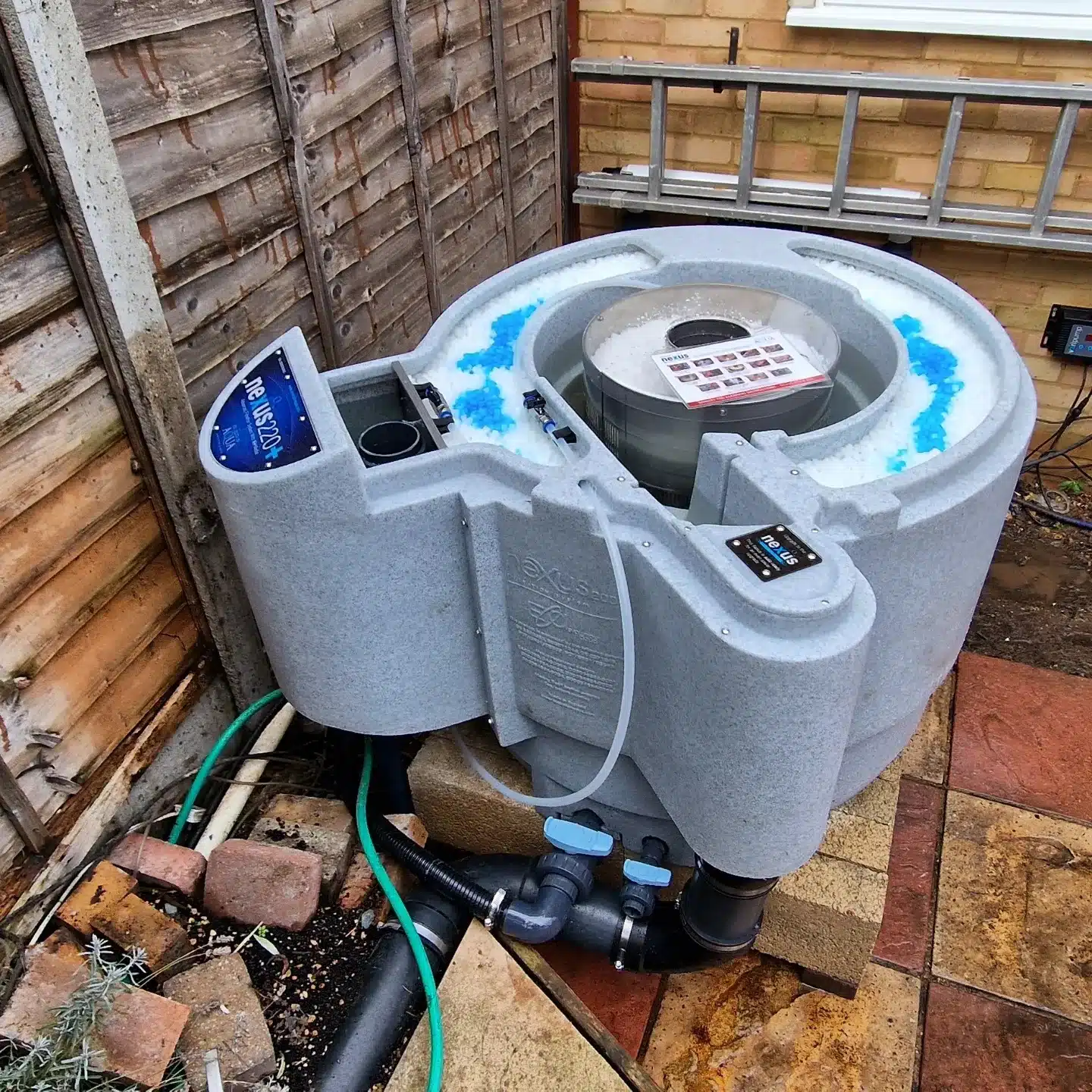
Evolution Aqua Nexus Pond Filter Guide: How It Works and Cleaning Tips
The Evolution Aqua Nexus has been a familiar sight beside koi ponds for years because it combines two jobs in one vessel. The centre section removes solid waste, while the outer moving bed supports the bacteria that deal with dissolved fish waste. It is a straightforward idea, but choosing the right Nexus, installing it correctly and keeping the flow within sensible limits all make a noticeable difference.
That Pond Guy is not only an online retailer. We are a working koi pond building and installation company, and our team also carries out professional pond cleaning, filtration upgrades and ongoing maintenance. The advice below comes from specifying, installing and looking after pond filtration in the real world, where fish load, feeding, pipework and maintenance matter just as much as the largest pond volume printed in a brochure.
This guide compares the Nexus 220+, Nexus 320+, Nexus Ti filters, complete equipment bundles, automatic cleaning options and Ti UV upgrades. It also explains the flow rates and pond sizes we would actually work to on a koi pond.
Quick answer: the Nexus 220 is the smaller choice for ponds up to 18,000 litres, while the Nexus 320 provides more water volume, biological media and flow capacity for ponds up to 34,000 litres. Those are manufacturer maximums. Koi numbers, feeding, pipework and real flow through the filter still need to be considered.
Which Evolution Aqua Nexus is right for your pond?
| Model | Manufacturer maximum pond size | Maximum flow | Biological media supplied | Built in UV |
|---|---|---|---|---|
| Nexus 220+ | 18,000 litres | 10,000 L/h | 50 litres of K+ Media | No |
| Nexus 320+ | 34,000 litres | 13,000 L/h | 100 litres of K+ Media | No |
| Nexus 220 Ti | 18,000 litres | 10,000 L/h | 50 litres of K+ Media | Two 36 watt Titanium Enhanced UVC units |
| Nexus 320 Ti | 34,000 litres | 13,000 L/h | 100 litres of K+ Media | Two 55 watt Titanium Enhanced UVC units |
The 220 and 320 use the same filtration principle. The 320 is physically larger, holds 840 litres of water rather than 510 litres and can carry up to 300 litres of biological media rather than 150 litres. That extra capacity is useful on larger ponds, heavily stocked koi ponds and systems where feeding is likely to increase.
Do not choose only from the headline pond size. A modest pond containing a large weight of koi and receiving heavy summer feeds can place more demand on a filter than a much larger pond with a few ornamental fish. If your pond sits close to a quoted limit, the larger filter usually gives you more breathing space.
Our real world Nexus sizing recommendations
Installer’s quick answer: for a normally stocked koi pond, we would usually regard the Nexus 220 as a strong choice at around 10,000 litres with roughly 7,000 to 8,000 litres per hour genuinely reaching the filter. For a Nexus 320, our practical starting point is around 15,000 litres with roughly 12,000 to 13,000 litres per hour reaching it.
These figures are deliberately more conservative than the manufacturer’s headline maximum pond volumes. They reflect the way we assess working koi ponds, where fish grow, summer feeding increases and the measured flow after pipe resistance can be very different from the number printed on the pump.
| Filter | Our practical koi pond guide | Our target flow at the filter | Standard air pump match |
|---|---|---|---|
| Nexus 220+ or Nexus 220 Ti | Around 10,000 litres | About 7,000 to 8,000 L/h | Airtech 75 |
| Nexus 320+ or Nexus 320 Ti | Around 15,000 litres | About 12,000 to 13,000 L/h | Airtech 95 |
These are guides rather than promises. A heavily stocked pond, very high feeding rate, long pipe runs or an unusual return system can justify a larger filter or a different flow target. We always look at the whole installation before treating any single volume as a hard limit.

Evolution Aqua Nexus 220 pond filter
How a Nexus pond filter works
Pond water first enters the central Eazy section. The static K1 Micro media catches fish waste, algae and other suspended solids. Water then passes into the outer chamber, where the K+ Media is kept moving by air. This moving bed provides an oxygen rich surface for beneficial bacteria.
The Eazy mechanical stage
The Eazy is the part that needs routine cleaning. It contains 18 litres of K1 Micro in the Nexus 220 and 20 litres in the Nexus 320. The media remains static during normal filtration so waste can be trapped between the pieces. During a cleaning cycle, air is diverted into the Eazy and the media boils vigorously, releasing the trapped dirt so it can be drained to waste.
The moving bed biological stage
The outer chamber contains K+ Media. Air keeps it circulating and supplies the oxygen used by the bacteria living on it. Those bacteria convert toxic ammonia and nitrite produced by fish and decomposing organic matter into less harmful nitrate.
The Nexus 220+ is supplied with 50 litres of K+ Media and can hold up to 150 litres. The Nexus 320+ starts with 100 litres and can hold up to 300 litres. Extra media can help with a genuinely heavy fish and feeding load, but filling a new filter to its maximum on day one is not automatically better. New media still has to mature, and the air pump must be able to keep the full quantity moving properly.

The central Eazy removes solids before water reaches the outer moving bed
What is different about the Nexus Ti?
The Nexus Ti keeps the same mechanical and biological filtration stages as the equivalent Nexus+ model. Its main difference is the Titanium Enhanced UVC system built into the clean water outlet. The 220 Ti uses two 36 watt UVC units and the 320 Ti uses two 55 watt units.
This brings the UV treatment into the filter itself, so there is no separate UV body to position and less external plumbing to plan. It makes for a neater installation and treats the water after the mechanical and biological stages. The titanium chamber is intended to improve the effect of the UV light on suspended green water algae.
It is important to understand what the Ti addition does not change. It does not increase the maximum flow rate, biological media capacity or the amount of fish waste the filter can process. It adds integrated green water control and simplifies the equipment layout. If you already have a suitable external UV, the standard Nexus+ may still be the sensible choice. If you want one tidier filtration and UV package, the Ti is worth considering.
Compare the Nexus 220 Ti and Nexus 320 Ti, or view the standard Nexus 220+ and Nexus 320+.
Can an existing Nexus be upgraded to Ti?
In many cases, yes. The Evolution Aqua Nexus Ti UV Upgrade Kit adds the built in Titanium Enhanced UV arrangement to compatible Nexus 220 and 320 filters manufactured after 2006. There are separate 220 and 320 versions, so the correct model must be selected.
Before ordering, identify the exact Nexus generation and check its manufacturing period. Older pre 2006 filters are not supported by the current Ti upgrade. If the filter has previously been modified, or you are unsure which version you own, send us clear photographs of the filter, inlet, outlet and identification markings before buying the kit.
The Ti upgrade is different from the older Eazy upgrade kit. The Ti kit adds integrated UV treatment. An Eazy upgrade changes the central mechanical section on certain older Nexus filters. They solve different problems and should not be confused.
Gravity fed or pump fed?
A Nexus can be installed in either layout, but the position of the filter and circulation pump changes.
Gravity fed Nexus installation
In a gravity fed system, water normally travels from a bottom drain or large bore pond outlet into the Nexus. The water level inside the filter sits at approximately the same level as the pond. A pump after the filter returns the clean water to the pond.
This is the layout we would usually favour for a purpose built koi pond. Solids travel to the filter without first passing through a pump impeller, and the pump handles cleaner water. It does require the Nexus to be installed at the correct height and enough space for a large, level base.
Pump fed Nexus installation
In a pump fed layout, a submersible pump sends pond water into the Nexus and the filtered water returns to the pond by gravity. This can be easier to add to an existing pond, but the gravity return must be large enough, continuously falling and free from restrictions. The filter also needs to sit above the return water level.
The correct automatic cleaning kit depends on the layout. Use the Nexus 220 gravity fed automatic kit, Nexus 320 gravity fed automatic kit or the Nexus pump fed automatic kit to match the actual installation.
Choosing the circulation pump and air pump
The flow stated in a pump name is its maximum before the resistance created by pipe length, bends, valves, UV units and height. The water actually reaching the filter will be lower. The manufacturer’s recommended flow is 6,000 L/h for the Nexus 220 and 11,000 L/h for the Nexus 320, with maximum permitted flows of 10,000 L/h and 13,000 L/h respectively. Our practical koi pond targets above sit within those limits while allowing a useful turnover rate.
Our complete Nexus packages use a Varipump 10000 with the Nexus 220 and a controllable Varipump 20000 with the Nexus 320. The larger pump is not intended to run blindly at full output. Its controller allows the system to be commissioned around the real pipework and the measured flow the filter needs.
The air pump keeps the biological media moving during normal filtration and cleans the Eazy when air is diverted. Our standard matches are the Airtech 75 for a normally loaded Nexus 220 and the Airtech 95 for a normally loaded Nexus 320.
Quick answer: choose the circulation pump from the flow that will genuinely reach the Nexus, not the figure on the box. Choose the air pump from the total quantity of moving bed media and check that every piece rolls freely.
Adding more K+ Media to a Nexus
Evolution Aqua K+ Filter Media can increase the available biological surface area, but it must be added sensibly and supplied with enough air. More media is not a replacement for correct flow, mature bacteria, regular cleaning or sensible feeding.
Nexus 220 media and air upgrade
The Nexus 220 is supplied with 50 litres of K+ Media. A useful real world upgrade is a further 50 litres, giving 100 litres in total. In this configuration our installed-system preference is the Evolution Aqua Airtech 130. It provides generous air capacity for the larger media load and helps compensate for normal airline and manifold resistance.
Nexus 320 media and air upgrade
The Nexus 320 is supplied with 100 litres of K+ Media. It can be upgraded with a further 100 litres, giving 200 litres in total. For that setup we recommend the Evolution Aqua Airtech 150 so the larger moving bed remains active across the full chamber.
Add media gradually and watch it during normal operation. Established media can take time to become fully buoyant. If it gathers in a corner, clumps together or leaves still areas, reduce the media load or improve the air distribution before adding more.
Complete Nexus filter kits
A complete kit takes much of the guesswork out of matching the main equipment. We leave installation pipework out because every pond has a different distance, lift and connection layout.
Standard Nexus+ complete systems
- Nexus 220+ complete filter, pump, external UV and air pump set
- Nexus 320+ complete filter, pump, external UV and air pump set
Nexus Ti complete systems
- Nexus 220 Ti complete filter, pump, built in UV and air kit with free lid
- Nexus 320 Ti complete filter, pump, built in UV and air kit with free lid
Nexus Ti automatic bundles
- Nexus 220 Ti automatic filter bundle with free lid
- Nexus 320 Ti automatic filter bundle with free lid
You can also browse the full Evolution Aqua Nexus range for lids, connections, waste kits, media and cleaning upgrades.
Starting and maintaining the Nexus biological filter
A new Nexus needs time to establish the bacteria that process ammonia and nitrite. Use dechlorinated water, provide strong aeration from the start and test ammonia and nitrite regularly while fish and feeding are introduced.
PURE+ Filter Start Gel for new media
Evolution Aqua PURE+ Filter Start Gel is intended for starting new filters and maturing fresh media. Apply it directly over the Nexus biological media rather than pouring it into the pond at random. The manufacturer’s treatment rate is 1 litre for up to 10,000 litres of pond water, while 2.5 litres treats up to 25,000 litres.
On a larger newly commissioned installation, our practical approach may be to split the selected total dose, applying about 1 litre directly over the media first and the remainder in smaller follow-up applications over the first few days. Follow the bottle dosage for the pond volume, keep the system well aerated, use chlorine-free water and switch the UV off for 12 hours after dosing. A smaller top-up can also be useful after substantial filter maintenance or a disruptive clean.
PURE Pond Balls for ongoing support
Evolution Aqua PURE Pond Live Bacteria Balls are an ongoing maintenance product rather than a replacement for initial filter-start gel. Add them to the biological chamber, ideally inside a filter bag so they remain in the filter while moving with the K+ Media. As the balls move around, they release bacteria and enzymes where the biological stage can use them.
Quick answer: use PURE+ Filter Start Gel when commissioning new media or after major maintenance. Use PURE Pond Balls monthly for ongoing biological support. Neither product replaces water testing or the time needed for a biofilter to mature.
What the Nexus Automatic System does
The Nexus Automatic System controls the main cleaning stages rather than changing how the filter treats water. It switches the circulation pump, diverts air into the Eazy, operates the waste valve and returns the filter to normal running. The gravity fed kit also controls the inlet plate.
Evolution Aqua states that the current Automatic System can be fitted to Nexus 220 and 320 filters manufactured after 2006, with different kits for gravity fed and pump fed systems. Current Nexus+ filters are supplied auto ready, which makes the installation more straightforward.
Automatic cleaning is useful if you want regular cycles without operating the valves yourself. It still needs checking. Waste routes can block, valves need maintenance and the Eazy, air system and water levels should be inspected routinely.

The Nexus Automatic System carries out the main cleaning sequence
How to clean a Nexus filter
The exact valve sequence differs between gravity fed and pump fed installations, so keep the Evolution Aqua instructions for your model beside the filter. The normal clean is based around the same process:
- Stop or isolate the circulation flow as described for your installation.
- Isolate the Eazy using the correct inlet plate or cleaning pipe.
- Divert the air from the outer biological chamber into the Eazy.
- Allow the K1 Micro to agitate for about five minutes so trapped waste is released.
- Open the main waste valve and drain the dirty water.
- Close the waste valve, refill the Eazy and repeat if the discharge is still heavily soiled.
- Return the air to the outer chamber, remove the isolation parts and restart circulation.
Evolution Aqua recommends cleaning the Eazy every one to two weeks in normal use and not routinely leaving it for more than three weeks. In warm weather, during heavy feeding or when blanket weed and fine algae are present, it may need cleaning much more frequently. The useful indicator is not the calendar alone. Watch the water level and flow through the filter.
Do not pressure wash mature biological media or rinse it with untreated chlorinated tap water. The moving bed is a living biological stage. Clean the mechanical section, remove settled waste and preserve the established biofilm.
Common Nexus problems to watch for
The outer chamber water level is falling
On a gravity fed system, a falling outer chamber level can mean the Eazy needs cleaning, the flow path is restricted or the return pump is moving water away faster than the pond can refill the filter. Check the Eazy and pipework before simply increasing pump output.
The media is not moving evenly
Check that the air pump is delivering properly, the airline and valves are open, and the air ring is not blocked. New media can float strongly until it wets and matures. Too much media for the available air will also create still areas.
The pond is green even though the filter is mature
The biological stage deals with dissolved fish waste, but it is not a substitute for an ultraviolet clarifier. A standard Nexus+ normally needs a correctly sized external UV. A Nexus Ti has the UV built in, and compatible older filters can use the Ti UV upgrade kit. Bulb age, quartz cleanliness and actual flow all affect UV performance.
Waste is not draining properly
Check the waste pipe for a blockage and make sure it has a sensible fall or a suitable pumped sump arrangement. The optional Nexus waste pipe kit can produce a neater connection, but the final waste route still needs to suit the site.
Questions people ask about Nexus pond filters
Is a Nexus suitable for a koi pond?
Yes. The Nexus was developed for demanding pond filtration and is widely used on koi ponds. Size it from the mature fish load, summer feeding and real system flow rather than pond volume alone.
Should I choose a Nexus 220 or 320?
The 220 is suitable for many medium koi ponds and has a 10,000 L/h maximum flow. The 320 provides more water volume, double the supplied biological media and a 13,000 L/h maximum flow. Choose the 320 when the pond, stocking or future plans would leave the 220 close to its limit.
Is Nexus Ti a completely different filter?
No. The mechanical Eazy and moving bed principle remain the same. The main Ti difference is the integrated Titanium Enhanced UVC arrangement in the clean water outlet.
Does a standard Nexus include a UV?
The standard Nexus 220+ and 320+ do not have a built in UV. Use a suitable external UV, choose a complete kit that includes one, select a Nexus Ti, or fit a compatible Ti UV upgrade kit.
Can I upgrade my old Nexus to Ti?
The current Ti UV kit is designed for compatible 220 and 320 models manufactured after 2006. Confirm the exact model and age before ordering. Pre 2006 Nexus filters are not supported by the current kit.
Can a Nexus be pump fed?
Yes. The filter can be pump fed, provided it is installed above the return water level and the gravity return is large enough. For a purpose built koi pond, a gravity fed bottom drain installation is often the preferred layout.
How often should a Nexus be cleaned?
A clean every one to two weeks is a useful normal starting point, but every pond is different. Heavy feeding, fine algae and seasonal debris can make more frequent cleaning necessary. Watch the flow and water level rather than relying only on a timetable.
Does the biological media need replacing?
Not as a routine annual job. Established K+ Media carries the bacterial biofilm and should normally be retained. Replace only damaged or lost media, and add more only when there is a genuine biological need and enough air to move it.
Can I add an automatic cleaner later?
Yes, on compatible models. Current Nexus+ filters are auto ready, and Evolution Aqua supports automatic upgrade kits for post 2006 Nexus 220 and 320 filters. Select the gravity fed or pump fed version to match the installation.
What else is needed for a complete Nexus installation?
You will normally need a circulation pump, air pump, UV if it is not a Ti model, valves, unions, suitable pipework, a waste route and a stable level base. Gravity fed ponds also need correctly positioned bottom drain pipework. Our complete kits cover the main equipment, but installation fittings should be chosen for the actual pond.
What size koi pond would you personally use a Nexus 220 on?
For a normally stocked koi pond, our practical recommendation is around 10,000 litres with approximately 7,000 to 8,000 L/h genuinely reaching the filter. The manufacturer quotes a larger maximum pond volume, but our figure leaves more capacity for fish growth and heavier summer feeding.
What size koi pond would you personally use a Nexus 320 on?
We normally regard the Nexus 320 as a strong match for a koi pond around 15,000 litres, with approximately 12,000 to 13,000 L/h reaching the filter. Fish load, feeding and the overall hydraulic design still need to be assessed.
How much extra K+ Media can I add?
A practical upgrade is another 50 litres in a Nexus 220 or another 100 litres in a Nexus 320. Increase the air supply at the same time and add the media gradually, checking that the whole moving bed continues to circulate freely.
Which bacteria product should I use with a new Nexus?
Use PURE+ Filter Start Gel directly on new K+ Media when commissioning the filter. PURE Pond Balls are better suited to ongoing monthly support once the system is running.
Plan the whole system before ordering
A Nexus works best when the filter, pump, air, UV, pipe bore and waste route are treated as one system. Sketch the installation, measure the lift and pipe runs, and confirm whether it will be gravity fed or pump fed before buying the main equipment.
For more help, compare the complete Nexus product range, browse our complete pond filter kits, or read our wider guide to mechanical and biological koi pond filtration.
If you are replacing an older filter or working around existing pipework, send us photographs, pond dimensions and the current connection sizes. It is much easier to resolve a compatibility question before a large filter arrives than after the old system has been disconnected.
