






Choosing a Pond Pump: Head Height and Real Flow
Choosing a pond pump for your filter or waterfall
A pond pump needs to get enough water to your filter or waterfall once it is connected. The number on the box tells you its maximum flow, but the height it has to lift the water, the pipework and the equipment along the way all affect what you actually get. That is what we look at before recommending a pump.
We build, clean and maintain ponds, supply the equipment and keep koi ourselves. When you ask us about a pump, we want to know how the whole pond is set up. You might need a different pump, but sometimes the problem is a narrow hose, an awkward pipe run or a restriction that needs sorting out first.
This guide takes you through choosing a water pump, making sense of the figures on the box and checking the running costs. There is also advice on a pump that has started losing flow. An air pump does a different job; the advice here is for pumps that move water.
Before you choose a pump
How much water does your filter or waterfall need? Check its recommended flow, usually given in litres per hour.
How far does the pump need to lift the water, and what is in the way? The height, pipe diameter, bends and connected equipment all affect how much water gets through.
A pump might say 10,000 litres per hour on the box, but it will deliver less once it has to push water through your setup. Check the pump chart to see whether it will still supply enough water to do the job.
Start with the job you need the pump to do
Start by thinking about where the water is going. Is the pump sending pond water into a filter, returning filtered water to the pond, feeding a waterfall or running a fountain? The same pond can have more than one pump, with each doing a different job.
Our filter pumps are a useful place to start if you are pumping water through filtration. If you want to adjust the output, have a look at our variable pond pumps. Then check the instructions for the model you are considering, including where it can be installed.
If one pump supplies both a filter and a waterfall, do not assume that each will get half the water. The easier route can take more, and adjusting a valve on one branch can change the flow through the other. Include both routes in your sketch so we can see how they fit together.
What size pump do I need for my pond?
Your pond’s volume is a good place to start, but it does not tell us everything. Two ponds holding the same amount of water can have different filters, different numbers of fish and very different pipework. A pump labelled for a certain pond size still needs checking against your own setup.
For a rectangular pond, multiply length × width × average water depth in metres, then multiply by 1,000 to get litres. A pond measuring 4 metres by 2 metres with an average water depth of 1 metre holds roughly 8,000 litres. Use the water depth, not the height of the walls above it.
For a pond with shelves, sloping sides or an irregular shape, work out the volume in sections and allow for the shallower areas. If you recorded the water meter reading when you first filled it, keep that figure. Just make a note of whether it includes the filter and pipework too.
Check which gallons you are using
One UK imperial gallon is about 4.546 litres; one US gallon is about 3.785 litres. That difference matters when reading an overseas pump chart. We suggest keeping your pond volume and pump calculations in litres throughout.
How much water should pass through the filter?
Check the flow recommended for your filter as well as its maximum limit. The number of fish, how much you feed and the way the pond is set up also matter. A general rule about turning the pond over every hour or two is not enough on its own.
To work out roughly how long it takes to pump the equivalent of your pond volume through the filter, divide the volume by the actual flow. A 12,000 litre pond with 6,000 litres per hour going through the filter gives two hours. The water mixes as it moves, though, so that does not mean every drop has been cleaned after exactly two hours. Quieter areas of the pond still need good circulation.
Evolution Aqua’s Nexus advice, for example, gives suggested running flows as well as maximum flows. Those figures are for a Nexus, so use the instructions for your own filter. Our Nexus pond filter guide explains that range in more detail.
Check the UV clarifier and anything else the water passes through too. If the filter needs one flow and another piece of equipment cannot handle it, a bigger pump will not sort that out. We need to check how the equipment will work together.
Pump fed and gravity fed: check which arrangement you have
With a pump fed filter, the pump pushes pond water into the filter and the water then returns to the pond. With gravity fed filtration, water flows from the pond into a filter at pond water level, and the pump moves it onwards or back to the pond. This changes where the pump goes and whether it is handling dirty or filtered water.
If you are unsure, send us a photograph of the complete setup. Knowing which side of the filter the pump sits on is more useful than just knowing the filter brand.
What does pond pump head height mean?
You will see the word head on pump charts. It is a way of describing the pressure a pump has to overcome, shown in metres. The easiest part to picture is the height it has to lift the water. For an open waterfall, measure from the pond’s water surface up to where the water comes out, rather than from the pump on the bottom.
The pipework adds resistance too. Water has to travel through the hose or pipe, around bends and through any connected equipment. Pump calculations put that resistance into metres as well, then add it to the lift. You may see the result called total dynamic head. Oase’s pump selection guide explains how to calculate it. Its tables use imperial measurements, so take care with the units.
A return close to pond level still has resistance from the pipework, fittings and equipment. A long run or a narrow hose can make a considerable difference even when there is very little lift. If the pump will sit above the water it draws from, send us the details so we can check that arrangement too.
Why the two maximum figures can be misleading
A pump does not deliver its maximum flow at its maximum head height. The maximum flow is measured with little or no head to overcome. At the maximum head, there is virtually no flow left. The figures show the two ends of what the pump can do, rather than what it will deliver in your pond.
Look for the pump curve, which is the manufacturer’s chart showing how the flow changes as the head increases. Find the head for your setup and read across to see the flow. With an adjustable pump, check which speed the chart refers to. If the information only gives the two maximum figures, ask us for the chart before choosing.
A filter that needs 6,000 litres an hour
Say your filter needs 6,000 litres per hour and the water returns to the pond 1 metre above its surface. For this example, the resistance through the pipes and equipment adds another 1 metre. The pump chart therefore needs to show at least 6,000 litres per hour at 2 metres of head.
That extra metre is an example, not a fixed allowance for every pond. Your pipe length, diameter, fittings and equipment will determine your own figure. A pump with “6000” in its name may not supply 6,000 litres per hour once it is connected, so check its chart rather than choosing by the model name.
Check the pipework as well as the pump
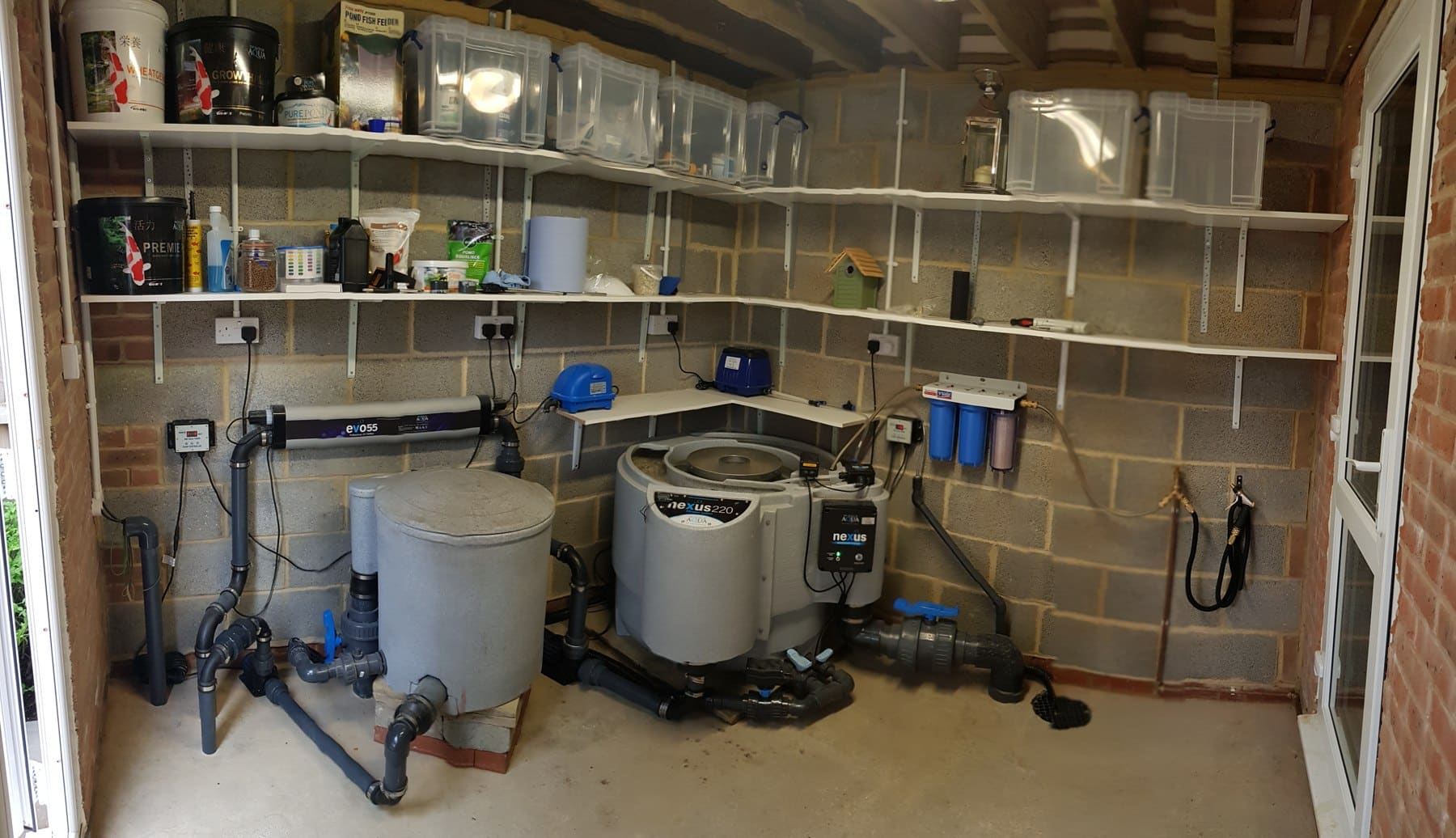
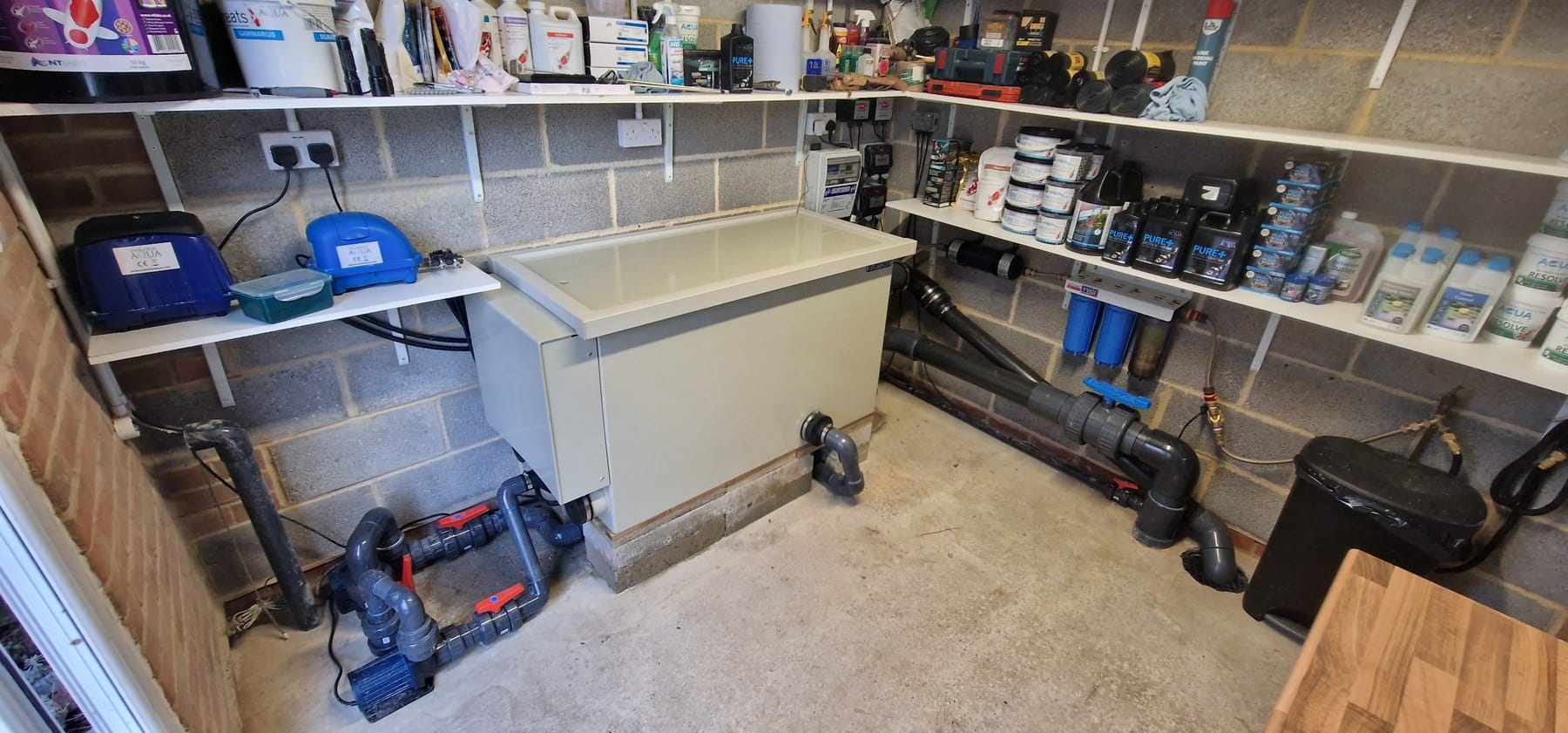
Before ordering, check the pipe diameter, approximate length, bends, valves and anything else the water passes through. A wide photograph and a short list of measurements are usually more helpful than lots of close ups. Look for narrow fittings behind the filter as well as the pipe you can easily see.
A new pump with a bigger outlet still has to push water through the pipework you connect to it. A short piece of larger hose will not help much if the rest of the run is narrow. Check the whole route, including reducers and adapters.
If you are building a new pond, think about servicing it too. Can you reach the pump? Can you undo a connection without taking the filter bay apart? Will the pipes be properly supported? It is much easier to leave enough room now than to change things once the pond is finished.
Hose length is only part of the picture
The same length of hose can give different results on two ponds. The diameter, bends, fittings, flow and connected equipment all matter. There is no single percentage you can deduct from every pump’s advertised flow to get the answer for your pond. A rough estimate can help us start a discussion, but we still need to check the details.
What size pipe should I use for a pond pump?
Start with the pipe size recommended for your pump, then consider how far the water has to travel and how much you need to move. A hose fitting that fits the pump does not necessarily mean that hose is a good choice for the whole run.
The Evolution Aqua Varipump manual, for example, recommends 1½ inch pressure pipe for the 10,000 model and 2 inch pressure pipe for the 20,000 and 30,000 models. Other pumps have their own recommendations, so check the instructions for the one you buy.
If you are unsure which fittings you have, send us a photograph of the markings on the pipe and the existing connection. Imperial pressure pipe sizes and metric sizes are not interchangeable just because the numbers look similar.
Choosing a pump for a waterfall or blade
For a waterfall, begin with the effect you want. A gentle trickle over rocks and a full sheet of water from a wide stainless steel blade need different flows. The width of the outlet, its shape and the height of the drop all influence the result.
Check how much flow the waterfall or blade needs for the effect you want. Then choose a pump that can still supply that amount after lifting the water and pushing it through the pipework. If the water goes through a filter or UV first, their flow limits need checking too.
A separate waterfall pump lets you turn the feature off without stopping the filter. It does mean another pump to buy, run and maintain. If you use one pump for both, make sure the filter still gets enough water when you adjust the waterfall.
Submerged or external installation?
Check whether the pump can sit in the pond, outside it or either. An external pump sits outside the water, but that does not automatically mean it can draw water up from below its inlet. Some pumps need water to reach them by gravity before they can run.
Oase allows submerged or dry installation for its AquaMax Eco Premium range. That does not apply to every pond pump. Follow your model’s instructions for its position, connections and protection.
If you are replacing an external pump, send us the full model label and a wider photo of the installation. We need to see both pipes and where the pump sits compared with the water level in the pond or filter.
Check the electrical connection before ordering
A pump being suitable for outdoor use does not mean every part of the kit can go underwater, or that it arrives ready to plug into a garden socket. Check the pump, controller and supplied cable separately.
The Evolution Aqua Varipump manual, for example, calls for a qualified electrician to connect it to a suitable outdoor supply with RCD protection. Its controller must not be submerged. Other pumps have their own connection requirements, so check those before buying and allow for any installation work.
What to look for when comparing pond pumps
| What the pump information says | What it means when you connect it |
|---|---|
| Maximum litres per hour | Check the pump chart to see how much water it will deliver after allowing for lift and resistance through your setup. |
| Maximum head | At this height there is virtually no flow left. Check the chart at the lower head your pond actually needs. |
| Maximum power consumption | Check how many watts it uses at the setting you plan to run. |
| Solids handling | Can it handle the debris in the water reaching it? Check the stated particle size and how the intake is protected. |
| Inlet and outlet size | Check that the fittings match and that the pipes are wide enough along the whole run. |
| Dry installation permitted | Check where it can sit and how water reaches its inlet. Being allowed outside the pond does not mean it can draw water up into itself. |
Why we recommend variable speed pond pumps
We really like variable pumps because they give you flexibility once everything is connected. You can turn the output up or down to suit the flow your filter needs, or get a waterfall looking how you want it. It makes setting up the pond much easier, especially when the actual flow differs from what you expected.
We would choose a good quality variable pump that can deliver enough water through the finished setup. The controller then lets you adjust it to suit the filter or waterfall. You still need to stay within the limits of the filter and UV.
The percentage on the controller is not a flow measurement. Running at 50 per cent does not tell you how many litres per hour are reaching the filter or pond. Check the pump information and measure the flow where you can.
Check what comes with the pump. Is the controller included? Do the fittings match your pipework? Do you need to buy anything else to use a particular control feature? Factor that into the price as well as the running cost.
How much will the pump cost to run?
Compare pumps that can both supply enough water for your pond. A small pump might use less electricity, but that is no saving if it cannot keep the filter or waterfall working properly. For an adjustable pump, use the power consumption at the setting you expect to run.
To work out the cost, divide the watts by 1,000, multiply by the hours it runs, then multiply by your electricity price per kWh. A pump using 100 watts for 24 hours uses 2.4 kWh a day. At 25p per kWh, that is 60p a day. Use the price on your own bill and the power used by your pump.
A few running costs to compare
The table uses 25p per kWh to show how the costs add up when a pump runs all day and night. Your own electricity price may be different. These figures are for the pump alone; they do not include your standing charge, UV, air pump or other pond equipment.
| Power used | Per day | 30 days | 365 days |
|---|---|---|---|
| 50 W | £0.30 | £9.00 | £109.50 |
| 100 W | £0.60 | £18.00 | £219.00 |
| 150 W | £0.90 | £27.00 | £328.50 |
| 200 W | £1.20 | £36.00 | £438.00 |
At that electricity price, a difference of 50 watts adds up to £109.50 over a year. That is worth comparing with the purchase price, as long as both pumps can do the job. Do not turn a pump down so far that the filter stops getting the flow it needs.
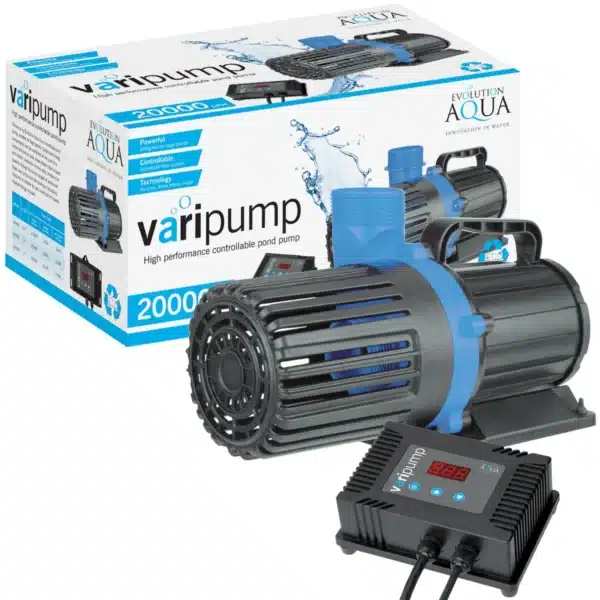
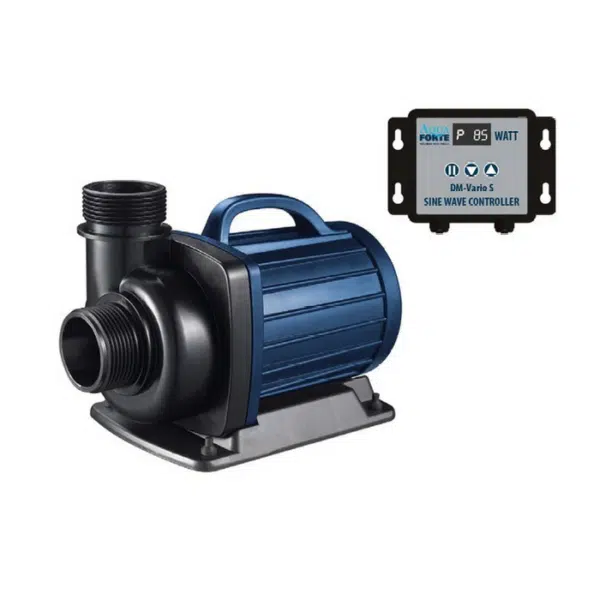
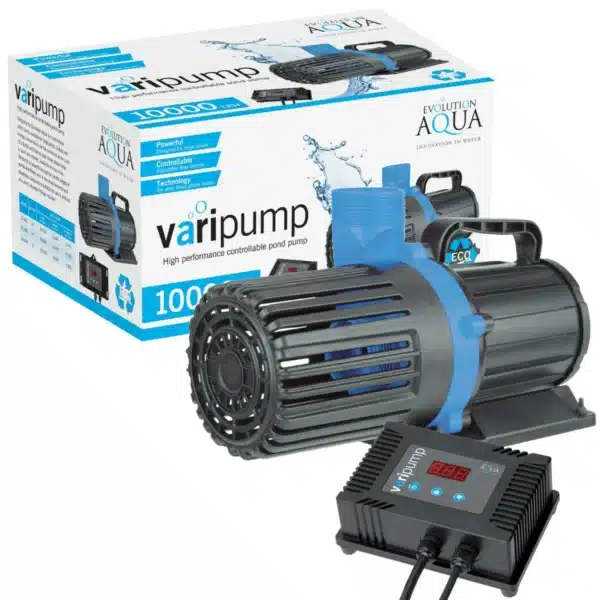
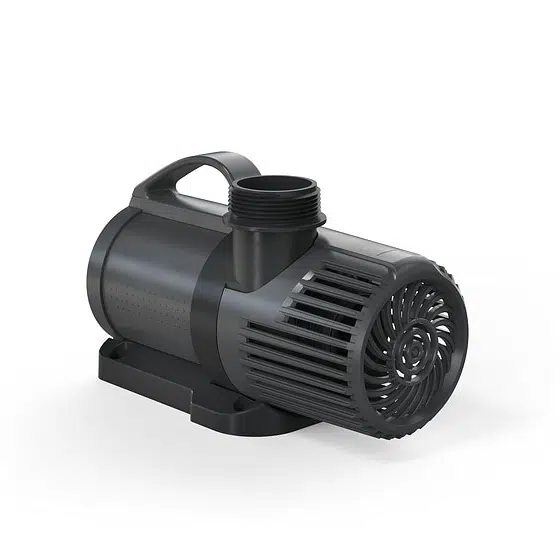
These are two pumps from our variable range. The right one for you depends on how much water reaches the filter or waterfall through your own pipework. The biggest number in the model name is not enough to choose by.
Our advice on choosing a good quality pond pump
We recommend buying a good quality pump from a manufacturer that supports its products. You generally get what you pay for. We would look for a pump with spare parts, sensible running costs and decent warranty cover, rather than choosing purely on the price and the flow figure on the box.
A cheap pump can work out expensive if it needs replacing sooner or cannot be repaired economically. That does not mean every cheaper pump is a poor buy, but it is worth looking beyond the initial saving. This is equipment you may be running around the clock.
Compare the warranties too. Eligible Oase pumps, for example, offer up to five years of manufacturer cover, including an extension that needs registration. Check your model in Oase’s warranty guidance. If another pump comes with only a year’s cover, we would take that difference into account. A warranty does not tell you exactly how long a pump will last, but the cover and support behind it matter.
You do not need to buy the most expensive pump. Our advice is to buy the right pump for your pond, with a running cost you are happy with and support if something goes wrong.
How can I measure the actual flow from my pond pump?
A suitable flow meter is one way to check how much water is moving through your setup. If you have an open outlet that is safe and easy to reach, you may be able to time how long it takes to fill a container instead. Keep the outlet at the same height and avoid restricting the flow while you do it.
Divide the litres you collect by the seconds it takes, then multiply by 3,600. For example, 20 litres collected in 12 seconds is about 6,000 litres per hour. Repeat it a few times to check the result. A tiny container that fills almost instantly is harder to time accurately.
That tells you the flow at the outlet you have measured. Disconnecting the hose from the filter and testing the pump on its own removes resistance, so it will not tell you what happens when everything is connected again. If the pump feeds two outlets, measuring one will not tell you the total.
Has the flow dropped, or has it always been weak?
Was the flow always weak, or has it dropped recently? That is the first thing we would ask. If it worked well before, something has changed; if it has never worked properly, the original sizing or installation may need attention.
Before spending money on another pump, check for a dirty intake, a kinked hose, a valve that has moved or a filter that needs cleaning. Follow the equipment instructions when inspecting and servicing it. A bigger pump is not the answer to a blockage.
Tell us if the pump has become noisy, keeps stopping or is doing something different from before. That helps us decide what to check. Disconnect all pond electrical equipment from the mains before putting your hands in the water or servicing the pump. Leave electrical repairs to a qualified electrician.
What we would check before spending money
If an existing pump used to give a good flow, start with the intake, impeller maintenance, hose route and filter condition. If it has always struggled, check the original sizing and pipework. Those two situations can look much the same at the waterfall, but they call for different solutions.
Should a pond pump run all night?
If the pump runs your biological filter, keep it running day and night. Oase’s filtration advice also calls for continuous operation. A separate decorative fountain can be different, as long as turning it off does not remove circulation or aeration your fish rely on.
If the electricity bill is a concern, look at pump efficiency, unnecessary restrictions and how much flow the filter needs. We would not start by putting essential filtration on a night timer.
Can I leave my pond pump running in winter?
Check the winter instructions for your pump, filter and the rest of the setup. A frost resistant pump does not protect an exposed hose, UV housing, filter or waterfall from freezing. The temperature a pump can tolerate in storage may also be different from the temperature it can run at.
The Varipump instructions, for example, give a running temperature range of 0–35°C and say not to run it outside that range. Other pumps have different limits. Send us the model and a photo of where it is installed if you need help planning for winter.
If you are shutting down a seasonal water feature, drain and store it as the instructions require. A pond with fish needs a plan that keeps its filtration and oxygen supply working through winter. Do not simply unplug everything when the first frost arrives.
Other questions about choosing a pond pump
Can a pond pump be too powerful?
Yes. Too much flow can be a problem if the filter or return cannot handle it. An adjustable pump gives you some flexibility, but check that its adjustment range suits the amount of water your filter needs.
Will a larger pump clear green water?
Not necessarily. Check the filter, UV, maintenance and actual flow first. A larger pump moves more water, but it will not automatically solve green water. It can also push water through the UV or filter faster than their instructions allow.
Is a dry installed pump the same as a self priming pump?
No. A dry installed pump sits outside the pond. A self priming pump can draw water into its inlet in the way its instructions describe. Do not assume an external pond pump can do that, position it above water level without checking, or let it run without water.
Do I need the same brand of pump and filter?
You do not necessarily need matching brands. What matters is whether the pump supplies the right flow, the filter can handle it and the installation and connections are suitable. If you are buying a package with a matched system guarantee, check its conditions too.
What to send us for a pump recommendation
- Your pond’s estimated volume and how you calculated it.
- What fish you keep and what you want this pump to supply.
- Exact filter, UV and current pump model names.
- The height from the pond water surface to an open return or waterfall.
- Pipe diameter, approximate length and the main fittings.
- A wide photograph of the equipment and a sketch of the route.
- Whether you are replacing a failed pump, correcting poor flow or planning a new pond.
If you do not know every measurement, send what you have and say which details are estimates. A rough sketch and a few clear photographs are enough to start the conversation. We can help work out which measurements are still needed.
Need a hand choosing your pump?
Browse our pond pump range, or read about our filter and pump upgrade service if the existing arrangement needs attention. If you are unsure which pump suits your pond, send us the details above and we will help you narrow down the options.
