







Pressurised Pond Filters: Choosing and Looking After One
Plan how the water will return to the pond
A pressurised pond filter lets you keep the water in a closed pipe after it has passed through the filter. That can be useful when the return has to go uphill to a waterfall, or when you want the filter tucked out of sight beside the pond.
It still has to be the right filter for the fish, feeding and water flow. A small foam filter and a large pressure vessel filled with plastic media do not do the same amount of work just because both are described as pressurised.
Here we explain the differences, what to check before choosing a pump and how to avoid the common installation and cleaning problems. For a broader comparison of systems, see our pond-filtration guide.
How does a pressure filter work?
A pump pushes pond water into a sealed filter body. Water passes through the filtration material, then leaves through a closed return pipe. Depending on the model, the media traps particles, provides surfaces for biological filtration, or does both. Some units also contain a UV clarifier.
Trapped dirt stays in the filter until it is cleaned out. The filter has not made that waste disappear. Cleaning frequency depends on the amount reaching it, so a pond with heavy feeding or a lot of fallen leaves will ask more of the same filter.
The biological side needs time to mature and a suitable supply of oxygenated water. Clear water is useful, but check ammonia and nitrite to know whether the system is handling the fish’s waste.
Pump-fed, gravity-return and gravity-fed: what is the difference?
Pump-fed tells you that the pump sends water into the filter. It does not tell you whether the filter is sealed. An open box filter can also be pump-fed, with water flowing back to the pond under gravity.
Gravity-return describes that free-flowing route back. An open filter normally needs to sit high enough for the return to work. You cannot assume it can push water up a higher waterfall.
Gravity-fed usually describes a different arrangement, where water from the pond enters a filter at the appropriate water level before being pumped back. Our drum guide explains this in more detail.
When someone asks whether a filter can sit below the waterfall, we need the whole route: where the pump is, where the filter will sit, the height of the return and the pipework between them.
The main types you will come across
| Type | What to understand before choosing |
|---|---|
| Foam pressure filter, such as Oase FiltoClear | Usually combines foam filtration and an integral UV. Check the specific koi rating, cleaning access and permitted pressure. |
| Bead filter | A pressure vessel using a particular bead media and valve arrangement. Check its own cleaning procedure and pump requirements. |
| Evolution Aqua K+Advanced | A pressure filter using K+Media, supplied with a blower and multiport valve. It should not be described as using K1 Micro. |
| Evolution Aqua Tempest | A compact K+Media polisher generally added to an existing filtration system; check the flow through that branch. |
| Evolution Aqua Surge | A compact filter with K+Media and integrated UVC. Its air-cleaning process is different from continuous aeration in a moving-bed chamber. |
Oase FiltoClear: check the koi figure
The number in a filter’s name is easy to mistake for a koi-pond recommendation. The current UK FiltoClear 31000 specification table gives different figures: up to 31,000 litres, 15,000 litres with fish stock and 7,500 litres with koi. That is a substantial difference.
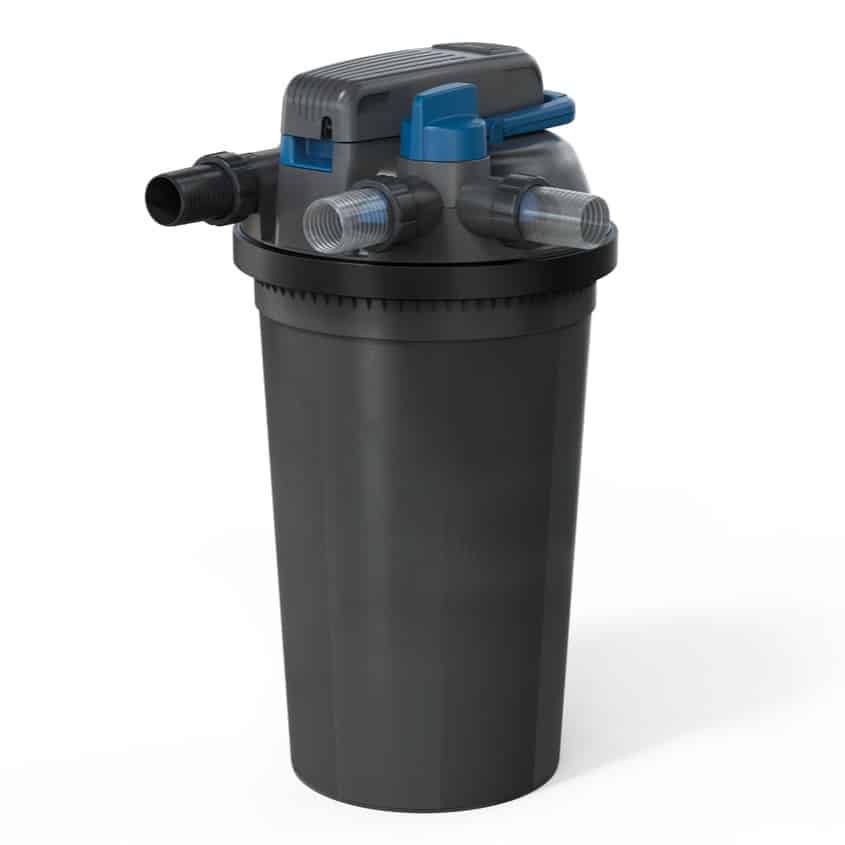
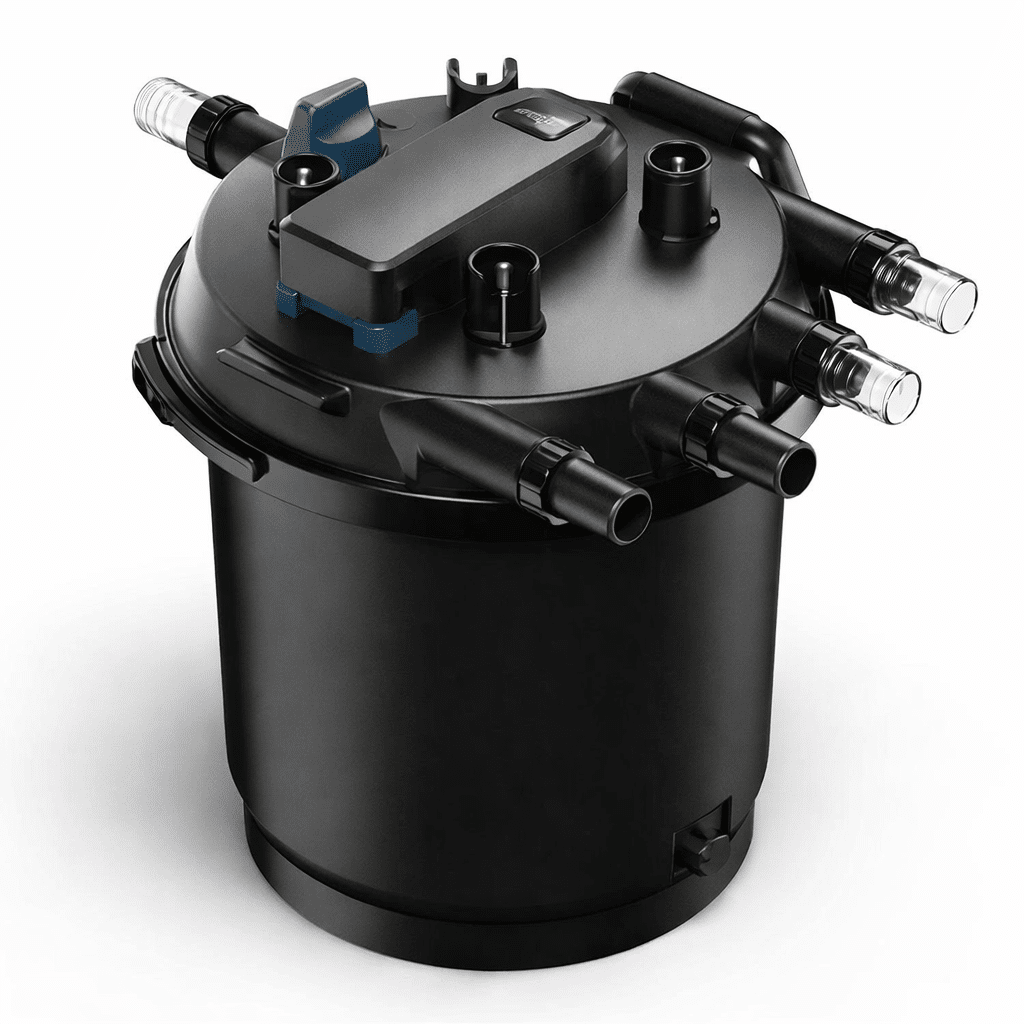
The larger FiltoClear 60000 is also available, with a different body and connections. Its UK table lists 60,000 litres maximum, 30,000 litres with fish and 15,000 litres with koi. Check the current model and set contents rather than assuming an older small-unit specification applies across the range.
Manufacturer ratings help narrow the choice. They do not guarantee that a filter will suit every pond of that volume, whatever the number and size of koi or the amount being fed. Keep room for the fish’s growth and for realistic maintenance.
| Model | Largest published pond figure | With fish stock | With koi |
|---|---|---|---|
| FiltoClear 31000 | 31,000 litres | 15,000 litres | 7,500 litres |
| FiltoClear 60000 | 60,000 litres | 30,000 litres | 15,000 litres |
| FiltoClear 90000 manufacturer specification | 90,000 litres | 45,000 litres | 22,500 litres |
These are the separate ratings in Oase’s current UK tables, not interchangeable descriptions of the same pond. A nominal 10,000-litre koi pond, for example, is already above the 31000 model’s published koi figure. Even where a pond is within a stated rating, feeding, fish growth and the water route still need checking.
The FiltoClear 31000 complete filter, pump and UV kit is a different purchase from a filter on its own or a manufacturer Set OC package. Check the named pump and what is included. Hose, fittings and their required lengths depend on the garden, so a kit name does not settle every installation detail.
K+Advanced and traditional bead filters
Evolution Aqua’s K+Advanced range uses its own K+Media, rather than conventional solid beads or K1 Micro. Water passes through the media bed, which catches particles and supports biological filtration. The supplied blower is used as part of the cleaning routine.
Evolution Aqua gives optimum flows of 6,000, 12,000, 18,000 and 30,000 litres per hour for the 20, 24, 30 and 36 models respectively. Those figures describe water passing through the filter. They are not a recommendation to buy a pump with the same maximum-flow number on its box.
Follow the specific filter manual for the valve sequence, blower use and pressure limits. Evolution Aqua says not to operate the multiport valve with the circulating pump running. Do not transfer that unit’s pressure limit or cleaning sequence to another brand.
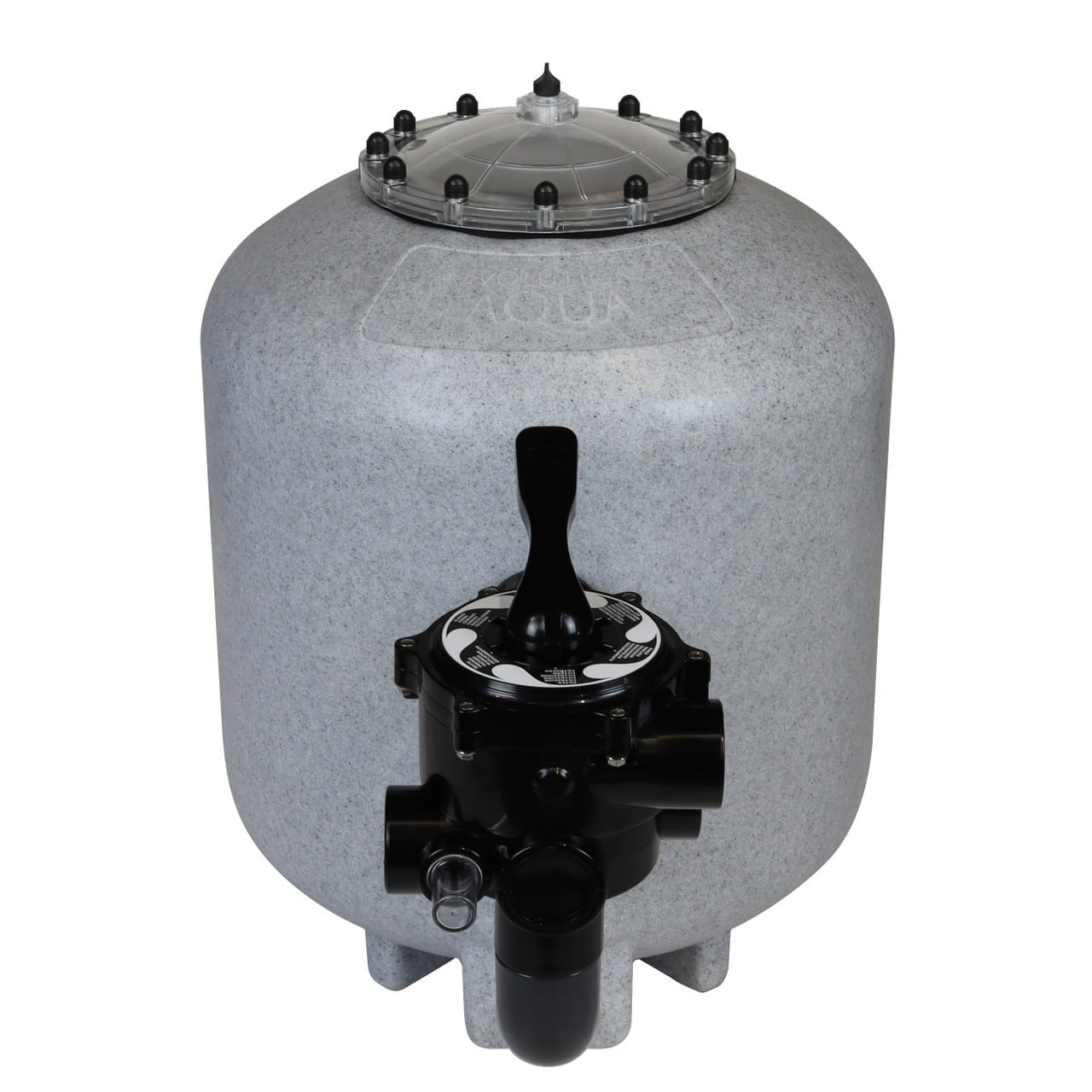
You can compare the K+Advanced 20-inch filter with the other sizes in our K+Advanced range. Bigger models bring different media quantities, flow requirements and connection sizes. Buying the next size up without checking whether the pump can clean it properly is not a complete upgrade plan.
A pre-filter can help by removing larger material before it reaches the pressure vessel. Whether that is appropriate, and which type to use, depends on the whole system. It is particularly useful to discuss how leaves, string algae and heavy solids will be collected rather than expecting the same bed of media to deal with everything indefinitely.
Where do Tempest and Surge fit?
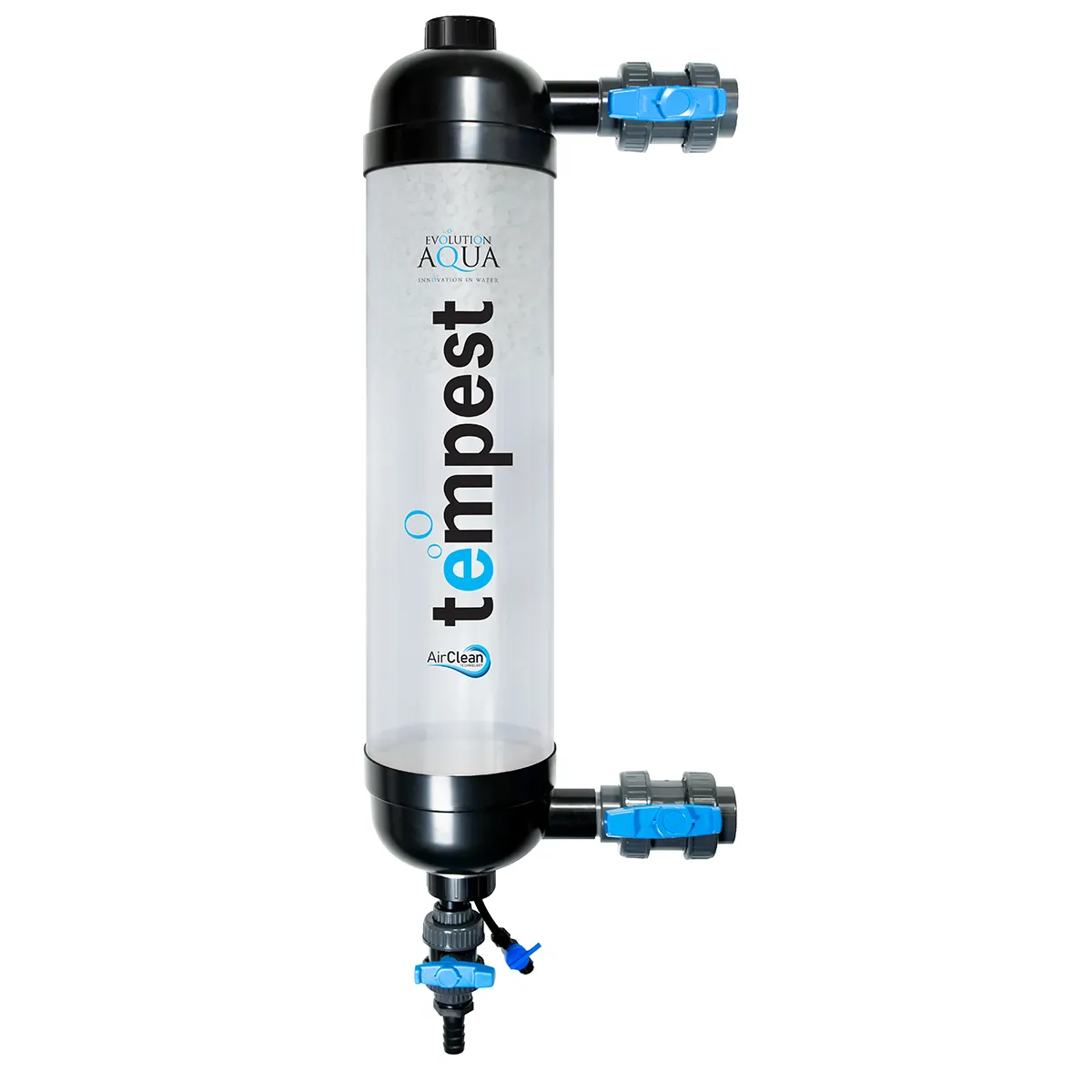
The Tempest is a K+Media polisher. Evolution Aqua specifies an optimum flow of 5,000 litres per hour and explains that bypass arrangements may be needed where the pond circuit moves more water. The full pump flow does not necessarily have to pass through the polishing branch.
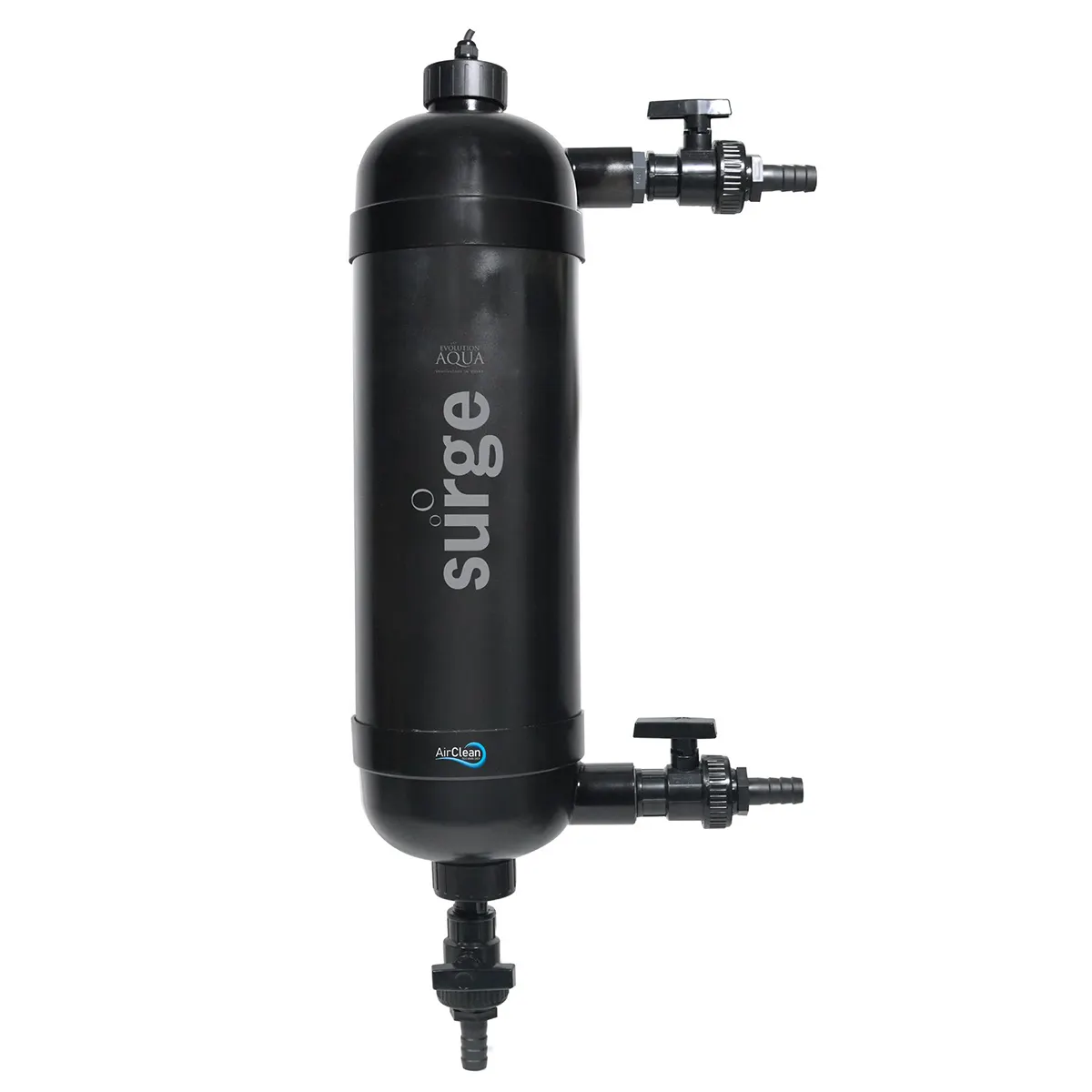
The Surge combines K+Media with an integral UVC and is marketed for ponds up to 5,000 litres. Its published optimum flow is 2,500 litres per hour. Treat that as a model-specific starting point and assess the actual fish load.
Both draw in air during the appropriate cleaning process to agitate the media and release trapped waste. That is not the same as continuously bubbling air through the biological chamber of a Nexus or another moving-bed filter.
We sell both the Tempest and the Surge, but would not treat them as interchangeable. The Tempest is generally considered when improving polishing on an existing circuit. The Surge includes its own UVC and has a different published flow range. Start with the job the filter is meant to do, then check the installation and fish load.
A transparent polishing vessel can make trapped dirt easy to see. That is helpful for maintenance, but it does not tell you whether ammonia is under control. Use the NT Labs PondLab 200 kit or the appropriate separate tests to check the biological side as well.
Choose the pump for the complete route
The pump has to move water through the pipework and filter, then to the return point. Narrow hose, bends, a UV, a raised waterfall and the filter itself all affect what gets back to the pond.
Start with the flow the filtration system needs. Then check which pump can still provide it through the proposed installation. Our pump-sizing guide shows how to allow for the lift and pipework without relying on the pump’s maximum number.
Check permitted flow and pressure separately. A filter’s pressure limit is a safety boundary, not a target to aim for. More pump power is not an automatic improvement. Get advice before adding a larger pump to a closed system.
Pipe and hose size can make a noticeable difference
A long narrow hose can restrict the water far more than expected. Before replacing a struggling pump, check for crushed hose, partly closed valves, blocked fittings and an unnecessarily small connection. A stepped hose tail can have a smaller unused section at its end; follow the fitting instructions so that the connection does not become an avoidable restriction.
Measure flexible hose by the correct internal size and match threaded and pressure-pipe fittings properly. A nominal pipe measurement and a hose’s internal diameter are not automatically the same fitting. Check the manufacturer’s connection drawing before ordering a collection of adaptors.
Leave service connections where parts will need to come out. Secure the pipework so its weight is not hanging from a plastic filter connection, and avoid an arrangement that needs cutting apart for a routine lamp change. A neat installation should be straightforward to service as well as tidy on the first day.
Think about everyday running as well as purchase price
The circulation pump usually runs for far longer than a cleaning blower. That makes it worth choosing a suitable pump and avoiding unnecessary restriction. A variable-speed pump may provide adjustment, but it still has to be compatible with the filter and capable of delivering the water the system needs.
You can estimate electrical use from actual watts and hours. A steady 100-watt load running for 24 hours uses 2.4 kWh. Multiply that by your own tariff to estimate the cost. This is an illustration, not a claim about a particular pump’s consumption at your setting. Include the UVC and any separate air equipment when comparing the whole system.
Leave room to live with the filter
A filter that can be partly buried still needs accessible controls, service space and a sensible waste route. Think about how you will open it, lift out parts, change the appropriate UV lamp and reconnect everything. Do not bury a model beyond the manufacturer’s permitted level.
Plan the waste line before fitting the filter. Cleaning sends pond water out, so know where it can go safely and how replacement water will be treated. Avoid a layout where someone can easily leave a waste valve open and drain the pond.
For pumps installed outside the pond, establish whether the chosen model and position require priming or a flooded suction. Check its own instructions. A closed pressure filter does not make every external pump self-priming.
Give the biological filtration time to establish
A new filter can catch dirt before its biological media is ready for the existing fish load. Do not use a clear pond as proof that the new system has matured. Test ammonia and nitrite, feed cautiously and watch the fish while the system establishes.
The same point matters after a major change. Replacing every foam and washing everything thoroughly at once can remove a large part of the established biological surface. Follow the model’s maintenance instructions and plan media replacement so that the pond does not suddenly lose the filtration it has been relying on.
Our pH guide explains why alkalinity and stable water conditions matter too. A filter cannot make up for unsuitable source water or a pond that is being fed beyond what the system can process.
Cleaning and servicing
Keep the model’s instructions beside the equipment until the routine is familiar. Some filters squeeze foams using an external handle; others have a blower, rinse and backwash positions. The right order matters.
Never open a pressurised filter body while it is under pressure. Safely isolate the relevant equipment and release pressure as the manufacturer directs before opening it. UV and electrical servicing also need the correct isolation procedure.
Watch the return flow and any fitted indicators, and note how quickly the filter needs attention. A sudden increase in cleaning frequency may be telling you that more dirt is arriving, a pre-filter is blocked or something in the system has changed. Do not just keep increasing the pump speed to compensate.
How often should a pressure filter be cleaned?
There is no useful once-a-month answer for every pond. Watch the flow, the amount of waste discharged and the model’s cleaning indicator if fitted. Note what is normal for your pond in summer, then look into any sudden change.
A new installation may collect an existing backlog of dirt. Autumn leaves and loosened blanketweed can also increase the load. If cleaning becomes a daily struggle, check why the material is arriving and whether the filter is appropriate; do not assume the owner simply needs to work harder.
Backwashing is a water change as well as a cleaning job. Keep an eye on the level, make sure the waste route stays secure and arrange suitable replacement water. After cleaning, confirm the controls are back in their correct filtration positions and that water is returning to the pond before walking away.
Foams, UV lamps and seals: match the exact model
Write down the filter name, model number and approximate age before ordering spares. FiltoClear models with similar-looking numbers can use different foam sets and UV components. Our genuine FiltoClear foam sets are selected by model, rather than by choosing whichever sponge looks close in a photograph.
A lamp that still lights up is not proof that it retains its intended UV performance. Use the specified replacement interval and lamp, and inspect the quartz sleeve as the instructions require. Never look directly at an exposed operating UVC lamp. Proper covers, interlocks and electrical isolation are part of the equipment’s protection.
Check seals and seating surfaces when the manual calls for opening the unit. Do not try to cure a leak by forcing a clamp or adding an improvised sealant. A distorted seal, damaged fitting or cracked component needs the correct repair. Keep the exact parts diagram with the maintenance record.
If the water is green, the flow is weak or the filter leaks
Green water: confirm that it is suspended algae rather than brown sediment. Check the UVC, lamp age, sleeve condition, flow and the model’s pond suitability. A pressure filter containing a UVC does not remove the need to assess sunlight, feeding and the rest of the pond.
Weak return: begin with the pump intake and accessible restrictions, then follow the filter’s cleaning procedure. Do not open the pressure body to investigate while it is running. If the return remains poor after normal cleaning, compare the actual water route with the pump’s performance information.
Water escaping around the lid or connections: safely isolate and release pressure as directed before inspection. Do not keep running it simply because most of the water is still returning to the pond. A leak can worsen, and a pump-fed circuit can remove pond water surprisingly quickly.
Ammonia or nitrite despite clear water: treat this as a water-quality issue. Check the result, fish load, feeding, oxygen supply and filter history. Polishing the water more finely does not solve an immature or overloaded biological stage. Our common-problems guide explains the checks in more detail.
What happens in winter or during a power cut?
Follow the manufacturer’s temperature and frost instructions. A partly buried vessel is not automatically frost-proof, and exposed hoses, valves and UVC components may have different requirements. Think about how the system can be isolated, drained or protected where the manual requires it.
After a long interruption, do not assume a filter full of stagnant water is ready to send straight back to the fish. The right restart depends on how long it stopped and what is inside. Keep the fish’s oxygen needs in mind and get advice if the condition of the filter is uncertain. A sensible maintenance record makes that decision much easier.
Are pressurised filters any good?
They can be a useful choice where you want a closed return pipe, limited visible equipment and a filter that can be serviced from above. The important part is choosing one for the actual fish and feeding. A compact unit on a modest garden pond is a different proposition from the same unit on a heavily fed koi pond.
We would compare the maintenance you are prepared to do, not just the space available. If the filter will be hidden behind dense planting, can you still get to the cleaning handle and waste line easily? If the pond will hold more koi in a few years, what room is there to expand? Those questions usually reveal more than a claim that one filter type is always best.
Label the normal valve positions clearly and keep a dated note of lamp changes, foam replacements and unusual cleaning frequency. This makes it easier for someone else to look after the pond while you are away.
When would we look at another kind of filter?
If a compact pressure filter needs constant cleaning or has too little capacity for growing koi, compare the whole system before buying a larger version of the same thing. Space, waste handling and access may point towards an Oase ScreenMatic, a Nexus or a drum with an appropriate biological stage.
Send us the pond volume, fish and feeding details, photographs of the current equipment, the available space and where the return must go. Those details are much more useful than choosing from a pond-size label alone.
