






Miniature Bulrush (Typha minima)
| Size | 1 Ltr, 1 Ltr – Pack of 3, 3 Ltr, 9cm – Pack of 3 |
|---|---|
| Plant Type | Marginal |
| Sun / Shade | Full Sun |
| Flower Colour | Brown |
| Growth Rate | Slow |
| Native to UK | No |
| Plant group |
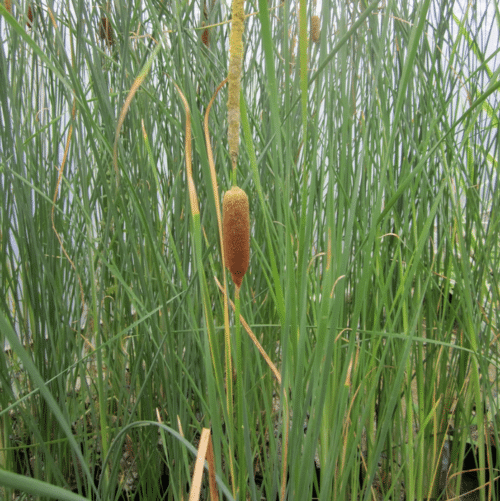
Miniature Bulrush has fine green leaves and small brown summer heads for a sunny shallow pond margin. It suits smaller-scale planting when given the right water cover and regular checks for crowding.
Price range: £14.00 through £34.50 (inc VAT)
Miniature Bulrush (Typha minima)
Fine reedmace leaves and small brown summer heads
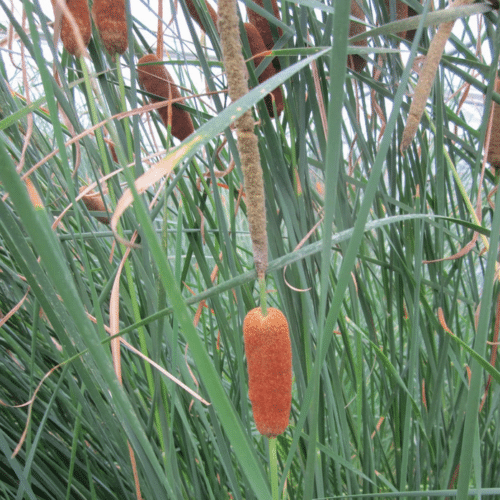
Miniature Bulrush gives a pond the familiar look of reedmace on a much smaller scale than the large species seen beside lakes. Its narrow green leaves and small brown heads have a simple outline that sits comfortably with flowering marginals, without competing with every flower for attention.
The cylindrical heads form on upright stems in summer, while the slender foliage makes a light vertical accent. It is a good option when you want a change of shape beside rounded lily pads or broader iris leaves. A small plant can still develop into a visible clump, so leave room around its basket.
Typha minima belongs at the wet edge. The RHS recommends fertile boggy soil or shallow pond margins with up to 10cm of water cover, in sun. A grower’s 16–20cm shelf instruction includes the height of that grower’s basket; it is not a recommendation to put 20cm of water above the plant.
The common name should not be taken to mean that the plant cannot spread. Although it is suitable for smaller ponds and containers, the RHS specifically advises managing it. Keep an eye on growth outside the basket and divide when the clump needs it, especially where other small plants share a narrow shelf.
Leave healthy stems through autumn if you want their structure, then clear dead material as fresh growth starts in spring. Keeping suitable sound stems around the pond can provide climbing places for emerging insects. Position the plant where you can reach it without trampling the edge.
This species is hardy in the UK and is not native to Britain. Its leaves are seasonal, so a winter plant will not have the same appearance as a summer clump with brown heads. Choose it for its fine texture and scale, while allowing for ordinary maintenance rather than assuming it will stay permanently neat.
UK-grown plant. Grown at a dedicated aquatic plant nursery in the South of England.

What you receive
The options are a 1-litre plant, a 3-litre plant, a pack of three 1-litre plants or a pack of three 9cm pots. Select the format and number of containers you need, allowing for the developing clump and access to lift or divide it later.
Miniature Bulrush loses its leaves seasonally. A resting plant may have little above the soil, while a growing-season plant may carry green blades or old flower stems. The small brown heads are a summer feature, and a new delivery is not necessarily at the flowering stage.
Is this right for your pond?
This is a smaller reedmace-style plant for a sunny, shallow margin. Its restrained scale is useful, but the word miniature should not be taken to mean that it can be planted and then ignored indefinitely.
- A shallow sunny shelf: Choose full sun with fertile wet soil or appropriate shallow water. Avoid a shaded lower shelf where both the water cover and competing foliage make establishment harder.
- A smaller vertical feature: Fine green leaves and short brown flower heads give a different outline from broad-leaved marginals. Plan for mature leaves that can be longer than the height of a newly supplied pot.
- A managed container: It can suit container planting and smaller ponds, provided you can lift the basket and check its growth. Leave open space around the clump instead of filling every gap with plants.
- The correct species: Typha minima is a non-native species. If your aim is a strictly native planting scheme, choose the plants by botanical identity rather than assuming every plant called a bulrush is native.
Planting position and getting established
Use fertile wet soil or a suitable aquatic basket on a stable shallow shelf. If repotting a 9cm nursery plant for pond use, choose an aquatic basket and suitable aquatic loam rather than leaving it in a solid nursery pot. Keep the planted root area secure so the narrow shoots are not left leaning as the basket moves.
Allow up to about 10cm of water over the planted compost surface, following the label supplied with the plant. That is water cover, not the total depth to the shelf: the basket itself takes up some of the distance. Check the actual basket height and water level before lowering the plant into position.
Do not place a small new plant at a greater depth merely to hide the basket. Keep the emerging growth above the water and check it as it establishes. Leave enough room to reach the container from a safe position; a plant chosen for a small pond still needs access for the spring tidy and eventual division.
Looking after your plants
- Keeping the root area wet: Check that the basket remains in its shallow marginal position when the pond level falls. A short plant in a small pond can be affected quickly if the water drops below the rootball.
- Summer inspection: Look at the clump boundary as well as the flower heads. If new shoots are extending into neighbouring planting, deal with the outward growth while it is still easy to separate.
- Spring tidying: Remove dead leaves and old flower stems before fresh spring growth begins. Cut carefully around the new shoots instead of pulling the old material through the centre of the clump.
- Division: Divide in spring when the clump needs reducing or the basket is congested. Replant healthy rooted sections into suitable wet conditions; a small newly bought plant does not need to be split merely because division is possible.
- Longer-term space: Keep the basket reachable and check its sides as the rhizomes develop. Containers make inspection easier, but they are not a permanent substitute for controlling an expanding clump.
Size and growing conditions
- Botanical name
- Typha minima
- Common names
- Miniature bulrush; dwarf reedmace
- Habit
- Rhizomatous marginal perennial
- Foliage
- Narrow green blades; seasonally deciduous
- Flower heads
- Short dark-brown cylindrical heads in mid- to late summer
- Height
- Often around 40–60cm in nursery culture; leaves and stems vary
- Spread
- Allow around 10–50cm, with outward growth to manage
- Light
- Full sun
- Soil
- Fertile wet or boggy soil
- Water cover
- Up to about 10cm over the planted compost surface; follow the supplied label
- Spring care
- Clear old stems before new growth; divide if needed
- Native status
- Not native to Britain or Ireland
- RHS information
- RHS plant profile: Typha minima
Delivery and basket information
We do not deliver live plants to Northern Ireland.
Orders received by 11am Monday to Wednesday are normally dispatched on the following working day using a next working day courier service. During busy periods, dispatch may occasionally take an extra day.
To avoid plants being held in depots over a weekend, we do not usually dispatch on Fridays. Highlands and Islands orders using a two day service are not normally dispatched on Thursdays.
Please read our delivery information for delivery arrangements and contact us if you need to check the timing of a particular order.
The 9cm option arrives in nursery pots. For pond planting, pot these plants into suitable aquatic baskets with aquatic planting soil before positioning them at the depth shown on their labels.
Finofil baskets are made from 100% recycled polypropylene co-polymer. They are not suitable for ordinary kerbside recycling; reuse them where possible and check local specialist recycling options. Their fine mesh helps retain aquatic soil while allowing water to reach the roots.
Basket measurements for the offered sizes:
- 1 Litre Basket – usually 11 × 11 × 11cm square; some varieties may be supplied in a 14cm diameter × 10cm round basket
- 3 Litre Hexagonal Basket – 18 × 18 × 16cm
Other plants to compare
Pickerel Weed — Pickerel Weed has much broader foliage and blue flower spikes, with a taller mature presence. Compare it where you want a substantial flowering clump rather than the fine leaves and brown heads of a miniature reedmace.
Pendulous Sedge — Pendulous Sedge forms a larger arching clump with evergreen foliage in moist pondside soil. It offers a different winter outline and needs more room than this small shallow-water bulrush.







Reviews
There are no reviews yet.