





Gardener’s Garters (Phalaris arundinacea ‘Picta’)
| Size | 1 Ltr, 1 Ltr Pack of 3, 9cm Pack of 3, 3 Ltr |
|---|---|
| Plant Type | Marginal |
| Sun / Shade | Full Sun to Part Shade |
| Growth Rate | Fast |
| Native to UK | No |
Gardener’s Garters is chosen for white-and-green striped leaves rather than brightly coloured flowers. The leaves catch the light and give a broad planting a lighter texture. They may pick up pink colouring in cooler periods, adding another seasonal detail without changing the identity of the cultivar.
Price range: £14.00 through £34.50 (inc VAT)
Gardener’s Garters (Phalaris arundinacea ‘Picta’)
Striped grass leaves with a very vigorous running habit
Gardener's Garters is chosen for white-and-green striped leaves rather than brightly coloured flowers. The leaves catch the light and give a broad planting a lighter texture. They may pick up pink colouring in cooler periods, adding another seasonal detail without changing the identity of the cultivar.
The flower panicles are relatively understated. It is the repeated striped blades and the arching growth that provide most of the ornamental interest. Give the foliage a clear setting rather than mixing it tightly with other strongly patterned plants that compete for the same visual space.
Running rootstock can build a very extensive colony, with an eventual width beyond eight metres. Plan how the roots will be restricted and reached before planting. The young pot is a starting size rather than a guide to the final area the grass may occupy.
Sun or partial shade is suitable, with a range of soils tolerated. For a pondside planting, use the actual label to decide the root position rather than assuming a universal submerged marginal depth. Keep enough access to inspect and remove runners, particularly where neighbouring beds would be difficult to clear once invaded.
This is the striped garden cultivar Picta, rather than an unselected wild reed canary grass. Its leaves and subtle summer panicles change through the season. Plan a generous, inspectable area for the running roots rather than judging the final planting from the width of the delivered container.
UK-grown plant. Grown at a dedicated aquatic plant nursery in the South of England.

What you receive
Choose one plant in a 1 litre container, three plants in 1 litre containers, three plants in 9 cm nursery pots or one plant in a 3 litre container.
Neither pot volume nor basket shape is a permanent boundary to the running rootstock. Keep roots appropriately moist while you prepare the site.
How it changes through the year
The striped leaves provide growing-season interest, sometimes with pink colouring in cooler conditions. Flower panicles appear in summer but are secondary to the foliage. Seasonal changes do not remove the need to manage the perennial running roots.
Choosing a place for it
- For striped foliage: White-and-green leaves provide most of the ornamental display, with possible pink tints in cool weather.
- For substantial space: Its eventual spread can exceed eight metres, so plan boundaries and maintenance.
- For managed access: Choose a position where running roots can be inspected and removed.
Planting and getting it established
Start by deciding how the running roots will be restricted and reached. Gardener's Garters can make a very extensive colony, so an ordinary border gap beside valued plants can become difficult to manage. Use a position with a clear boundary and access for lifting or removing rhizomes.
Sun or partial shade can suit it, and it tolerates a range of soils. For pondside use, follow the actual plant label for the root position rather than applying a general submerged-depth band. Set the rootball at its existing level in a medium appropriate to the soil or container.
If a label-approved container is placed in water, measure cover above the planted crown or medium separately from the shelf depth. Keep space around the container for inspection. A mesh basket can make lifting easier, but it does not guarantee that vigorous roots will never extend into surrounding ground or other planting.
Looking after it
- Running roots: Inspect the outside of the intended patch during growth. Remove unwanted rhizomes and new rooted shoots promptly; cutting leaves alone does not remove the spreading rootstock.
- Containment: Check a container at its sides and base when lifting it. Reduce or divide crowded growth rather than squeezing the entire root system back into an undersized space.
- Leaf display: Allow the striped leaves room to arch and be seen. Avoid packing it tightly beside other plants that would be hidden as the grass becomes broader.
- Tidying: Remove dead or deteriorating material as needed, retaining healthy leaves during the growing season. Cooler-weather pink tints can be normal rather than damage.
- Feeding and moisture: Care for the actual soil position and assess the plant before feeding. More fertiliser is not a way to solve root spread or a site that has become too crowded.
- Disposal: Keep unwanted rhizomes and fragments within managed garden disposal, away from natural waters and unmanaged neighbouring ground.
Plant details
- Botanical name
- Phalaris arundinacea 'Picta'
- Main feature
- White-and-green striped leaves, sometimes pink-tinted in cool weather
- Mature height
- About 1–1.5 m
- Potential spread
- Can exceed 8 m
- Light
- Sun or partial shade
- Habit
- Very vigorous perennial with running rootstock
- Native status
- Striped horticultural cultivar
- RHS information
- RHS plant profile: Phalaris arundinacea 'Picta'
Delivery and basket information
We do not deliver live plants to Northern Ireland.
Orders received by 11am Monday to Wednesday are normally dispatched on the following working day using a next working day courier service. During busy periods, dispatch may occasionally take an extra day.
To avoid plants being held in depots over a weekend, we do not usually dispatch on Fridays. Highlands and Islands orders using a two day service are not normally dispatched on Thursdays.
Please read our delivery information for delivery arrangements and contact us if you need to check the timing of a particular order.
The 9cm option arrives in nursery pots. For pond planting, pot these plants into suitable aquatic baskets with aquatic planting soil before positioning them at the depth shown on their labels.
Finofil baskets are made from 100% recycled polypropylene co-polymer. They are not suitable for ordinary kerbside recycling; reuse them where possible and check local specialist recycling options. Their fine mesh helps retain aquatic soil while allowing water to reach the roots.
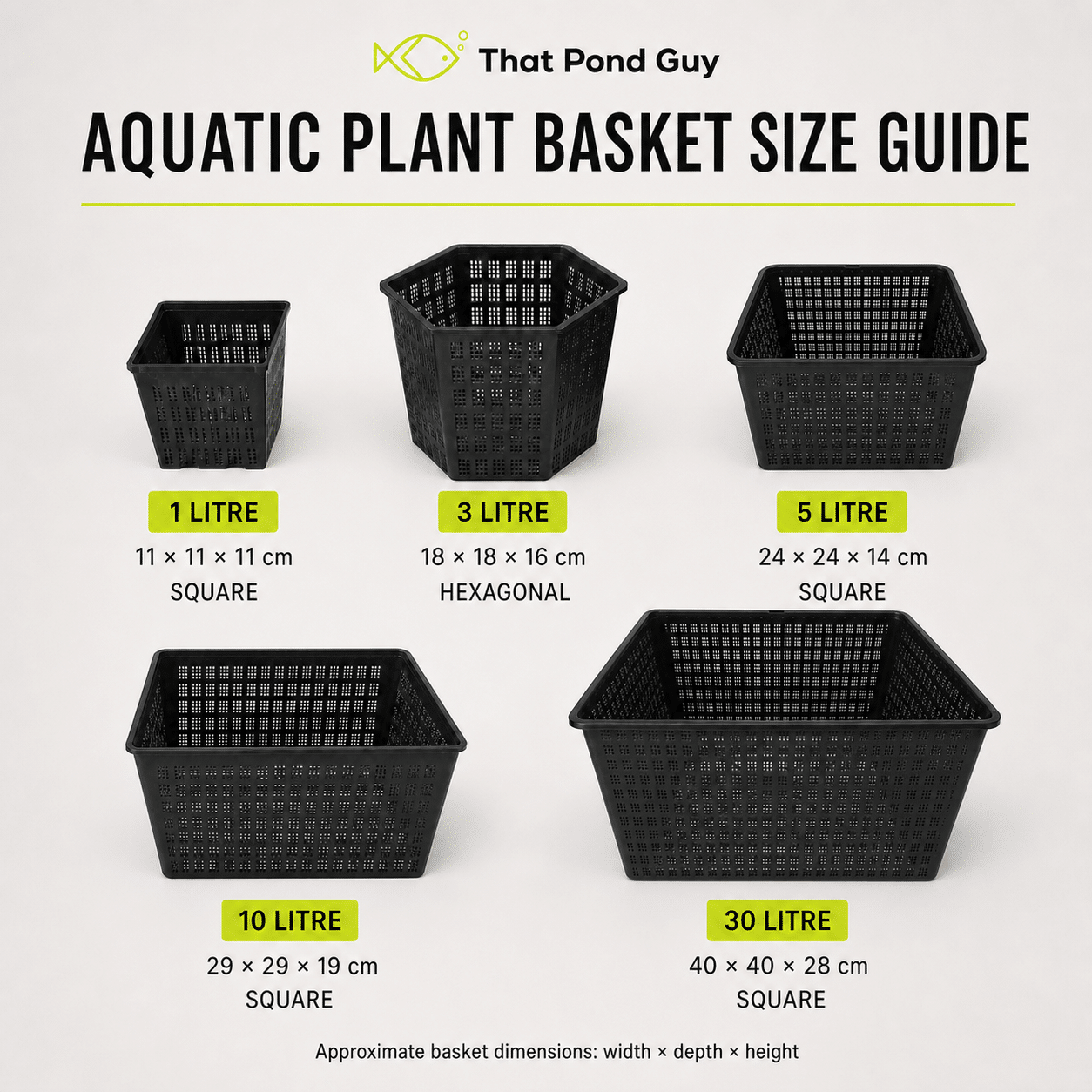
Basket measurements for the offered sizes:
- 1 Litre Basket – usually 11 × 11 × 11cm square; some varieties may be supplied in a 14cm diameter × 10cm round basket
- 3 Litre Hexagonal Basket – 18 × 18 × 16cm
Other plants to compare
Golden Japanese Sweet Flag — Compare a much lower yellow-leaved tuft for a wet position where an extensive grass colony would be unsuitable.
Cyperus Sedge — Its arching green leaves and hanging spikes provide another form, with a different mature size and moisture requirement.
Choosing plants and planting supplies
Marginal pond plants — Compare pond-edge plants by their eventual size, light and water-depth needs before filling a shelf.
Pond plant baskets and planting supplies — Choose a suitable container and growing medium for the position described above.








Reviews
There are no reviews yet.