





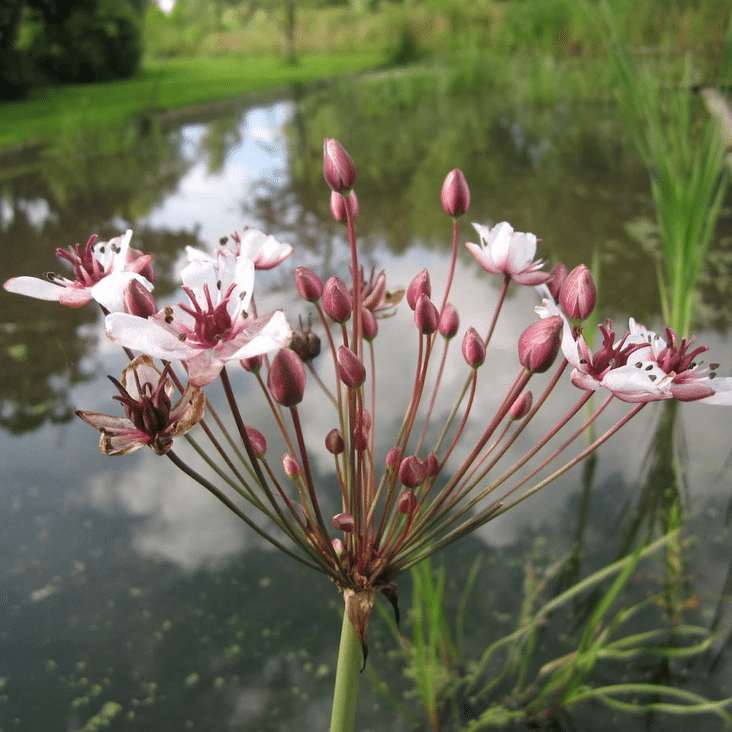
Flowering Rush (Butomus umbellatus)
| Size | 1 Ltr, 1 Ltr Pack of 3, 9cm Pack of 3, 3 Ltr |
|---|---|
| Plant Type | Marginal |
| Sun / Shade | Full Sun |
| Flower Colour | Pink |
| Growth Rate | Fast |
| Native to UK | Yes |
A native marginal perennial with upright leaves and pink summer flower umbels. Choose a sunny wet margin or shallow shelf and allow for mature stems around 1–1.5 m tall. Available in the selectable nursery-pot and aquatic-basket formats.
Price range: £14.00 through £34.50 (inc VAT)
Flowering Rush (Butomus umbellatus)
Pink summer flowers held above a clump of upright, twisting leaves
Flowering Rush brings height and an open, airy flower shape to a sunny pond margin. Its rosy-pink flowers are carried in an umbel: a group of small blooms on fine stalks that spread out from the top of a taller stem. The flower heads rise above the leaves, so they are especially effective where you can see them against the water rather than hidden behind other tall plants.
The leaves are narrow, upright and slightly twisted, with a triangular shape in cross-section. Young growth can show bronze-purple tones before becoming darker green. This gives the plant some interest before the flowers appear, while its clean, vertical outline contrasts well with round waterlily pads and lower planting around the pond edge.
Despite the common name, Butomus umbellatus is not a true rush in the genus Juncus. It is a rhizomatous aquatic perennial grown for its leaves and pink summer flowers. Choosing it for that particular combination is more useful than assuming that all plants called rushes will have the same appearance or growing requirements.
Allow for a substantial mature plant. The RHS gives an eventual height of 1–1.5 m, including the flowering stems, with a clump spread of about 10–50 cm. Its rhizomes still need checking as the planting develops. A compact delivery pot should not be mistaken for the finished size, particularly if you are planting close to a path or in front of a view across the pond.
Flowering Rush suits fertile wet mud at the pond edge or an appropriate shallow-water shelf. Give it full sun and keep the root area wet. This makes it a different choice from a plant for an ordinary border that dries between waterings, and from a waterlily intended to sit well below the surface.
Its pink flower display is seasonal, generally in summer and particularly late summer in the RHS description. The individual flowers are small, but their grouped arrangement creates the display. Weather, establishment and growing conditions affect timing, so the photograph should not be taken as a promise that your plant will arrive in bloom.
In a garden pond, an aquatic basket makes the clump easier to position, lift and divide when needed. Keep enough room around it to remove old stems and reach neighbouring plants. A little planning at the start helps you enjoy the tall foliage and flowers without making routine pond care awkward.
What you receive
Choose the format that suits your planting: a 1-litre plant, a pack of three 1-litre plants, a pack of three 9 cm plants or a 3-litre plant. These are the current selectable formats for this listing; the selector above shows availability. A pack of three contains three plants in the stated format, rather than one larger basket.
The 9 cm plants arrive in nursery pots and should be moved into suitable aquatic baskets with aquatic planting soil before pond placement. Plants supplied in aquatic baskets can be positioned in those baskets, taking account of their growth and the water cover on their labels. Supplied size describes the container, not a guaranteed plant height or number of flower stems.
Flowering Rush loses its above-ground growth during its seasonal rest. A plant supplied while dormant may have little visible foliage, and a growing plant may not be in flower. Keep its root area moist while preparing the pond position, and do not leave the planting pot to dry out in sun or wind.
Is Flowering Rush right for your pond?
- A sunny shallow position: Choose a wet margin or shallow pond shelf with full sun. If the only space available is a deep pond floor, this is not the appropriate position for the plant.
- Room above the water: Allow for flowering stems reaching around 1–1.5 m on a mature plant. Place the clump where the height contributes to the view without blocking access to a filter, path or other planting.
- Seasonal colour: Choose it for upright foliage and a pink summer flower display. It is deciduous, so use other planting if you want the same part of the pond to retain a leafy appearance throughout winter.
- Managed growth: Keep access to the basket and inspect the rhizomes as the clump develops. Its native status does not mean that it should be left to spread through every available space in a small garden pond.
Planting position and water depth
The RHS recommends fertile mud at a pond margin or water up to 25 cm deep. Our grower’s range is 3–25 cm of water above the planting basket. These are position guides for the rooted planting, not the total depth to the pond floor. Follow the label supplied with your plant and give young growth a suitably shallow start.
Measure from the top of the planted basket to the water surface. For example, a shelf 25 cm below water does not put 25 cm of water above an 11 cm-tall basket standing on it: the basket takes up part of that depth. Checking the actual water cover avoids accidentally submerging a small plant too deeply.
If potting on a nursery plant, choose an aquatic basket with enough room for the root system and use suitable aquatic planting soil. Set the plant at its existing planting level rather than burying the leaves. Firm the medium gently around the roots and add a light gravel dressing if needed to keep loose soil in place, leaving the growing point clear.
Lower the basket carefully onto a firm, level shelf so the upright leaves remain above the water. Position tall planting securely and leave space to lift the basket later. Where you plant directly into a suitable wet margin, keep the root area consistently wet and be prepared to manage the spreading rhizomes.
Looking after Flowering Rush
- Keep the root area wet: Check shallow shelves and container ponds during dry weather, when falling water levels can leave a basket exposed. The planting should not be allowed to dry out while the leaves continue to stand in sun and wind.
- Tidy after flowering: Cut back spent flower stems after the display and remove dead or soft foliage as it develops. Take the cut material out of the water rather than leaving it to decay around the basket. Work carefully around healthy new growth.
- Review a crowded clump: Inspect the basket when growth becomes congested or the rhizomes begin to escape into neighbouring planting. Divide rhizomes in spring when necessary, keeping healthy rooted pieces and giving each enough space to establish.
- Feed only where needed: Start with suitable planting soil and assess the plant’s growth before adding feed. If feeding is needed, use a product intended for aquatic plants and follow its dose and placement instructions. Do not scatter ordinary garden fertiliser into the pond.
- Check the cause of poor growth: Review sunlight, moisture and actual water cover before moving the plant or adding fertiliser. A new planting needs time to settle, and a very small plant can struggle if placed immediately at the deepest end of its eventual range.
Seasonal growth and winter care
Flowering Rush is a hardy deciduous perennial. The leafy summer clump dies back as the season ends, leaving the living rhizomes below. Remove collapsed material that would otherwise sit in the pond and decay; do not discard a sound dormant planting simply because it has lost its leaves.
Keep the root area wet through its rest period. In a shallow container, check that the planting has not become exposed as water levels change. Spring is the time to look for fresh growth and assess whether an established clump needs division, rather than repeatedly disturbing a plant during its dormant season.
Size and growing conditions
- Botanical name
- Butomus umbellatus
- Common name
- Flowering Rush
- Plant type
- Rhizomatous marginal aquatic perennial; not a Juncus rush
- Flowers
- Rosy-pink flowers carried in umbels above the foliage
- Flowering season
- Summer; the RHS describes its main display as late summer
- Mature height
- RHS eventual range: 1–1.5 m, including flowering growth
- Clump spread
- RHS eventual range: 10–50 cm; inspect spreading rhizomes as the planting develops
- Light
- Full sun
- Planting position
- Fertile wet mud at the pond margin or a suitable shallow-water shelf
- Water cover
- Grower guide: 3–25 cm above the basket; RHS: wet margins or water up to 25 cm. Follow the supplied label for the growth being established.
- Winter
- Hardy and deciduous; rhizomes remain after the foliage dies back
- Native status
- Native to Great Britain and Ireland; separate from where the supplied plant is grown
- RHS information
- RHS plant profile: Butomus umbellatus
Delivery and basket information
We do not deliver live plants to Northern Ireland.
Orders received by 11am Monday to Wednesday are normally dispatched on the following working day using a next working day courier service. During busy periods, dispatch may occasionally take an extra day.
To avoid plants being held in depots over a weekend, we do not usually dispatch on Fridays. Highlands and Islands orders using a two day service are not normally dispatched on Thursdays.
Please read our delivery information for delivery arrangements and contact us if you need to check the timing of a particular order.
The 9cm option arrives in nursery pots. For pond planting, pot these plants into suitable aquatic baskets with aquatic planting soil before positioning them at the depth shown on their labels.
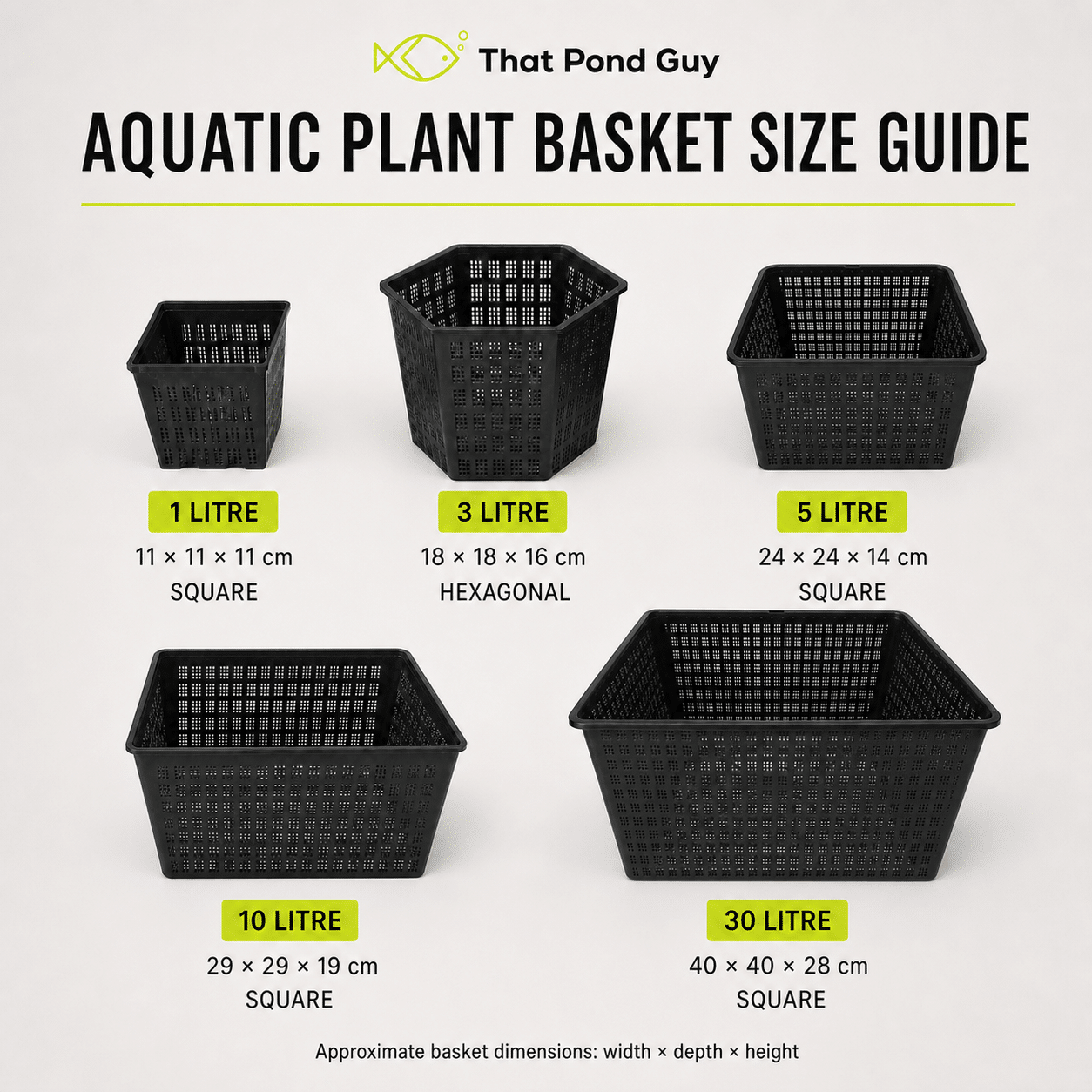
Finofil baskets are made from 100% recycled polypropylene co-polymer. They are not suitable for ordinary kerbside recycling; reuse them where possible and check local specialist recycling options. Their fine mesh helps retain aquatic soil while allowing water to reach the roots.
Basket measurements for the offered sizes:
- 1 Litre Basket – usually 11 × 11 × 11cm square; some varieties may be supplied in a 14cm diameter × 10cm round basket
- 3 Litre Hexagonal Basket – 18 × 18 × 16cm
Other plants for the pond margin
Yellow Flag Iris — Compare its yellow iris flowers and upright sword-like foliage if you want another strong vertical plant. Assess its own vigour and planting requirements before adding it beside Flowering Rush.
Water Forget-me-not — A lower-growing choice with small blue flowers for a different layer of marginal planting. It gives a softer edge rather than the tall pink umbels of Flowering Rush.
More pond plants and planting supplies
Marginal pond plants — Compare plants for different shelf depths, flower colours and mature heights before planning the pond edge.
Aquatic baskets and planting supplies — Choose appropriate baskets and aquatic growing medium when planting the smaller nursery-pot format or dividing an older clump.






Reviews
There are no reviews yet.