





Pond Plant Baskets & Planting Supplies
Aquatic Planting Supplies: Basket Sizes, Soil, Liners and Gravel
Measure the planting space, then compare the basket’s footprint, height and room for roots. Its litre size describes the container, not the water cover the plant needs.
Browse aquatic baskets, planting soil, gravel and hessian liners. Check whether the chosen plant already arrives in an aquatic basket before ordering extras. A rootless oxygenator or true free-floating plant needs a different approach from a rooted lily or marginal.
Price range: £0.90 through £1.86 (inc VAT)
£295.00 (inc VAT)
✔️ In stock - ready for dispatch




A practical guide to pond planting supplies
Basket shape, size and access
A basket helps manage many rooted aquatic plants and makes later lifting, division or repositioning easier. Allow room for root growth without crowding the shelf. Footprint and height matter alongside nominal capacity, particularly on narrow or curved pond edges.
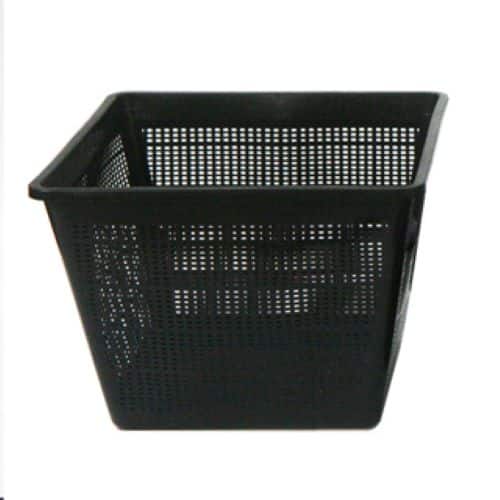
Compare the 1-litre square, 5-litre square, 10-litre square and 30-litre square baskets for different planting spaces. These are useful size comparisons, not fixed rules pairing every plant with one capacity. A vigorous water lily and a compact marginal have different needs.
A contour basket may fit a curved shelf better than a square one. Round baskets provide another footprint. Check exact dimensions on the selected listing, then allow space to lift the planted container again.
Floating baskets support suitable marginal planting where there is no shelf. They do not turn every pond plant into a free-floating plant; choose a suitable plant and allow for the support the basket provides.
Does the supplied plant need repotting?
A nursery pot and an aquatic mesh basket need different preparation. Check the supplied format, the root growth and the instructions for the exact plant. Some established plants can remain in the supplied basket initially; others need more space or a container suited to immersion.
Rootless hornwort and true free-floating plants do not use a basket of soil in the same way as rooted lilies. If you are choosing the plants as well, compare water lilies, marginals and oxygenating plants for their individual growing habits.
Aquatic soil, liners and gravel
Use a planting medium appropriate for aquatic use. Ordinary lightweight potting compost can float out or release unwanted material into the pond. Compare aquatic soil and pond planting compost, checking the chosen bag volume and whether the medium already contains feed.
A liner helps retain soil where the basket and medium require one. Fine-mesh designs have different lining requirements from coarser baskets; hessian is not automatically needed in every container. Compare hessian pot liners and cloth liners by their own measurements. A flat liner’s dimensions are not the diameter of a basket.
A suitable gravel dressing helps keep the planting medium in place. Follow the plant’s own instructions for the crown or growing point rather than heaping gravel over it. Lower the finished container gently so that the medium stays contained.
Work out the actual water cover
The depth to the pond floor is not necessarily the depth above the plant. Allow for the basket height and any support, then measure from the reference point given for the plant. Young lilies may need a shallower starting position and gradual lowering as their leaves reach the surface.
For the full method, read our guide to planting pond plants in baskets, with examples of basket choice, potting and measuring planting depth.
Support the container securely and avoid sharp or unstable objects against the liner. Allow for the weight of wet medium and roots when planning how to lift it. Basket lifting handles fit particular containers, so check compatibility rather than assuming they fit the whole range.
Feeding and later plant care
Use aquatic fertiliser tablets only at their directed rate and placement. Feeding cannot correct an unsuitable depth, too little light or a congested root system. Pond plant fertilisers and care includes different formulations, so keep their methods and application intervals separate.
Remove old growth when appropriate and plan for division or repotting once a plant outgrows its space. We would consider access as well as the appearance of a planted shelf: it still needs to be manageable when the plants fill out.
Our water lily planting and care guide explains water cover and the conditions lilies need. The RHS aquatic planting guide offers general planting advice; the selected plant and product instructions should guide the final setup.
Common questions about planting supplies
Can I choose a basket by litres alone?
Check its footprint, height and shape as well. A shallow contour basket and a round basket of a similar capacity can fit very different spaces. Leave room for the established plant and access for later care.
Are the plants and soil included?
An empty-basket listing supplies the basket unless additional contents are explicitly named. Check plants, medium, gravel, liners and the selected basket quantity separately before ordering.
Does every basket need a liner?
No. A very fine mesh can retain suitable medium without hessian, while a coarser basket may need lining. Follow the particular basket’s instructions rather than applying one rule to every design.
Do all pond plants need a basket?
No. Growing habit, supplied format and pond construction matter. Baskets are useful for many rooted aquatics, but true free-floating plants and some oxygenators need different handling.
