






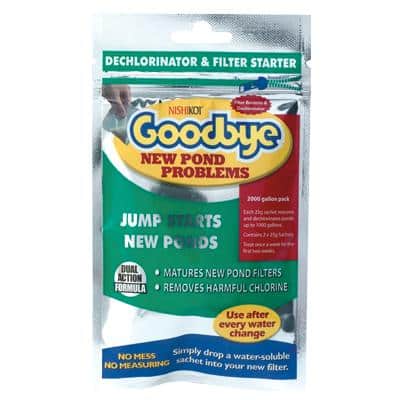
Nishikoi Goodbye New Pond Problems
| Brand | |
|---|---|
| Treatment Type | Dechlorinator and filter bacteria |
| Suitable For | New ponds, new filters and new fish introductions |
| Treatment Form | Two water-soluble sachets |
Two Nishikoi soluble sachets combining dechlorinator, filter bacteria and enzymes for new ponds and biological filters up to 9,000 litres.
£7.99 (inc VAT)
Nishikoi Goodbye New Pond Problems
A simple two-week start-up course for safer tap water and developing biofilters
Goodbye New Pond Problems combines a tap-water dechlorinator with concentrated filter bacteria and enzymes. It is intended for the vulnerable first weeks of a new pond or biofilter, when chlorine must be neutralised and the biological media has not yet developed a mature population capable of processing fish waste.
The box contains two 25g water-soluble sachets. Each treats 4,500 litres or 1,000 UK gallons, giving a two-week course for a pond of that size and cumulative coverage of 9,000 litres across the pack.
What this Nishikoi treatment is designed to do
- Combines dechlorinator with concentrated filter bacteria and enzymes.
- Two pre-measured water-soluble sachets.
- Each sachet treats 4,500 litres or 1,000 UK gallons.
- Designed for the first two weeks of a new pond or filter.
- Also useful when introducing new fish, provided water quality and stocking are managed sensibly.
Check the pond before adding a treatment
Start with the real pond volume and a basic water test. Ammonia, nitrite, pH and KH can reveal a system problem that no bottle or sachet will fix on its own. Allow for shelves, rockwork, pipework and filter chambers rather than dosing from the pond’s maximum outside dimensions. If the pond contains fish, make sure circulation and aeration are working before treatment begins.
- Test source water and confirm that the pond volume is known.
- Make sure the filter and aeration are running before fish are introduced.
- Use a separate liquid dechlorinator if a large water change exceeds the sachet schedule or current directions.
- Keep testing ammonia and nitrite; bacteria starters do not remove the need for water-quality monitoring.
How to use it responsibly
- Use one sachet in the filter or strong flow as directed during the first week.
- Repeat with the second sachet one week later.
- Feed very lightly while the biological filter develops.
- Take action immediately if ammonia or nitrite becomes detectable; do not wait for symptoms in the fish.
Always read the current pack before use because formulations and directions can change. Do not combine pond treatments unless the manufacturer specifically confirms that they are compatible. Remove loose algae and accumulated waste where practical, keep the filter maintained and retest the water instead of repeatedly adding product by appearance alone.
Available pack sizes, coverage and our price
| Pack | Stated coverage | Supplier code | Price |
|---|---|---|---|
| 2 x 25g Sachets | Two weekly treatments for 4,500 litres | NK287 | £7.99 |
Use it as part of a complete pond-care plan
Compare all beneficial bacteria and filter boosters and keep a reliable ammonia and nitrite test kit available during filter maturation. Browse all pond treatments.
New pond syndrome is managed by controlling stocking and feeding while the filter matures, not by bacteria alone. Any ammonia or nitrite reading calls for immediate water-quality management, increased aeration and reduced feeding.
Frequently asked questions
Does this instantly mature a new filter?
No. It introduces bacteria and enzymes, but the biofilm still needs time, oxygen and a controlled waste load to establish.
How many treatments are in the pack?
Two 25g soluble sachets, used one week apart for a pond up to 4,500 litres.
Does it remove chlorine?
Yes. Current product information describes an included dechlorinator alongside filter bacteria and enzymes.
Can fish be added immediately?
The product reduces start-up risk but does not make an overloaded new pond safe. Add stock gradually and test the water frequently.
Can it be used after a filter clean?
A bacterial booster can be useful after disruptive maintenance, but preserve mature media wherever possible and follow the current pack directions.




Reviews
There are no reviews yet.