






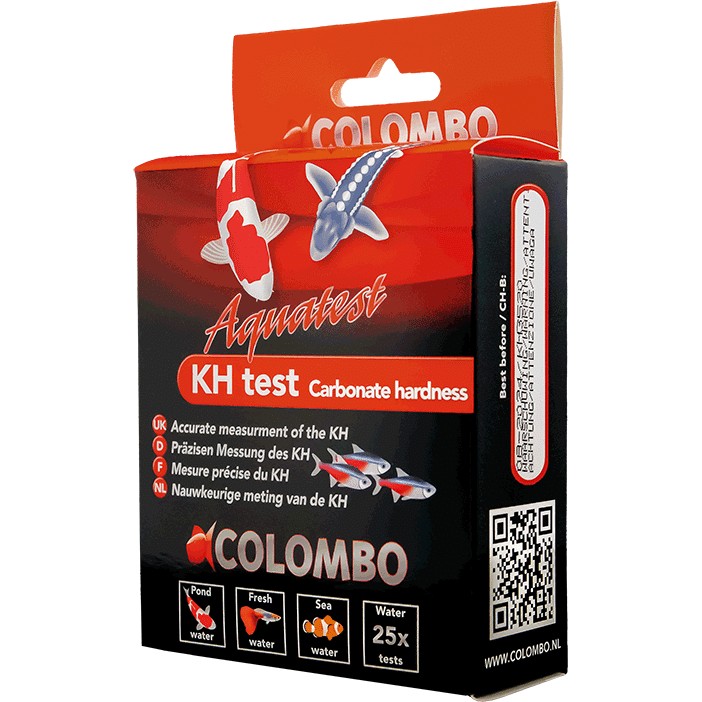
Colombo KH Pond Water Test Kit
| Brand | |
|---|---|
| Parameter | Carbonate hardness |
| Test method | Liquid drop test |
| Manufacturer part number | 05020297 |
Check carbonate hardness in your pond water with this Colombo liquid test kit. It provides a dedicated test for this parameter and can be bought separately when you need to replace a used test or build a selection around the readings you monitor.
£7.99 (inc VAT)
Colombo KH Pond Water Test Kit
A liquid drop test for carbonate hardness
Check carbonate hardness in your pond water with this Colombo liquid test kit. It provides a dedicated test for this parameter and can be bought separately when you need to replace a used test or build a selection around the readings you monitor.
Product details
| Brand | Colombo |
|---|---|
| Parameter | Carbonate hardness |
| Test method | Liquid drop test |
| Manufacturer part number | 05020297 |
| Supplier code | TK9543 |
Why measure KH alongside pH?
Carbonate hardness is relevant to the stability of pond-water pH. Colombo explains that low KH can allow pH to fluctuate rapidly, so a pH reading on its own does not provide the same information as measuring both parameters. This kit gives you a dedicated KH result to add to your pond records.
Use the Colombo pH test when you also need to measure acidity or alkalinity. GH, or general hardness, is another separate parameter with its own test. A result of eight on a KH test is not a pH of eight: the measurement and units are different. Write the parameter beside each number to avoid confusing results when reviewing your log later.
How the Colombo KH test works
This is a drop-count test with a visible colour-change endpoint. You add reagent gradually to a measured sample until its colour changes, then use the number of drops to determine KH. You are watching for that change, rather than trying to match several shades of the same colour against a printed scale.
The manufacturer’s procedure is based on a 5ml water sample. The relationship between drops and the result depends on that sample volume. Do not fill the tube by eye to a different level, halve the water to save reagent or apply a procedure from another test kit. Use the instructions supplied with the Colombo kit if packaging or directions have been revised.
Taking the reading step by step
- Start with a clean test tube and measure a 5ml sample as accurately as possible.
- Add one drop of KH reagent and mix. The sample should become light blue. If it becomes yellow with this first drop, Colombo identifies the KH as below 1°DH.
- If the sample is blue, continue adding one drop at a time, mixing after every addition, until it turns yellow.
- Count all the drops used, including the first. The total at the blue-to-yellow change gives the KH in °DH: two drops represent 2°DH, three drops represent 3°DH, and so on.
Keep the bottle vertical as you dispense the reagent and avoid air bubbles in the drops. Mixing between additions lets you observe the effect of each drop before adding another. If you lose count, repeat the test with a fresh measured sample instead of guessing the missing number.
Interpreting the endpoint
For example, if the sample changes from blue to yellow after six drops in total, record the result as KH 6°DH. If the very first drop produces yellow, record the manufacturer’s below-1°DH result; do not simply assume that every first-drop result means exactly one. Keep that distinction in your notes when following a pond with very low carbonate hardness.
This test measures the sample you have taken. It does not itself correct the water or identify every reason for a change. If an unexpected result repeats, compare it with the pond’s pH and recent maintenance or water changes before deciding what action is needed. The kit’s role is to provide evidence for that decision.
How many tests will the reagent provide?
Each test consumes the number of drops required to reach its endpoint. Water with a higher KH therefore uses more reagent per reading than water with a lower KH. For example, a ten-drop reading consumes twice as many drops as a five-drop reading, assuming the same drop size. That is why a test-count estimate should not be treated as an identical allowance for every pond.
Check how much reagent remains before a planned series of checks. This separate kit is useful when KH is the parameter you test most often, or when the KH reagent in a broader test case runs out before the others. The Colombo Pond Test Lab Professional combines KH with pH, GH, ammonia, nitrite, nitrate and phosphate if you need all seven tests together.
Clean tubes and consistent records
Colombo advises cleaning the tube immediately after testing as well as ensuring it is clean before use. Reagent left from an earlier test can interfere with the next sample. Keep the KH reagent and instructions together, close the bottle after use and follow its storage and expiry directions.
Record the date, KH result and relevant changes in a simple log. If you test both pond water and replacement water, label each sample and result clearly. Consistency in sample volume, bottle position and endpoint reading makes comparisons more useful than a collection of unlabelled numbers taken using different methods.
For the original procedure, consult the Colombo KH instructions. Match manufacturer reference 05020297 when identifying this individual KH test; the supplier ordering code for this listing is TK9543.




Reviews
There are no reviews yet.