






Bead Filters for Ponds
High-Performance Filtration for Clear, Healthy Koi Ponds
Bead filters are a powerful and efficient filtration solution designed primarily for koi ponds and heavily stocked fish ponds. Combining mechanical and biological filtration within a single pressurised vessel, bead filter systems deliver excellent water clarity while maintaining stable water quality.
If you are looking for a compact yet high-capacity filtration system, a pond bead filter offers a reliable and professional-grade option.
How Bead Filters Work
A bead filter uses thousands of small plastic beads inside a sealed pressure vessel. As pond water is pumped through the unit:
-
Solid waste and fine debris become trapped between the beads
-
Beneficial bacteria colonise the bead surface
-
Ammonia and nitrite are biologically converted through the nitrogen cycle
This dual-stage filtration process makes bead filters particularly popular for koi ponds where waste production is higher.
Because they operate under pressure, bead filters can be positioned above pond water level and return water to waterfalls or raised features without requiring a gravity-fed setup.
Why Choose a Bead Filter?
Bead filters are ideal for pond owners who want:
-
Excellent water clarity
-
Compact filtration design
-
Pressurised system flexibility
-
Reduced maintenance compared to traditional multi-bay filters
-
High-performance koi pond filtration
They are particularly well suited to pump-fed systems and can be paired with bottom drains, skimmers and UV clarifiers for a complete filtration setup.
Suitable for Koi & Heavily Stocked Ponds
Bead filters are most commonly used in:
-
Koi ponds
-
Large garden ponds
-
Raised formal ponds
-
Commercial or show ponds
-
Pump-fed filtration systems
Correct sizing is essential. Koi ponds require robust filtration to cope with feeding levels and fish waste.
Key Benefits of Bead Filters
-
Combined mechanical and biological filtration
-
Excellent water clarity
-
Compact footprint
-
Pressurised system flexibility
-
Suitable for pump-fed setups
-
Easy backwash cleaning system
-
Ideal for koi ponds
-
Durable construction
Compare media, backwash requirements and real fish load
-
Pressurised filter vessel
-
Plastic bead filter media
-
Multiport valve for backwashing
-
Designed for pump-fed operation
-
Flow rate capacity (litres per hour)
-
Maximum pond size rating
-
Compatible with UV clarifiers
-
Suitable for freshwater pond systems
Our practical view: A bead filter is compact and convenient, but it still needs a pump capable of overcoming the filter and pipe resistance, a proper waste route and regular backwashing. We size these from pond volume, fish load, feeding and desired turnover—not from the largest pond figure on the label alone.
Original price was: £825.99.£784.69Current price is: £784.69. (inc VAT)
5% Off
Out of stock
Original price was: £1,455.99.£1,383.19Current price is: £1,383.19. (inc VAT)
5% Off
Out of stock
Original price was: £1,905.99.£1,810.69Current price is: £1,810.69. (inc VAT)
5% Off
Out of stock
Original price was: £1,115.99.£1,060.19Current price is: £1,060.19. (inc VAT)
5% Off
Original price was: £1,295.99.£1,231.19Current price is: £1,231.19. (inc VAT)
5% Off
Original price was: £955.99.£908.19Current price is: £908.19. (inc VAT)
5% Off
Original price was: £3,159.99.£3,001.99Current price is: £3,001.99. (inc VAT)
5% Off
Out of stock
Original price was: £3,659.99.£3,476.99Current price is: £3,476.99. (inc VAT)
5% Off
Original price was: £3,366.99.£3,198.64Current price is: £3,198.64. (inc VAT)
5% Off




Choosing Between the Bead Filters We Stock
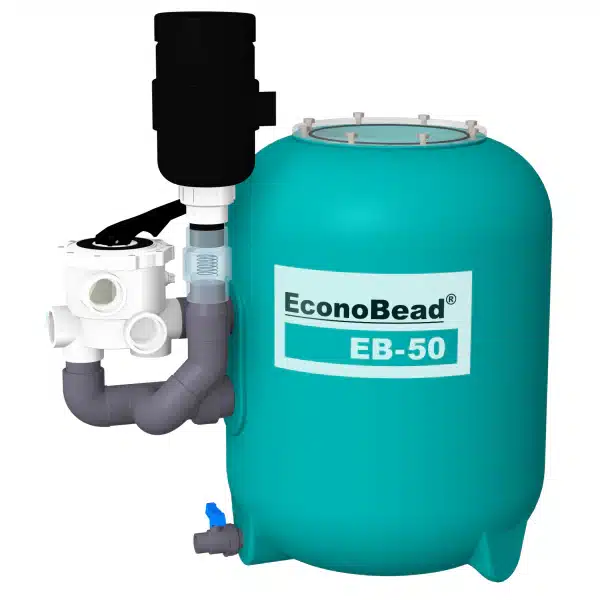
This category contains two distinct families. AquaForte EconoBead filters combine mechanical and biological filtration using floating beads and a multiport backwash valve. Evolution Aqua K+ Advanced filters use K+ media and are offered in 20, 24, 30 and 36 inch vessels. Both need correctly sized pumps and sensible pre-filtration on demanding koi ponds.
AquaForte EconoBead
The range runs from AquaForte EconoBead 40 (2800galls) and AquaForte EconoBead 50 (4700galls) through EB60, AquaForte EconoBead 100 (12,000 galls) and AquaForte EconoBead 140 (20,000 galls). Current AquaForte literature rates EB40, EB50, EB60, EB100 and EB140 for progressively larger ponds, but those figures assume suitable flow, pre-filtration and stocking. The EB100 and EB140 use larger 63 mm / 2 inch connections, while smaller models use 50 mm / 1½ inch arrangements.
Evolution Aqua K+ Advanced
Choose between Evolution Aqua K+ Advanced 20″ Bead Filter, Evolution Aqua K+ Advanced 24″ Bead Filter, Evolution Aqua K+ Advanced 30″ Bead Filter and Evolution Aqua K+ Advanced 36″ Bead Filter by working capacity, intended flow and fish load. The larger vessel is not a cure for restricted pipework or an undersized pump. Check the full filter instructions for pump flow, air-blower operation and waste discharge.
Plan the backwash before the filter arrives
Every clean sends dirty water to waste. Provide a drain route that can accept the discharge without flooding the filter house, and install unions and isolation so the multiport valve, blower and pump remain serviceable.
Bead Filters – Frequently Asked Questions
Bead filters are a popular choice for koi ponds and pump-fed filtration systems. Below are the most common questions pond owners ask when considering a bead filter for their setup.
1) What is a bead filter for a pond?
A bead filter is a pressurised filtration system that uses thousands of small plastic beads to provide both mechanical and biological filtration. Water is pumped through the beads, where debris is trapped and beneficial bacteria break down harmful toxins.
2) Are bead filters suitable for koi ponds?
Yes. Bead filters are particularly well suited to koi ponds due to their ability to handle higher waste loads. They provide excellent water clarity and support stable water conditions.
3) How does a bead filter differ from a drum filter?
A bead filter provides combined mechanical and biological filtration in one sealed unit. A drum filter focuses primarily on automatic mechanical waste removal and is often paired with separate biological chambers. Drum filters generally require less manual cleaning but may involve higher initial cost.
4) Do bead filters require backwashing?
Yes. Bead filters use a multiport valve to reverse water flow during backwashing. This cleans trapped debris from the bead media and restores performance. Backwashing is typically required every 1 to 2 weeks depending on pond load.
5) Can a bead filter be installed above pond level?
Yes. Because bead filters operate under pressure, they can be positioned above pond water level and still return water to waterfalls or raised features.
6) Do bead filters replace biological filters?
Bead filters provide biological filtration, but in heavily stocked koi ponds, they are sometimes paired with additional biological systems to maximise capacity.
7) What pump do I need for a bead filter?
Bead filters are pump-fed systems, so you will need a suitably sized pond pump that matches the recommended flow rate of the filter. Always check manufacturer guidelines for optimal performance.
8) Are bead filters energy efficient?
Energy consumption mainly depends on the pump driving the system. When correctly sized, bead filters offer efficient filtration with manageable running costs.
9) How often should a bead filter be cleaned?
Backwashing is typically carried out every 1 to 2 weeks during peak feeding seasons. More frequent cleaning may be needed in heavily stocked ponds.
10) Can bead filters improve water clarity?
Yes. Bead filters are well known for producing clear, polished water by trapping fine suspended particles while also supporting beneficial bacteria growth.
