





Large Pond & Lake Aeration Kits
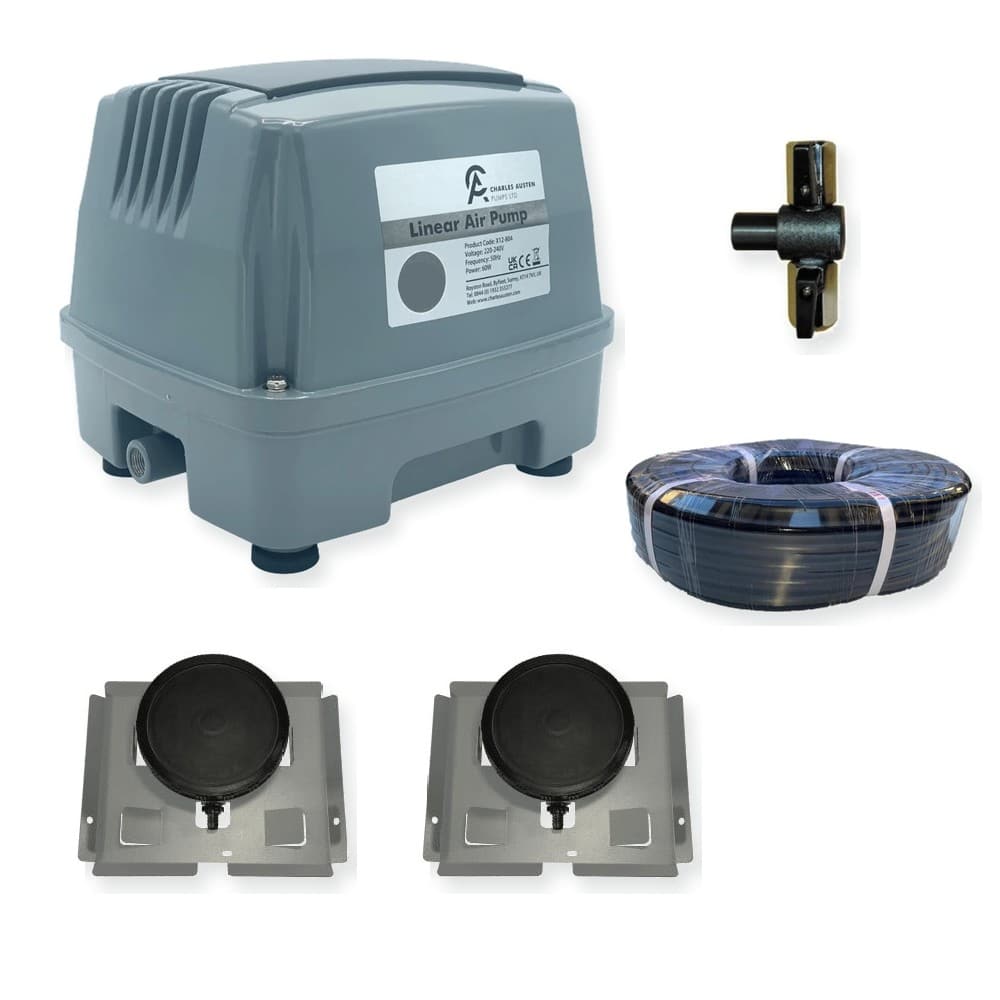
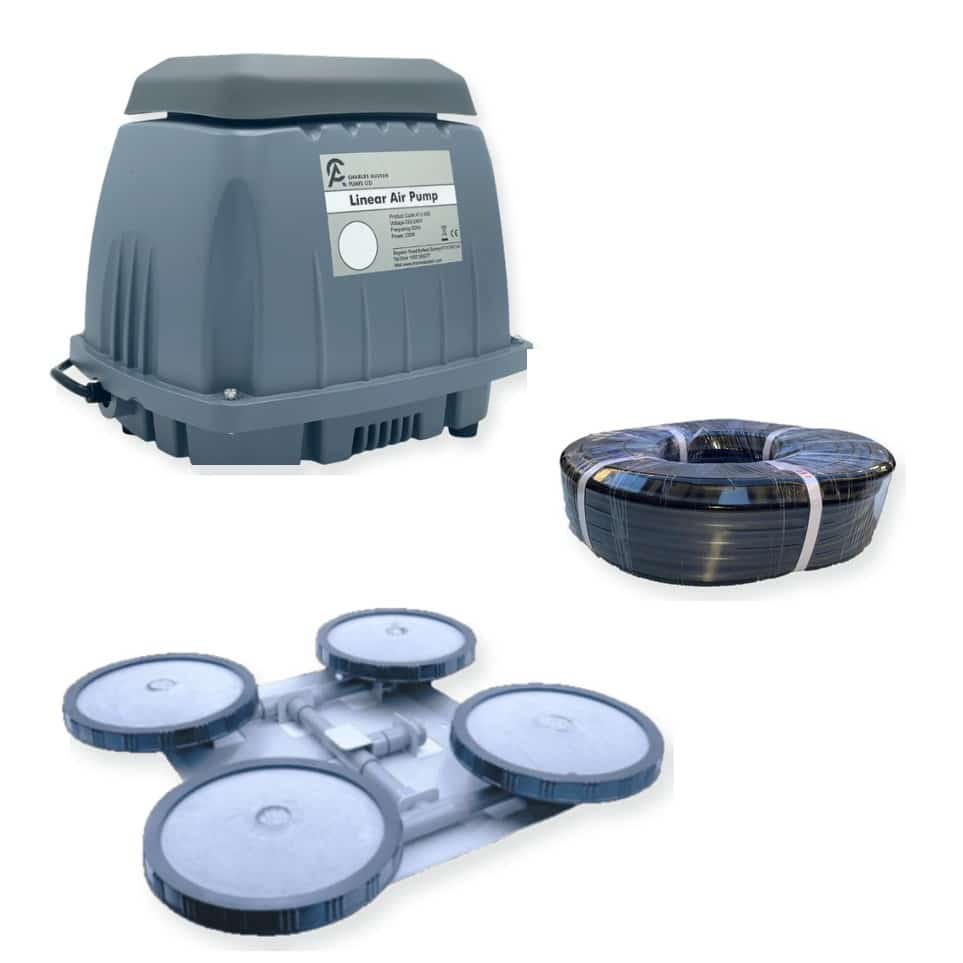
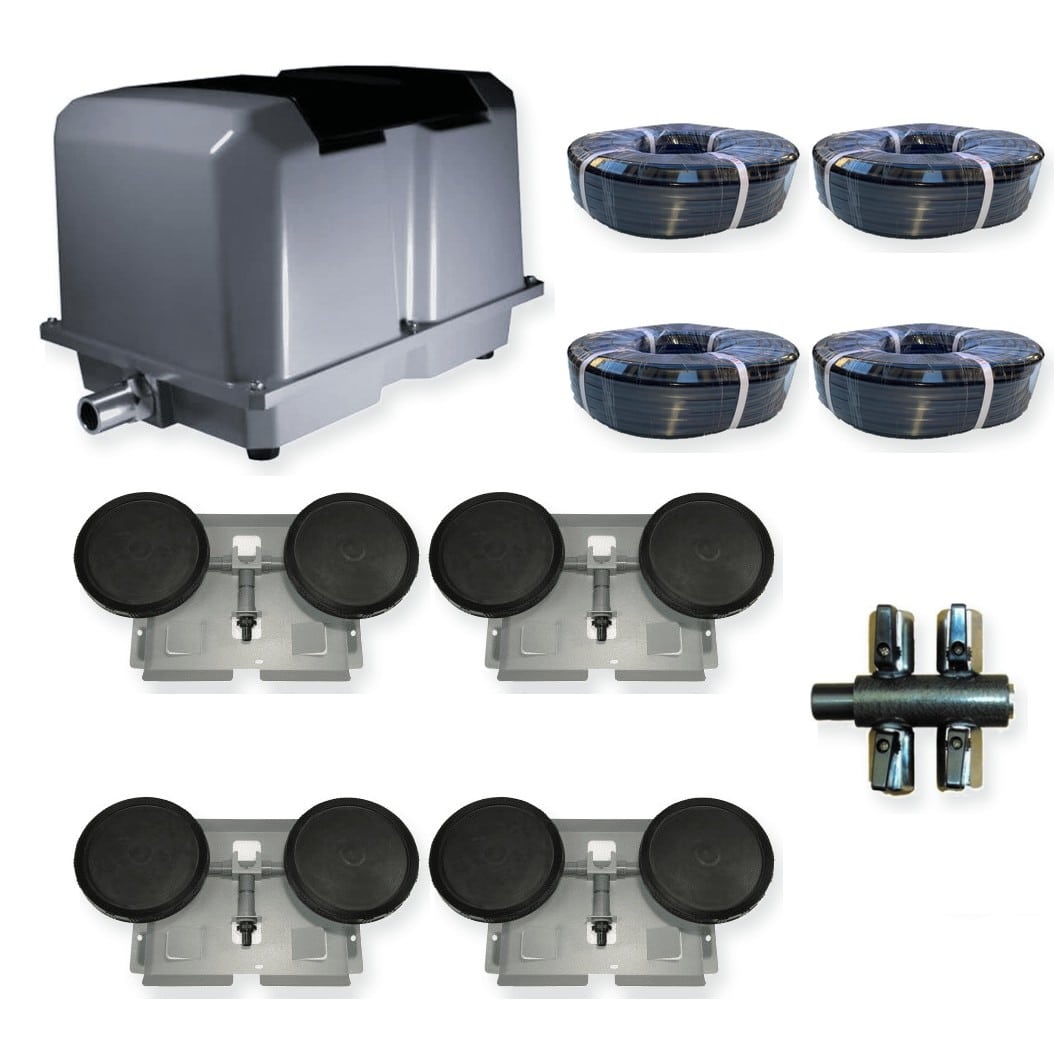
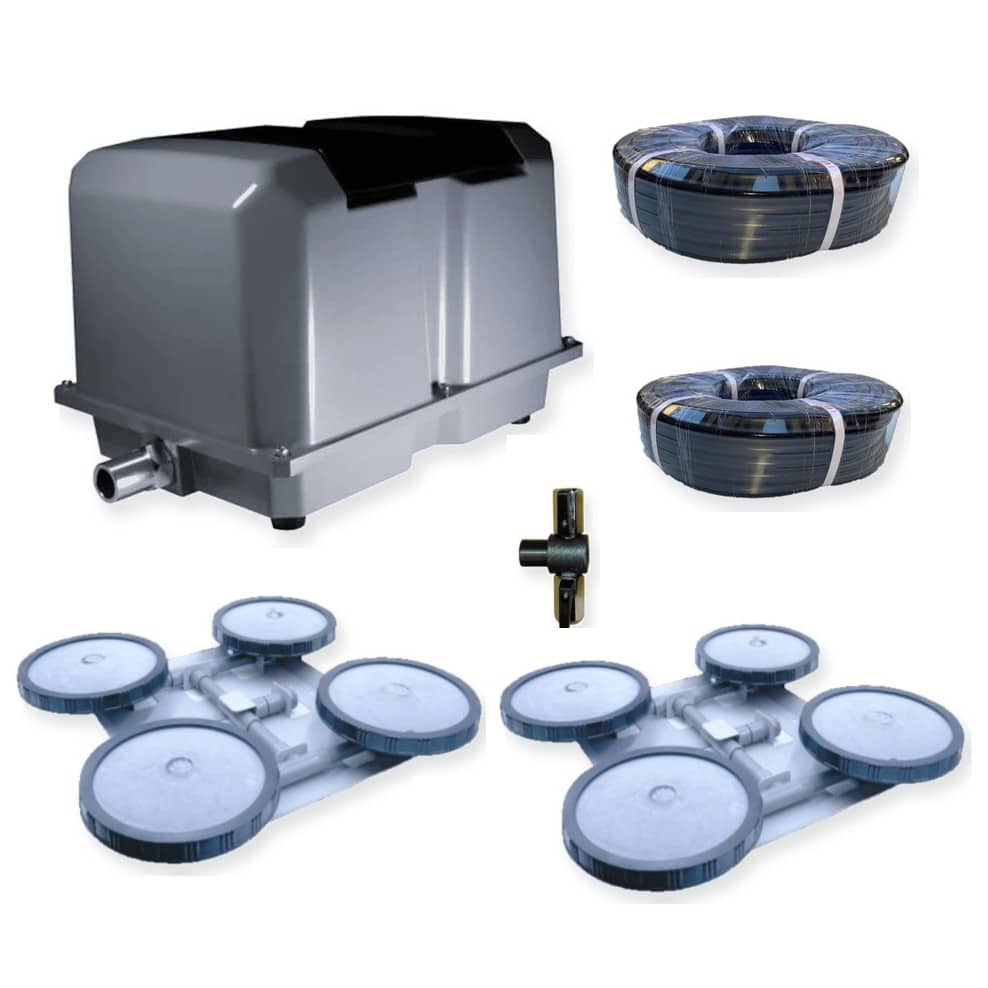
Choose a complete lake aeration kit without having to match the pump, diffusers, manifold and weighted airline separately. These systems combine proven Charles Austen ET air pumps with self-sinking DSW diffuser stations and the connection hardware needed for a balanced bottom-diffused aeration layout.
Use the new Typical Waterbody Size filter to narrow the range quickly. It is a practical starting point rather than a hard maximum: depth, pond shape, fish load, airline length and the number of separate circulation zones all affect the final choice.
Start with the shape of the water
- Large pond / small lake: twin-zone ET100 and ET120 kits for substantial ponds and compact lakes where two separate areas need circulation.
- Medium lake: ET200 and ET250 systems with a central four-disc station, two twin-disc stations or four separate diffuser points.
- Large lake: ET400 and ET500 systems for higher-output, multi-zone layouts using two DSW4 or four DSW2 stations.
A regular, bowl-shaped waterbody may suit one central diffuser station. Long, divided, islanded or irregular lakes usually benefit from several distributed stations. If you are unsure, send us the length, width, average and maximum depth, fish stocking and proposed airline distances and we will check the layout before you order.
Price range: £539.99 through £699.49 (inc VAT)
Available on back-order
Price range: £549.99 through £709.49 (inc VAT)
Available on back-order
Price range: £679.99 through £839.49 (inc VAT)
Available on back-order
Price range: £1,169.99 through £1,488.99 (inc VAT)
Available on back-order
Price range: £809.99 through £969.49 (inc VAT)
Available on back-order
Price range: £829.99 through £989.49 (inc VAT)
Available on back-order
Price range: £1,999.99 through £2,637.99 (inc VAT)
Available on back-order
Price range: £1,449.99 through £1,768.99 (inc VAT)
Available on back-order
Price range: £2,129.99 through £2,767.99 (inc VAT)
Available on back-order
Price range: £1,579.99 through £1,898.99 (inc VAT)
Available on back-order


Lake aeration kits: a practical UK selection guide
A well-designed lake aeration kit does more than create bubbles. A land-mounted air pump sends air through sinking airline to diffusers on the pond or lake bed. The rising fine-bubble plume lifts deeper water towards the surface, encourages gas exchange and creates vertical circulation through the water column. This can support fish, aerobic bacteria and more stable water conditions, particularly during warm weather when oxygen demand is high.
The correct system is not selected by acreage or airflow alone. Authoritative aeration guidance consistently treats depth, shape and profile as core sizing factors. A long or divided lake can need more diffuser positions than a round lake of the same area, while deeper diffuser positions create more pressure resistance. Fish stocking, organic load, temperature and the purpose of the system also change the duty required.
Which lake aeration kit should I choose?
| Typical waterbody tier | Kits in this range | Best starting point for |
|---|---|---|
| Large pond / small lake | ET100 Twin-Zone ET120 Twin-Zone |
Substantial ornamental or koi ponds and compact lakes where two separate diffuser points will spread circulation better than one central plume. |
| Medium lake | ET200 Central DSW4 ET200 Twin DSW2 ET200 Four-Zone DSW1 ET250 Central DSW4 |
Medium lakes, larger fisheries and irregular waterbodies needing either one concentrated central plume or several circulation zones. |
| Large lake | ET400 Twin DSW4 ET400 Four DSW2 ET500 Twin DSW4 ET500 Four DSW2 |
Large, deep, heavily stocked or multi-zone lakes that need high total airflow distributed through two or four substantial diffuser stations. |
Important: these labels are useful screening bands, not guaranteed coverage figures. Two lakes with the same surface area can need very different systems. Contact us for a suitability check if the lake is unusually deep, heavily stocked, divided by islands or margins, has long airline runs, or has a history of oxygen problems.
Central, twin-zone or four-zone aeration?
One central DSW4 diffuser station
A central four-disc station concentrates the pump output into one strong lifting plume. It is a sensible option for a reasonably regular, bowl-shaped pond or lake where water can circulate around a central point. Compare the Charles Austen DSW4 diffuser station used in these kits.
Two diffuser stations
A twin-zone layout separates the airflow between two areas. This is often better for long ponds, two-lobed lakes or waterbodies with an island, shelf or narrow section that interrupts circulation. The range uses either two single-disc DSW1 stations or two twin-disc DSW2 stations. Compare the DSW1 and DSW2 diffuser stations.
Four diffuser stations
Four separate stations provide the greatest flexibility for broad, irregular or multi-bay water. The manifold allows the branches to be balanced so that one shorter or shallower run does not take all the airflow. Four-zone layouts are particularly useful where the aim is to reduce isolated stagnant areas rather than create one very vigorous central plume.
Airflow and pressure are different
Airflow, measured in litres per minute, tells you how much air the pump can move. Pressure tells you how much resistance it can overcome. Water depth alone adds approximately 0.1 bar of hydrostatic pressure per metre before allowing for the diffuser membrane, airline length, bends, valves and fittings. This is why a high free-air figure does not automatically make a pump suitable for every depth.
The ET100 and ET120 kits are built around the published 0.12 bar duty point. The ET200, ET250, ET400 and ET500 systems use pumps published at 0.20 bar, giving more working headroom for larger diffuser systems and higher-loss installations. The ET400 and ET500 primarily add air volume for multiple stations; they should not be treated as unlimited-depth compressors. For a substantially deep installation, ask us to check the pressure requirement before ordering.
What is included in these pond and lake aeration systems?
- A matched Charles Austen ET air pump.
- One, two or four self-sinking DSW diffuser stations, selected to accept the pump output without excessive restriction.
- A suitably sized air manifold for multi-zone systems.
- Super-heavy-duty weighted airline that stays on the pond or lake bed, with additional airline options on each kit.
- The specified connectors, reducers and stainless steel hose clips needed for the listed layout.
If you already own part of the system, browse the individual large pond and lake diffusers, airline and manifolds instead. To compare bottom-diffused equipment with surface aerators and other approaches, visit our wider Lake Aerators & Diffuser Systems range.
How to plan a bottom-diffused aeration system
- Measure the waterbody. Record maximum length and width, average depth and maximum depth. If the depth varies sharply, sketch the profile.
- Map the shape. Mark islands, shelves, narrow channels, bays and known stagnant areas. These features often determine diffuser count more than total area.
- Define the objective. Fish oxygen support, general circulation, de-stratification, emergency summer support and helping aerobic breakdown are different duties.
- Check the fish and organic load. A heavily stocked koi pond or fishery normally needs a larger safety margin than an unstocked ornamental lake.
- Measure every airline run. Long runs, small-bore hose and multiple fittings increase resistance. Site the pump on a dry, ventilated base as close as practical.
- Balance the branches. On multi-zone systems, use the manifold valves to achieve an even bubble pattern rather than fully closing spare outlets and forcing the pump against unnecessary back pressure.
Installation and commissioning
Keep the air pump dry, ventilated and protected from flooding. Position it above the maximum water level where practical, or use the correct non-return protection. Use an outdoor electrical supply protected by an appropriate 30mA RCD and keep all mains connections away from water.
Lower diffuser stations with a separate rope rather than lifting them by the airline. Place them level so the whole membrane operates evenly. In an old, stagnant or strongly stratified lake, introduce bottom aeration gradually. Rapidly mixing oxygen-poor deep water throughout the water column can temporarily worsen conditions and stress fish. If the lake has a history of summer fish distress, test dissolved oxygen and obtain site-specific advice.
Running costs and maintenance
Continuous operation is common during warm weather and on heavily stocked water because dissolved oxygen can be lowest overnight and around dawn. Other systems may be run seasonally or on a planned schedule. The right approach depends on oxygen measurements, temperature, stocking and the reason for aerating; avoid repeatedly switching a heavily stratified system on and off without a commissioning plan.
- Inspect pump intake filters and ventilation regularly.
- Check airline for kinks, damage or loose clips.
- Clean diffuser membranes if the bubble pattern becomes uneven or airflow falls.
- Service the air pump with the correct model-specific diaphragm and filter kit.
- Keep an alternative oxygen source available where aeration protects valuable fish or critical stock.
Lake aeration kit FAQs
What size lake aerator do I need?
Start with surface area, average and maximum depth, shape, fish stocking, airline distance and the number of separate areas that need circulation. Use the Typical Waterbody Size filter for a first shortlist, then compare diffuser layout and pressure. Ask us to check the system if the waterbody is deep, irregular or heavily stocked.
Is a bottom diffuser better than a fountain?
They do different jobs. A bottom-diffused system creates vertical circulation from depth and keeps electrical equipment out of the water. A fountain or surface aerator creates strong surface movement and may be preferable on shallow water or where a visible display is wanted. Some large sites use both. Compare the options in our lake aerator range.
How many diffusers should a lake have?
A regular pond may work well with one correctly sized central station. Long, divided or irregular lakes usually need two or four stations so that each area develops useful circulation. The pump output must be divided across enough diffuser area to avoid excessive back pressure.
Where should lake diffusers be positioned?
Deep or stagnant zones are common starting points, but placing every diffuser in one spot can leave other areas unmixed. Consider the whole depth profile, lake shape, prevailing water movement and access for future maintenance. Avoid disturbing sensitive shallow habitat unnecessarily.
How deep can a pond or lake diffuser be installed?
Depth is limited by the pump’s available pressure after airline and diffuser losses, not by the diffuser frame alone. As a useful physical guide, each metre of water depth creates roughly 0.1 bar of resistance. Send us the exact depth and airline length for deeper installations so the duty point can be checked.
Does a lake aerator need to run all day?
Many stocked ponds and lakes run aeration continuously through high-risk warm periods, including overnight when photosynthesis stops but fish and bacteria continue consuming oxygen. The safest schedule depends on measured oxygen, temperature, stocking and whether the lake is already stratified.
Can aeration reduce sludge or algae?
Aeration supports oxygen and circulation and can help aerobic bacteria process organic material. It may form part of a sludge or water-quality plan, but it is not a guaranteed algae treatment and does not remove the source of excessive nutrients. Severe problems should be assessed alongside filtration, nutrient input, shade, sediment and water testing.
Are lake aeration kits safe for fish?
A correctly sized and gradually commissioned system is normally highly beneficial. Take extra care when first aerating an old, deep or stagnant waterbody because rapid de-stratification can move poor-quality bottom water through fish-holding zones. Start gradually and monitor fish behaviour and dissolved oxygen where risk is high.
Can I run pond aeration in winter?
Yes, but the objective and diffuser position may change. Aeration can maintain gas exchange, although intense mixing from the deepest point may remove a relatively warmer refuge in very cold conditions. A shallower seasonal position can be more appropriate; site-specific advice is recommended for stocked lakes.
What information do you need to recommend a kit?
Send the pond or lake length, width, average and maximum depth, a rough shape or sketch, fish type and stocking level, the main reason for aerating, the pump-to-water distance and the expected airline length to each diffuser. Photographs and any dissolved-oxygen readings are also useful.
Need help choosing?
These complete kits are designed to make a previously bespoke quotation easier to buy online, while preserving the important choice of diffuser layout and airline length. If the three size bands still leave two plausible options, contact That Pond Guy before ordering and we will help compare them against the actual waterbody rather than guessing from acreage alone.
