








Charles Austen 200 Twin DSW2 Pond and Lake Aeration Kit
| Brand | |
|---|---|
| Air Pump | Charles Austen ETD200, Charles Austen ET200, Charles Austen ETi200 |
| Power | 100 W, 160 W, 195 W |
| Diffuser Layout | 2 x DSW2 stations |
| Weighted Airline | 30m total (1 x 30m uncut reel), 60m total (2 x 30m uncut reels) |
| Air Flow | 200 L/min |
| Air Pressure | 0.15 bar, 0.2 bar |
| Water body size | Large pond / small lake |
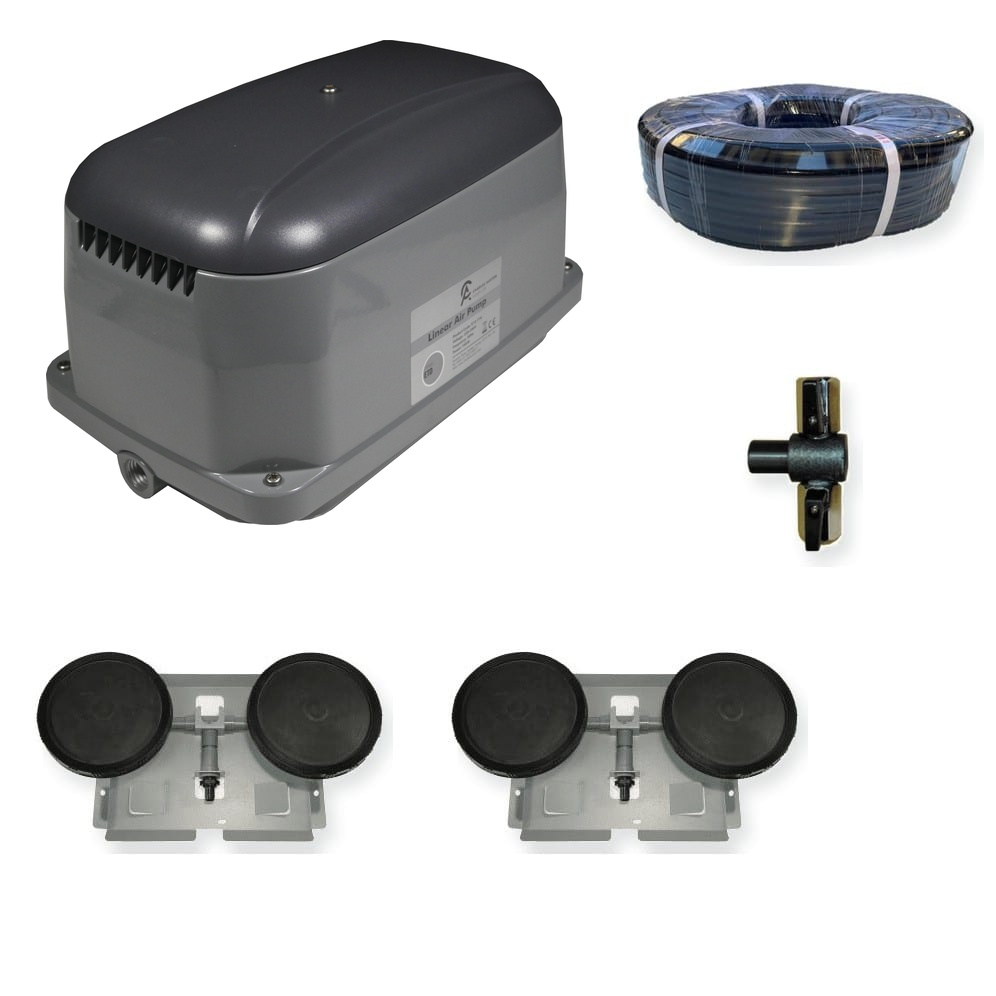
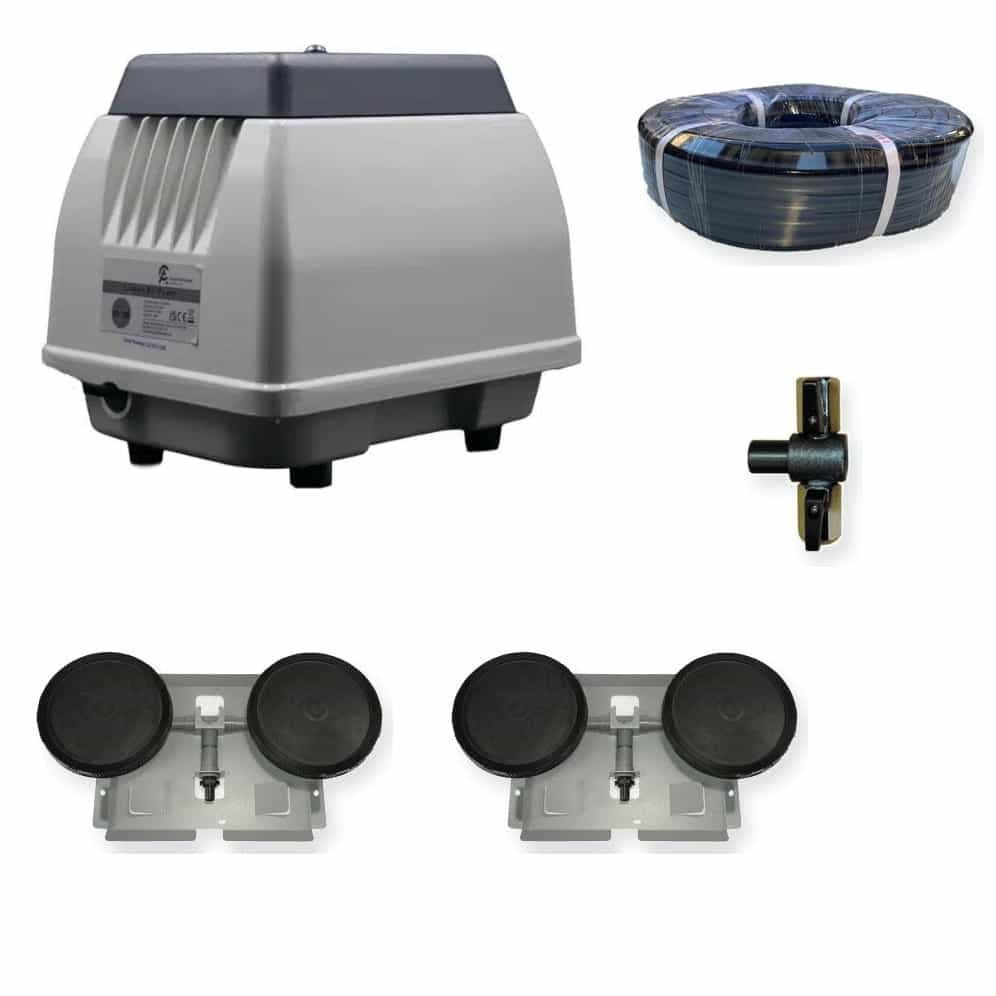
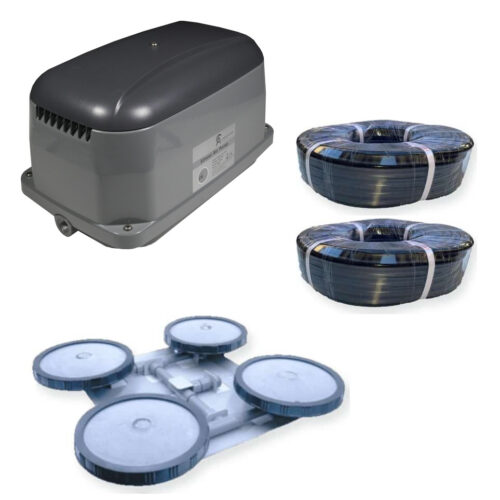
Aerate two areas of a large pond or small lake from one Charles Austen pump. Includes two weighted DSW2 stations (four discs), a two-way manifold, fittings and one or two uncut 30 m reels.
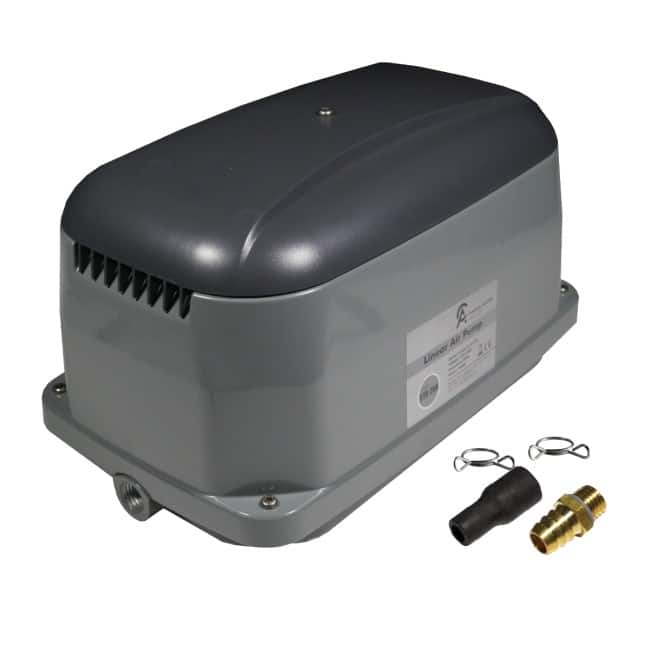
Best value: ETi200. Consider the ET200 for deeper diffusers or more restrictive runs. The ETD200 is the standard alternative. Compare the three pumps.
Price range: £698.99 through £971.49 (inc VAT)
200 Twin DSW2 pond and lake aeration kit
This Charles Austen pond and lake aeration kit runs two self-sinking DSW2 diffuser stations from one pump on the bank. With two discs on each station, you can spread aeration between two areas instead of grouping all four discs in one place. That’s useful for a long pond, a pond that bends round an island, or a small lake with two bays. The adjustable manifold lets you balance the airflow if one station is deeper or farther from the pump.
Which 200-series air pump should you choose?
| Pump & rating | When to choose it |
|---|---|
| ETi200 200 L/min at 0.15 bar 100 W |
Best value. Our first choice for shallower diffusers and less restrictive airline runs. It matches the ETD200’s rated airflow and pressure using less power. |
| ET200 200 L/min at 0.20 bar 195 W |
More pressure. For deeper diffusers or longer, more restrictive runs, check this option first. It can deliver its rated airflow against more resistance. |
| ETD200 200 L/min at 0.15 bar 160 W |
Standard alternative. The same nominal airflow and pressure as the ETi200, with a higher listed power draw. |
Start with the ETi200 if it can deliver enough air at your planned diffuser depths. For a more demanding layout, compare the ET200 at the same total backpressure, the combined resistance from the water, airline and fittings.
What you get from the ET200 upgrade is pressure headroom, not a higher headline flow. The ETi200 and ETD200 are both rated at 200 L/min at 0.15 bar; the ETi200 has a listed input of 100 W versus 160 W for the ETD200. That makes the ETi200 the sensible starting point if its curve suits your pond. The ET200 holds its 200 L/min rating at 0.20 bar, so it is worth comparing first if one diffuser has to sit deeper or a branch is particularly restrictive. Those figures are published ratings, not a promise of what either station will receive.
What’s included?
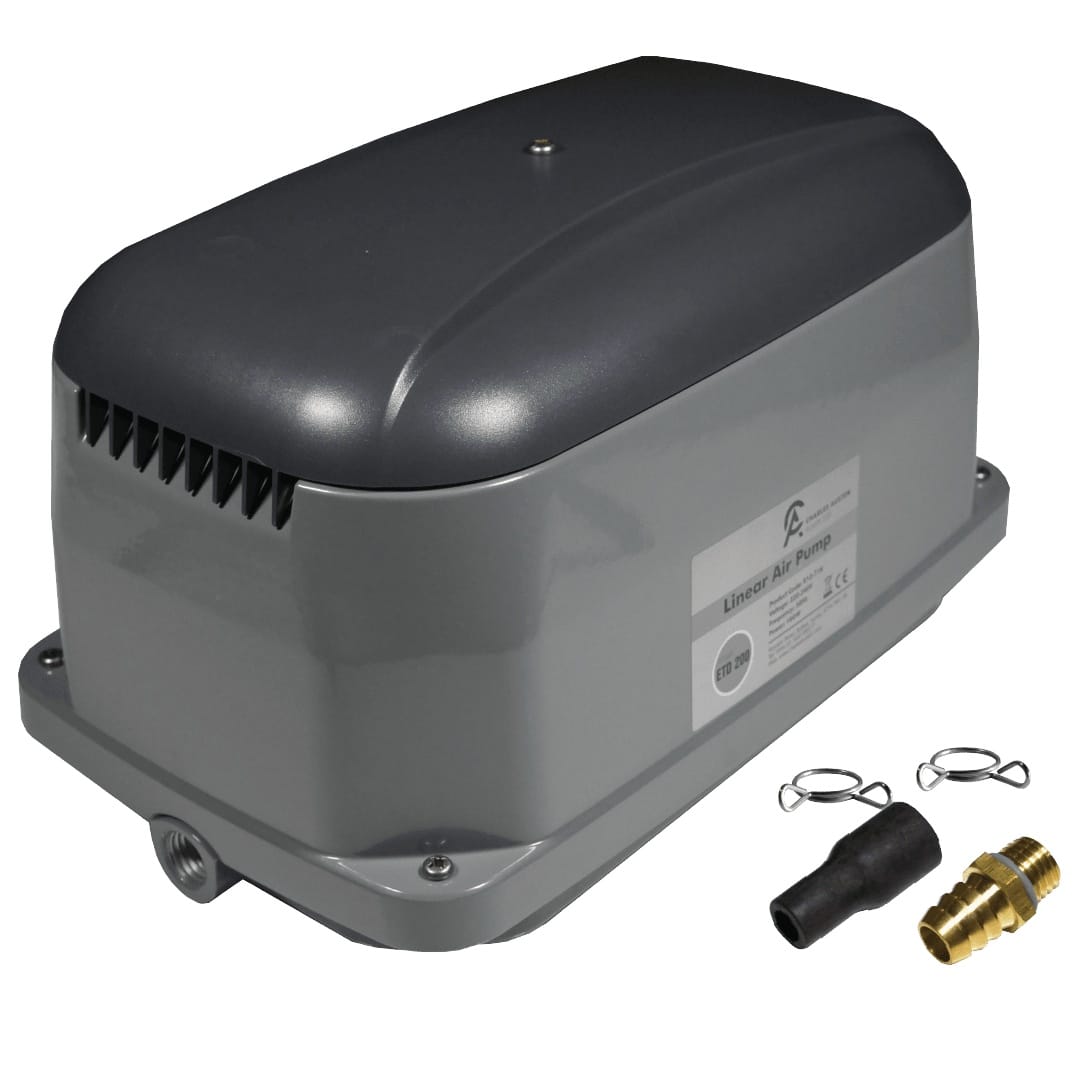
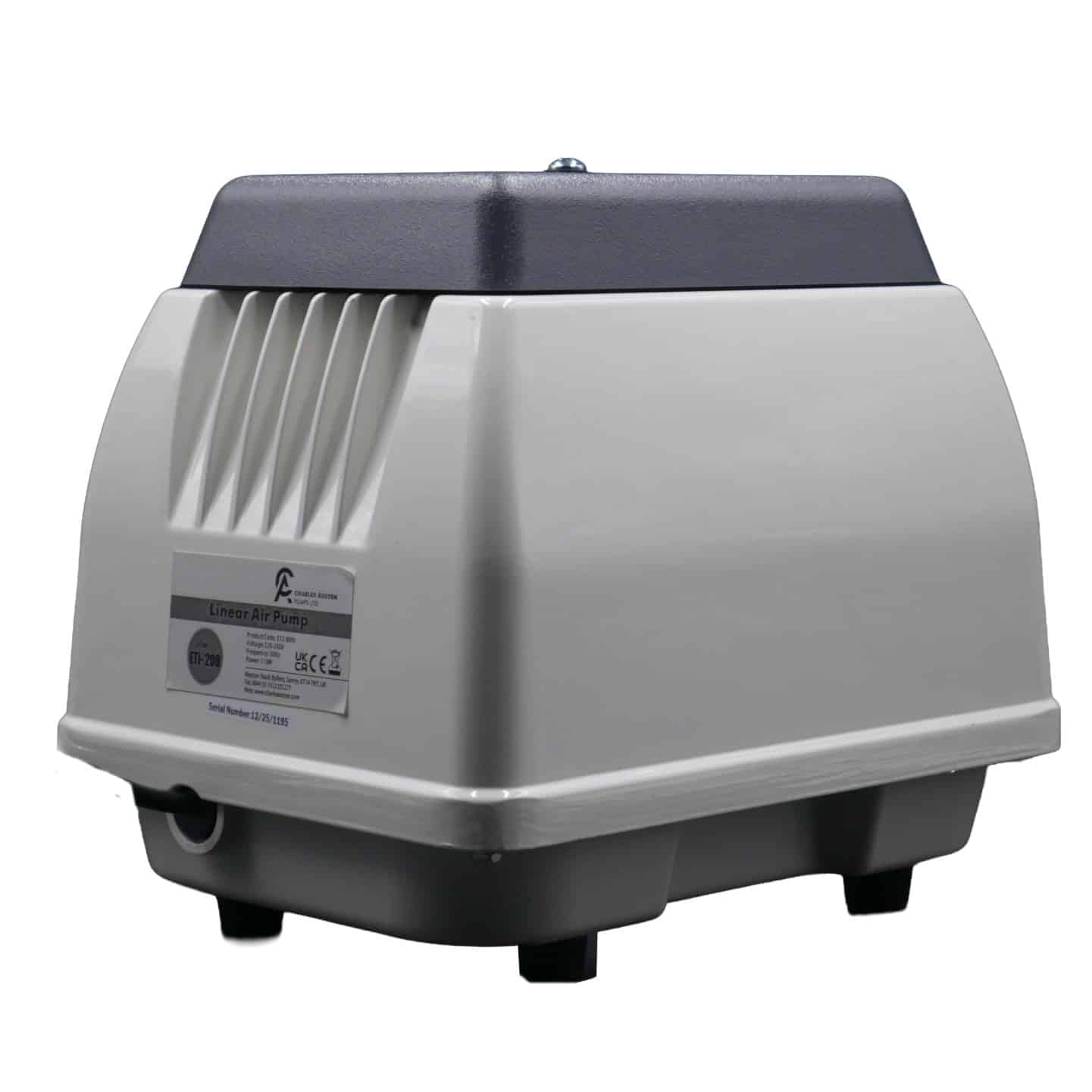
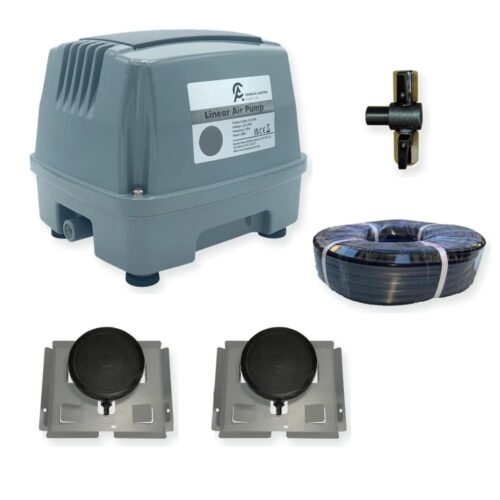
- One Charles Austen pump: ETi200, ET200 or ETD200.
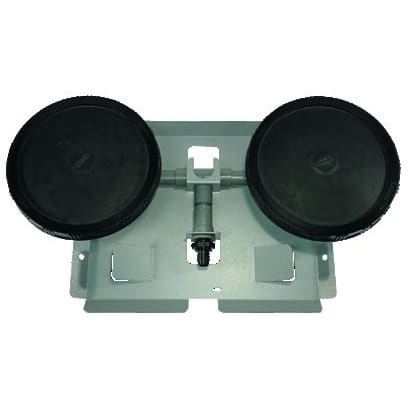
- Two weighted DSW2 diffuser stations, with four discs in total.
- A two-way adjustable manifold, matching pump connection and hose clips.
- One or two uncut 30 m reels of weighted airline, as selected.
Where two DSW2 stations make a difference
A twin-station layout is useful in a long pond, a pond with an island or bend, or a small lake with two distinct bays. Instead of putting all four discs in one spot, you can position a station in each area and adjust the two branches from the bank. The columns of rising bubbles draw water upwards around each station. This helps move water through two areas, but it doesn’t double the pump’s airflow or guarantee that every corner will circulate.
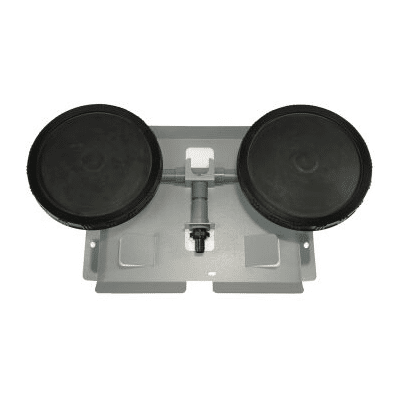
Each weighted DSW2 base carries two nominal 10-inch diffuser discs and is designed to sink without adding ballast. Start by marking two positions on a rough plan. Choose stable areas clear of deep, soft silt and leave enough access to bring a station back up for servicing. If one position is on a ledge and the other is near the bottom, measure their depths separately. Even with equal lengths of airline, the shallower station can take more air.
Choose one or two reels of weighted airline
- 30 m total: one uncut 30 m reel. The two measured routes must fit within that single reel, with a little slack. It does not have to be cut into two equal lengths.
- 60 m total: two uncut 30 m reels, one for each station. Check each route separately against its 30 m reel.
Measure from each manifold outlet along the actual route, across the bank and down to the diffuser. The airline is nominally ½ inch internal bore and is supplied uncut.
Worked example: If the measured routes are 11 m to one station and 16 m to the other, the total is 27 m. One 30 m reel leaves up to 3 m for extra routing and slack. If the routes are 20 m and 27 m, choose two reels so each route has its own 30 m length. A 33 m route does not fit on one of those reels, even if both runs add up to less than 60 m. Ask us about the right airline and connection for that setup before ordering.
Allow for bends, changes in bank level and enough spare line to bring the stations in for inspection. Lay out and check both routes before making the first cut. The weighted line is intended to sit down in the pond; route it so it doesn’t get kinked, pinched under a stone or caught by pond maintenance equipment.
Airflow, water depth and the three pump curves
Compare the three curves at the same pressure on the bottom scale. The top scale shows the equivalent depth in fresh water alone: 0.10 bar is about 1 m, 0.15 bar about 1.5 m and 0.20 bar about 2 m.
These are not recommended maximum depths. The airline, manifold and diffusers add resistance. At the water-only equivalent of a pump’s rated pressure, allowing for those extra losses means it will deliver less than 200 L/min. Measure depth from the water surface to each diffuser.
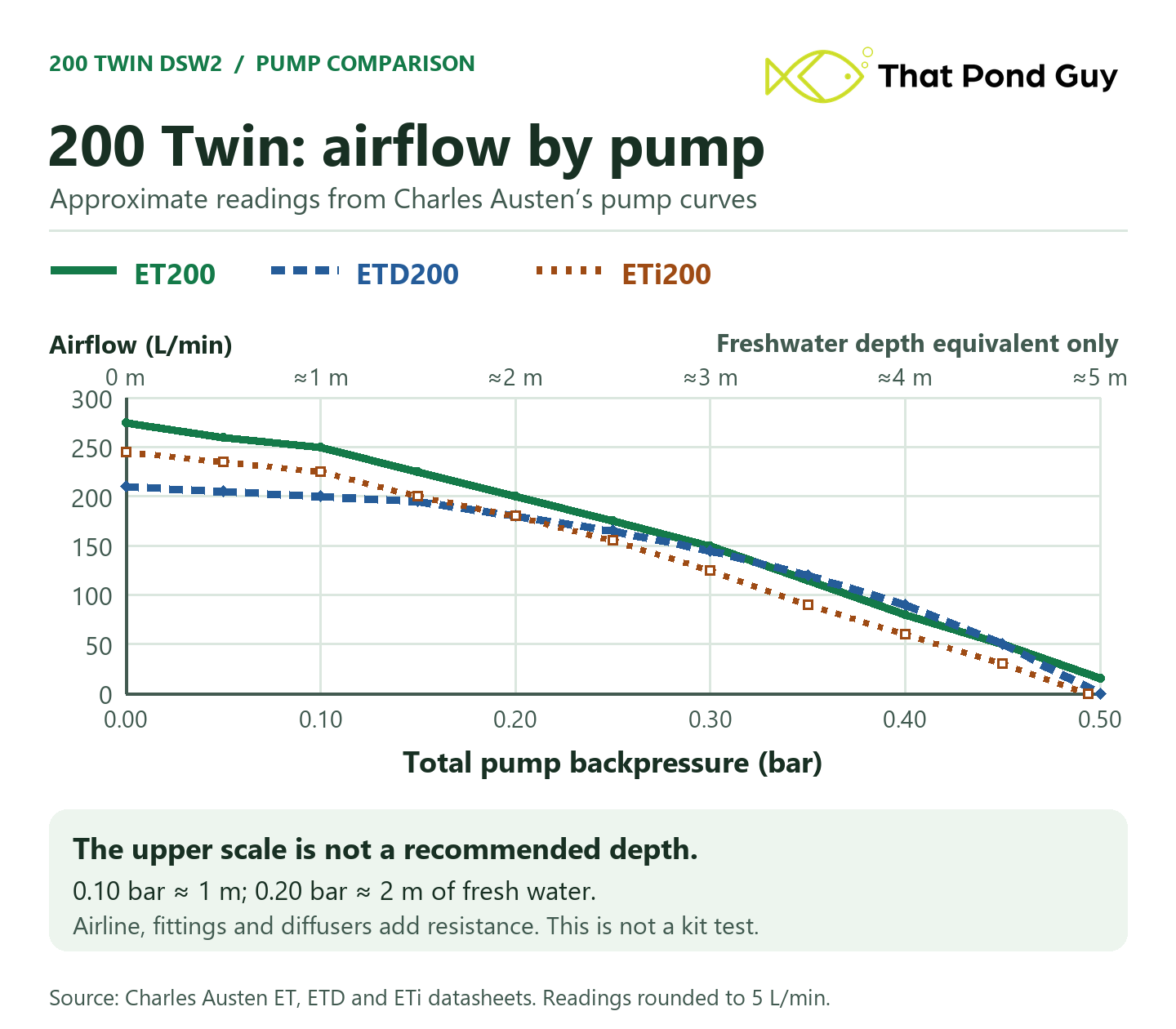
The ET200’s curve starts near 275 L/min in free air, not in a pond. At 0.20 bar total backpressure the ET200 is rated at 200 L/min, compared with about 180 L/min on the ETi200 and ETD200 curves. Charles Austen lists 30–60 L/min per diffuser head. An even split of 200 L/min would give 50 L/min per head, but the installed flow depends on the resistance and balance of both branches.
For example, a diffuser at 1.2 m depth already has roughly 0.12 bar of water pressure above it. That leaves only about 0.03 bar for other losses if you want a pump rated at 0.15 bar to stay at its 200 L/min operating point. That is an illustration, not a sizing verdict. Long runs, bends, small fittings and membrane condition can all change the result. The useful comparison is the airflow each pump can deliver at the pressure your system actually needs.
Set up and balance the two branches
- Site the pump first. Use a firm, dry, ventilated position above the water level and clear of flooding. Leave space for the pump to draw air and for filter access. Follow the pump instructions and use a suitably protected outdoor electrical supply.
- Lay out the connections and stations. Run a separate line from each adjustable manifold outlet and secure the joints with the matched fittings and clips. Check for kinks and lower each station with a suitable lowering line. Don’t lift or suspend a station by its airline.
- Check the two bubble patterns. With the branches open, see how each station behaves. If the shorter or shallower line is taking most of the air, adjust that branch gradually at the manifold and check the other again. Never shut both outlets with the pump running. A similar-looking bubble pattern is useful for a visual check, but is not a measurement of litres per minute.
Introduce bottom aeration gradually in a pond that has been stagnant or has poorly oxygenated deep water. Rapid mixing can change conditions quickly. If fish are already distressed, seek immediate advice rather than assuming a new diffuser will resolve the problem. Aeration supports gas exchange and water movement; it doesn’t replace filtration or guarantee clear water.
Keep both stations working well
- If one station is weaker: check its manifold setting, the hose route and joints, whether the station has moved deeper or settled into silt, and the condition of its diffuser membranes.
- If both stations have become weaker: check the shared pump connection, the pump’s air filter and any restrictions before assuming the pump is too small or needs replacement.
Note how both stations look when the system is new so you have something to compare against later. Isolate the power before inspecting or servicing the pump, use model-specific service parts, and follow the manufacturer’s instructions for the pump and diffusers.
Check your layout before ordering
Ask us to check your kit size. Send both diffuser depths, both measured airline routes and a brief description of your pond and fish stocking. For a different layout, compare our large pond and lake aeration kits.






Reviews
There are no reviews yet.