






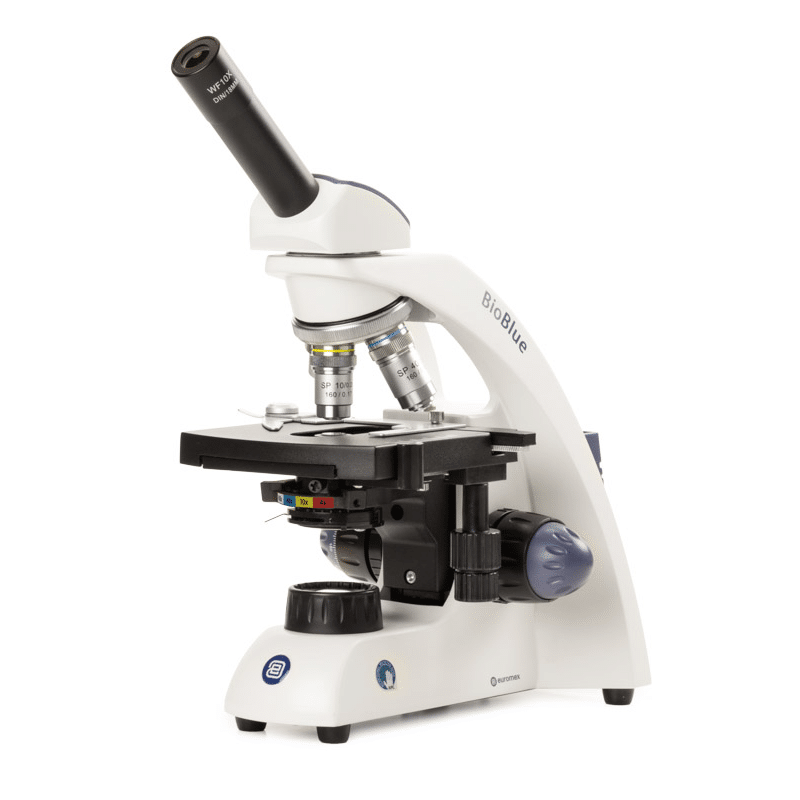
Novex Euromex BioBlue BB.4220 Monocular Microscope
| Brand | |
|---|---|
| Manufacturer model | BB.4220 |
| Magnification | 40x, 100x and 400x |
BioBlue BB.4220 monocular microscope with 40x, 100x and 400x optical magnification, a mechanical X-Y slide stage and adjustable LED illumination. Includes 10x wide-field eyepiece and semi-plan 4x, 10x and S40x objectives.
£425.00 (inc VAT)
Novex Euromex BioBlue BB.4220 Monocular Microscope
40x, 100x and 400x optical magnification with a mechanical slide stage
The BioBlue BB.4220 is a monocular compound microscope with three semi-plan objectives, a wide-field eyepiece and a mechanical X-Y stage. It is the model supplied by SKS under reference MI978. For a koi keeper examining prepared microscope slides, its useful distinction is the combination of controlled slide movement and separate coarse and fine focusing, rather than a headline magnification figure alone.
The supplied 10x eyepiece works with 4x, 10x and spring-loaded 40x objectives to produce total optical magnifications of 40x, 100x and 400x. The S40x designation identifies a spring-loaded objective. This specification identifies the standard monocular BB.4220. It does not include the built-in camera or screen found on separate digital and LCD models in the BioBlue range.
Optical specification at a glance
| Model | BioBlue BB.4220 / SKS MI978 |
|---|---|
| Viewing head | Monocular, inclined 45°, rotatable 360° |
| Eyepiece | WF 10x/18mm with pointer |
| Objectives | Semi-plan 4x, 10x and S40x |
| Total magnification | 40x, 100x and 400x |
| Stage | 130 × 130mm, with 70 × 28mm mechanical travel |
| Condenser | Height-adjustable Abbe N.A. 1.25 with iris diaphragm |
| Illumination | Adjustable 1W LED |
Understanding the three magnifications
The objective number and total viewing magnification are different measurements. Multiplying the 10x eyepiece by the objective power gives the total: the 4x objective produces 40x, the 10x objective produces 100x, and the 40x objective produces 400x. Knowing which objective is selected makes it easier to record observations and compare what you see on different occasions.
A lower setting gives a broader view of the specimen, helping you locate an area of interest before examining it more closely. Increasing magnification reduces the area visible through the eyepiece, so a systematic approach is more useful than beginning at the highest setting. Image quality also depends on preparation, focus and illumination; additional magnification does not automatically make every feature easier to identify.
The reversed nosepiece has four positions, although this model’s standard specification includes three objectives. An unused position does not mean that a fourth objective is supplied. In particular, the BB.4220 specification should not be confused with BioBlue versions supplied with a 100x oil-immersion objective for 1,000x total magnification.
Why the mechanical stage matters
The 130 × 130mm stage supports the slide, while its mechanical controls provide movement over a 70 × 28mm range. Those are different measurements: the first describes the platform and the second describes how far the slide can travel under the objective. The BB.4220 has a mechanical stage, rather than the basic fixed slide clips used on the BB.4200.
Controlled movement helps when working methodically across a prepared sample. You can move through neighbouring areas and return towards an observation without repeatedly pushing the slide by hand. Keep notes of the objective setting and sample identity as you work, particularly when looking at more than one preparation.
Focusing and illumination
Coaxial coarse and fine focusing controls allow larger initial movements followed by smaller adjustments. Euromex specifies 200 fine-focus graduations, 2µm per graduation and 0.4mm travel per rotation. The stand also has a rack stop and coarse-focus friction adjustment. Follow the supplied instructions when setting these controls; they are adjustments for careful use, rather than permission to force the slide towards the objective.
The height-adjustable condenser and iris diaphragm control how light reaches the sample. Together with the adjustable LED, they help you balance brightness and contrast. A bright field alone does not prove that the instrument is set optimally. Take time to learn the controls with a suitable prepared slide before relying on observations from an unfamiliar sample.
Using microscopy alongside pond checks
A microscope provides a way to inspect a prepared specimen. It does not measure the pond’s ammonia, nitrite, pH or other water parameters. Keep those checks separate: the Colombo Pond Test Lab Professional covers water measurements that optical observation cannot replace.
Interpretation is a skill as well as an equipment choice. Record what you observe and seek experienced help when identification is uncertain before choosing a treatment. For two-eyepiece viewing and a wider objective set, compare the BioBlue BB.4260 binocular microscope. That model includes a 100x oil-immersion objective, unlike the standard BB.4220.
Keeping the instrument ready for use
Choose a clean, stable working surface with space for slides and notes. Keep pond water away from the instrument and return it to a dry storage area after use. Use the dust cover and suitable optical cleaning materials, following the manufacturer’s instructions. The Euromex BioBlue support page provides range-specific learning resources to help you become familiar with operation and care.






Reviews
There are no reviews yet.