






Cloverleaf Absolute Potassium Permanganate+
| Brand |
|---|
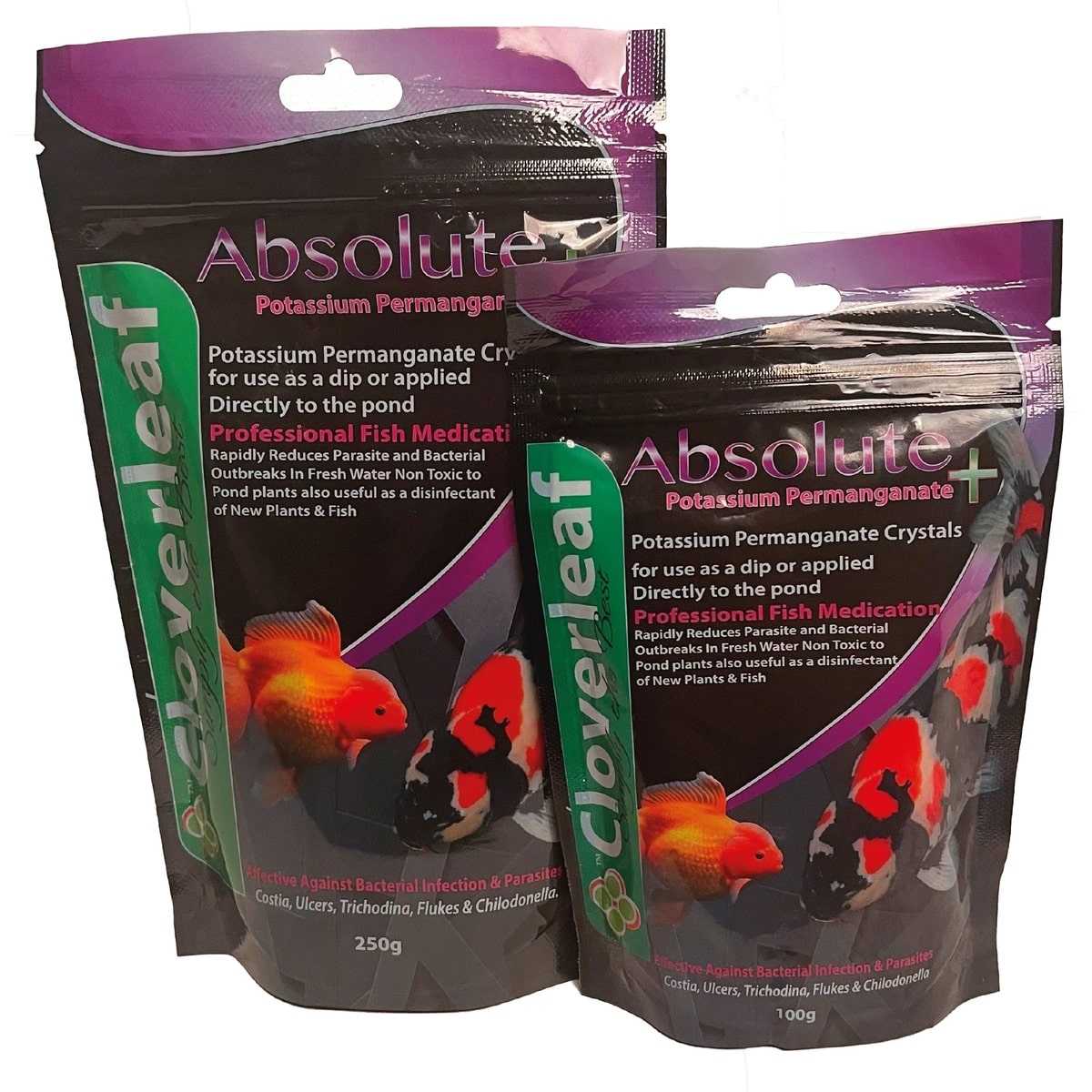
Cloverleaf potassium permanganate crystals in 100g and 250g packs. Published pond dose: 1.5g per 1,000 litres. Read the current label before use; pond treatment and fish dip concentrations are different.
Price range: £12.99 through £20.99 (inc VAT)
Cloverleaf Absolute Potassium Permanganate+
100g and 250g crystalline pond fish treatment
Cloverleaf Absolute Potassium Permanganate+ is an oxidising treatment supplied as crystals for ornamental pond use. Choose a 100g or 250g pouch to suit the amount required for your pond. Cloverleaf publishes separate directions for treating pond water and for a closely supervised fish dip. These applications use very different concentrations and must not be confused. Read the current pack instructions, establish the actual water volume and identify the problem before selecting a treatment.
The manufacturer’s range includes the 100g pack under code PP100/6 and the 250g pack under PP250/6. Both contain the same named treatment; the larger pack changes the quantity supplied, rather than the standard pond dosing rate. The photograph shows the two pack sizes for comparison. Your selected option supplies one pouch in the size ordered.
What is potassium permanganate used for?
Cloverleaf describes Absolute Potassium Permanganate+ as a treatment for a range of external parasites, including Costia, Chilodonella, Trichodina and white spot, alongside skin and gill flukes. Its published product information also names anchor worm, fish lice and leeches. Select medication for an identified problem rather than assuming that rubbing, lethargy or changes in breathing establish a particular diagnosis.
The product acts as a powerful oxidising agent. Cloverleaf explains that it oxidises dissolved organic material and can improve water clarity. This does not make it a routine substitute for filtration, maintenance or checking water quality. A treatment decision should take account of the fish, the pond’s condition and the current manufacturer’s instructions, rather than water appearance alone.
Standard pond dosing rate
Cloverleaf’s published pond dose is 1.5g per 1,000 litres, approximately 220 imperial gallons. Measure the amount for the actual volume being treated. The examples below are calculated directly from that rate and describe one application; they are not a schedule for repeated dosing.
| Pond volume | Quantity at the published pond rate |
|---|---|
| 1,000 litres | 1.5g |
| 2,000 litres | 3g |
| 5,000 litres | 7.5g |
| 10,000 litres | 15g |
| 20,000 litres | 30g |
At this rate, 100g is sufficient for approximately 66,667 litres and 250g for approximately 166,667 litres across measured applications. These are arithmetic coverage figures, rounded to the nearest litre. They do not mean that the complete pouch should be added to a smaller pond, or that a second application is automatically appropriate. Use the dose required for your installation and follow the current label.
Preparing the pond treatment
The manufacturer’s directions say to shake the bag to loosen compacted material before measuring. Add the calculated quantity to a watering can containing pond water, then aerate that solution with an air stone for 20 minutes before adding it to the pond. Have the container, measuring equipment and air supply ready before beginning. Keep the preparation process separate from household food preparation.
Check the units carefully when measuring. Grams describe the mass of treatment, while litres describe the water volume. Cloverleaf states that a spoon is included and gives a 1ml spoon equivalent of 1.5g for this product. Do not transfer that conversion to a different powder or use an unrelated kitchen spoon as though its capacity were identical.
Pond treatment and a fish dip are different procedures
Cloverleaf also publishes a separate dip procedure. A dip uses a substantially different concentration and a short exposure period, so it must never be substituted for the whole-pond instructions. Consult the current packaging and seek experienced fish-health guidance before undertaking a dip, particularly if the fish is already distressed. Prepare the correct equipment and understand the complete procedure before moving the fish.
For routine purchasing, choose the pack against your measured requirements and the treatment method you intend to follow. If you are uncertain about diagnosis, dosing or the suitability of the procedure, resolve that uncertainty before applying medication. Increasing the dose or improvising a treatment sequence is not an appropriate way to compensate for an uncertain diagnosis.
Water testing and handling
Our NT Labs Pond Lab Multi-Test Kit checks ammonia, nitrite, nitrate, pH, KH and GH. Water readings help establish the pond’s condition when investigating fish-health concerns, although a water test does not identify parasites. Record the readings and any recent treatments so that you have useful information if further advice is needed.
Cloverleaf advises wearing a face mask and gloves when handling aquatic medications and water treatments. Keep the pouch in its original labelled packaging and follow its storage, handling and disposal directions. Retain measuring equipment with the product, and keep a treatment record showing the date, water volume and quantity used. This helps everyone involved in caring for the pond see what has already been applied.
Choosing between the two packs
The 100g pouch is the smaller option, while 250g provides more material for larger measured requirements. Select the size in the menu before adding it to your basket. For another targeted medication, compare Cloverleaf Absolute Fluke+ 50g for confirmed skin or gill flukes. Each treatment has its own directions and restrictions; a comparison link is not a recommendation to combine products.





Reviews
There are no reviews yet.