





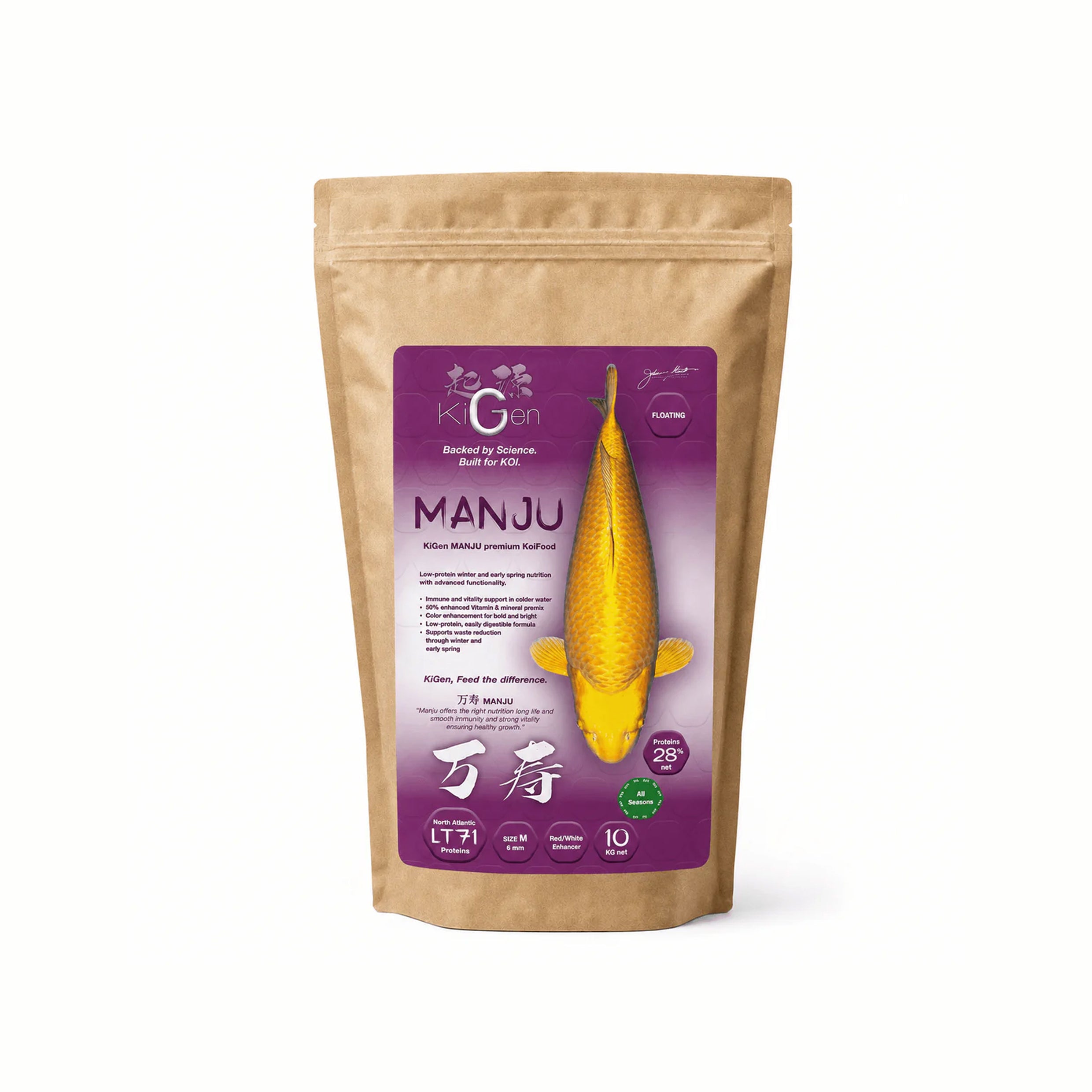
KiGen Manju 6mm Floating Koi Food
| Brand | |
|---|---|
| Pellet Size | 6mm |
| Food Type | Staple / Complete |
| Feeding Season | All Season / Year Round |
| Pellet Behaviour | Floating |
| Weight | 5kg, 10kg |
A 28% protein, 6 mm floating maintenance food with an enriched vitamin and mineral premix. Designed to support condition and colour when a rich growth diet is unnecessary. Available in 5 kg and 10 kg bags.
Price range: £75.00 through £130.00 (inc VAT)
Out of stock
KiGen Manju 6mm Floating Koi Food
Lower-protein maintenance nutrition for year-round condition and cooler water
KiGen Manju is a 6 mm floating koi food designed around maintaining condition rather than pushing growth. Its 28% protein content is lower than the KiGen growth-led recipes, and an enriched vitamin and mineral premix complements the food when koi are eating smaller amounts. It is a useful choice for cooler active periods, winter and early spring, as well as year-round maintenance where that suits the fish.
The practical aim is steady care: supporting body condition, vitality and the appearance of the koi while matching nutrition to a slower feeding routine. Manju is particularly relevant when the pond has moved out of its main growth period but the fish are still active and taking food.
Why choose Manju for maintenance?
- 28% protein in the finished food.
- 6 mm floating pellets make appetite and uneaten food easy to observe.
- An enriched vitamin and mineral premix for periods of reduced food intake.
- Formulated with colour retention, condition and everyday vitality in mind.
- A dedicated maintenance option within the KiGen range.
- 5 kg and 10 kg bags on this product page.
Lower protein with continued nutritional support
Growth and maintenance place different demands on a fish. When koi are less active, simply continuing a rich summer ration can provide more food than they can use. Manju pairs a lower protein level with attention to micronutrients, so the emphasis stays on maintaining the fish rather than increasing the amount fed.
Protein still matters in a maintenance diet: body tissues need ongoing repair and replacement. Manju’s label identifies fishmeal and shrimp meal within its maintenance formula. The 28% figure describes the finished feed and should be compared with the declared protein content of other foods, not with a fishmeal ingredient grade.
Sorghum and the vitamin and mineral premix
Sorghum is the main carbohydrate ingredient. It provides starch for energy and contributes to the structure of the extruded pellet. The premix supplies vitamins and minerals alongside the larger ingredients, with increased emphasis on micronutrient support when fewer feeding opportunities mean less food is eaten overall.
Manju is also formulated with the preservation of beni, the red areas, and shiroji, the white skin, in mind. This is useful during the shorter days and reduced light associated with winter covers. Food is one part of maintaining appearance and condition, alongside the pond environment and the individual fish’s natural characteristics.
Manju product and feeding details
| Detail | Manju |
|---|---|
| Crude protein | 28% |
| Crude fat | 8.0% |
| Crude fibre | 1.9% |
| Crude ash | 12.4% |
| Pellet | 6 mm floating |
| Bag sizes on this page | 5 kg and 10 kg |
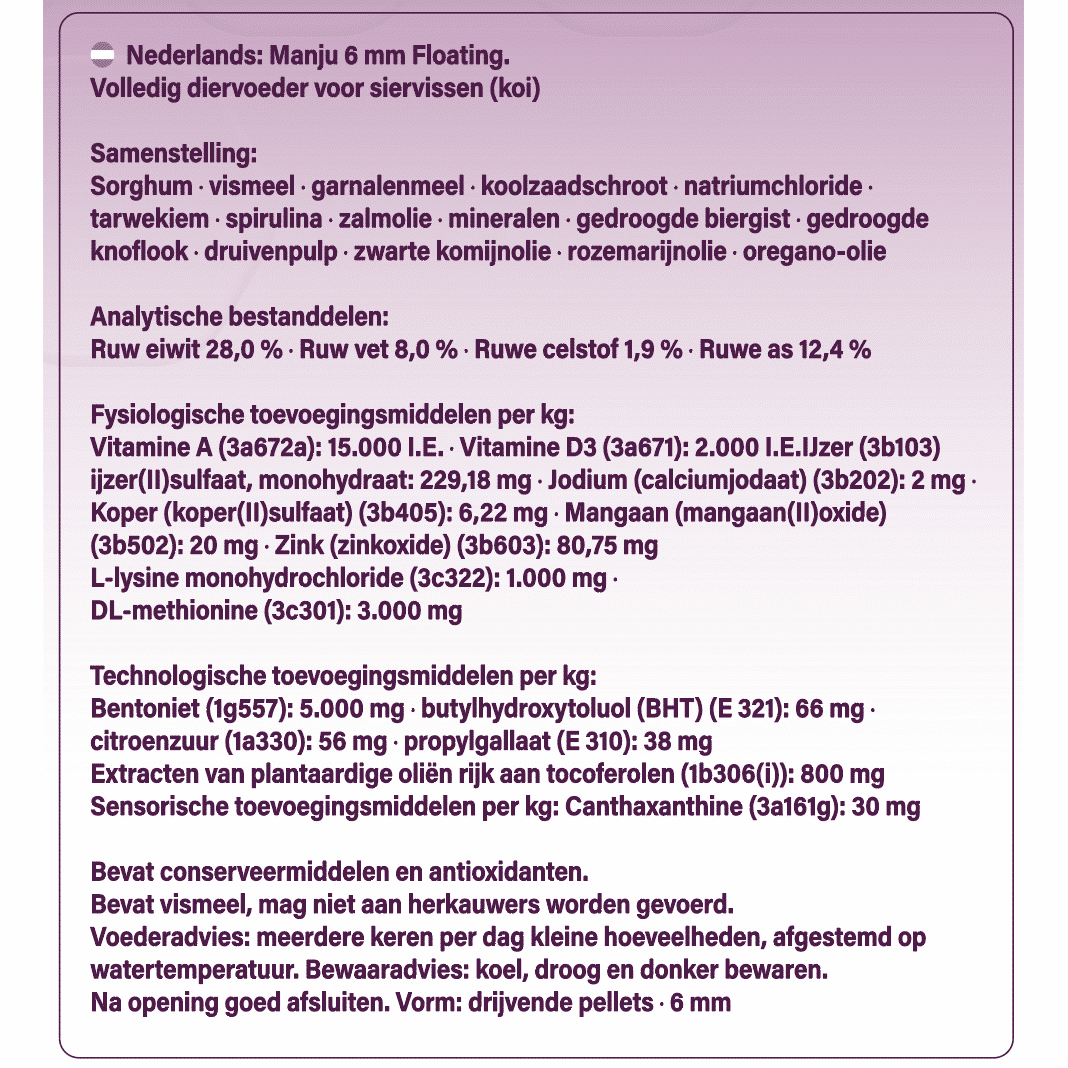
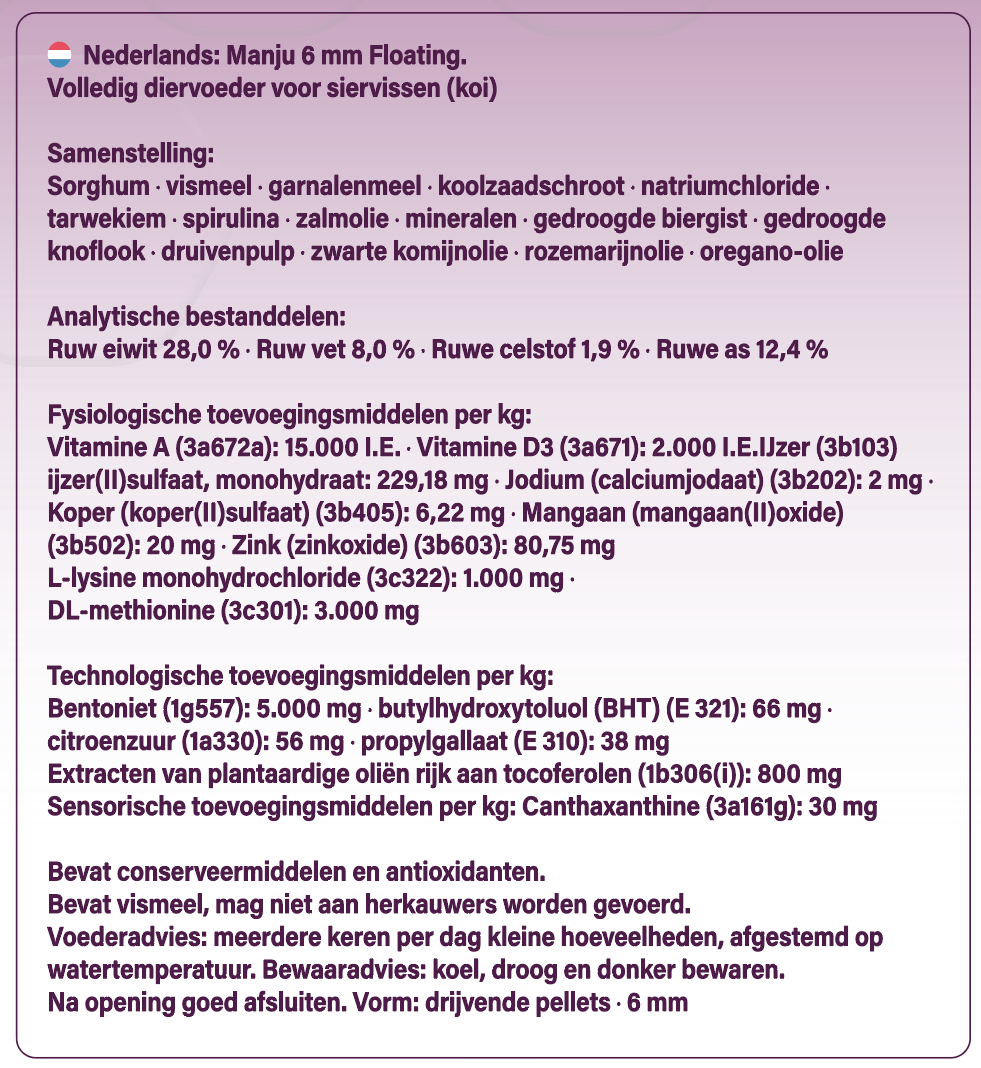
These figures and the composition below follow the label artwork published in KiGen’s own product galleries, checked on 7 September 2026. The labels name sorghum, whereas the January brochure uses millet. We use the label wording here and omit ingredient inclusion percentages that it does not declare. Check the bag supplied for the declaration and instructions applicable to that pack.
Declared composition
Manju: Sorghum; fishmeal; shrimp meal; rapeseed meal; sodium chloride; wheatgerm; spirulina; salmon oil; minerals; dried brewer’s yeast; dried garlic; grape pulp; black cumin oil; rosemary oil; oregano oil.
Manju’s label identifies fishmeal without a grade. It also lists wheatgerm, so it should not be described as wheat-free. We do not specify FM66 or LT71 for Manju while KiGen’s brochure and range page disagree.
Vitamins, minerals and other declared additives
| Declared additive | Manju |
|---|---|
| Vitamin A (3a672a) | 15,000 IU/kg |
| Vitamin D3 (3a671) | 2,000 IU/kg |
| Iron(II) sulphate, monohydrate (3b103) | 229.18 mg/kg |
| Iodine, calcium iodate (3b202) | 2 mg/kg |
| Copper(II) sulphate (3b405) | 6.22 mg/kg |
| Manganese(II) oxide (3b502) | 20 mg/kg |
| Zinc oxide (3b603) | 80.75 mg/kg |
| L-lysine monohydrochloride (3c322) | 1,000 mg/kg |
| DL-methionine (3c301) | 3,000 mg/kg |
These are the label’s additive declarations, not a separate analysis of the total naturally occurring nutrients in the food.
Vitamin E and vitamin C amounts are not stated in the published Manju label; that omission should not be read as a zero content.
Manju — technological additives per kg: bentonite (1g557), 5,000 mg; butylhydroxytoluene/BHT (E321), 66 mg; citric acid (1a330), 56 mg; propyl gallate (E310), 38 mg; extracts of vegetable oils rich in tocopherols (1b306(i)), 800 mg. Sensory additive: canthaxanthin (3a161g), 30 mg/kg.
Contains preservatives and antioxidants. Contains fishmeal and must not be fed to ruminants. This is complete feed for ornamental fish (koi).
Read the manufacturer’s label: Manju label. Label images are also available in the product gallery.
Using Manju in winter and early spring
Year-round suitability does not mean feeding at every temperature. Measure the water and watch the fish. Koi under winter covers may be difficult to observe, so take time to establish whether they are actually feeding rather than putting food in as a habit.
The January 2026 guide advises no feeding below 8°C. Between 8°C and 18°C it gives very small daily rations, increasing gradually as conditions allow. In early spring, appetite can return before the filtration system is ready for a large increase in food, making a measured approach especially useful.
Manju daily feeding guide
The figures below are percentages of the combined body weight of the fish, for the entire day. Split the allowance into small feeds and adjust downwards whenever appetite, oxygen availability or water quality calls for it.
| Water temperature | Total food per day (% of fish body weight) |
|---|---|
| Below 8°C | Do not feed |
| 8–10°C | 0.05–0.10% |
| 10–12°C | 0.10–0.15% |
| 12–14°C | 0.15–0.20% |
| 14–16°C | 0.20–0.25% |
| 16–18°C | 0.25–0.30% |
| 18–20°C | 0.30–0.45% |
| 20–22°C | 0.45–0.60% |
| 22–24°C | 0.60–0.75% |
| 24–26°C | 0.75–0.90% |
| 26–28°C | 0.60–0.80% |
| Above 28°C | Less than 0.60% |
For example, 0.1% of 10 kg of koi is just 10 g over the whole day. A rate of 0.25% for the same collection is 25 g per day. Weighing a typical portion makes these low feeding levels much easier to judge than relying on a handful.
KiGen adds that the practical upper feeding limit for Manju is usually below 0.8% of body weight under most conditions, even though the warmest part of its table extends higher. The upper table values should therefore not become automatic targets. Offer only what is cleared comfortably within a few minutes and remove uneaten pellets.
Reduce feeding promptly if ammonia or nitrite rises, if the koi lose interest or if conditions change. Above 28°C the guide calls for a smaller ration. Continue to prioritise aeration and the current pack instructions at both ends of the temperature range.
Choosing a bag and planning the changeover
Choose the 5 kg bag where consumption is moderate, or the 10 kg option for a larger collection that will use it while fresh. Cooler-water feeding uses surprisingly little food, so judge pack size against the reduced daily ration rather than the pond’s summer consumption. Both options are 6 mm floating pellets; the selector above shows current availability.
Introduce Manju progressively as you adjust the feeding routine, rather than making a large change to both the food and the total quantity at once. Reseal the bag, keep it in a cool, dry place away from sunlight and use a dry scoop. Follow the storage and best-before information on the pack.
Choosing between the KiGen foods
Use our KiGen koi food comparison guide to compare all six foods by pellet size, protein level, feeding purpose and floating or sinking format.
- KiGen Tosai — 3 mm floating food for the growth and development of young koi.
- KiGen Tosai RG-92 — the 3 mm young-koi option with added RG-92 algae extract.
- KiGen Miori — an accessible 6 mm floating food for balanced everyday feeding.
- KiGen Kinsai — premium 6 mm floating or sinking food for growth, body shape and colour.
- KiGen RG-92 Special — the 6 mm premium option with RG-92, in floating and sinking pellets.
Explore our complete koi food range to compare other diets and pellet sizes.



Reviews
There are no reviews yet.