KiGen recipes, pellet sizes and feeding depth
Compare the KiGen range by the exact recipe and pellet format: Tosai and Tosai RG-92 are 3mm floating options, while Miori, Manju, Kinsai and RG-92 Special are distinct 6mm foods. Where a listing offers floating and sinking choices, select the format as well as the pack weight.
Compare each individual recipe rather than reading one formula’s declaration across the whole range. KiGen is currently out of stock. Any displayed comparison price is for reference, not a promise of availability.
Compare recipes and pellet options · Compare current pack value
Price range: £24.50 through £165.00 (inc VAT)
Out of stock
Price range: £75.00 through £130.00 (inc VAT)
Out of stock
Price range: £16.00 through £95.00 (inc VAT)
Out of stock
Price range: £32.50 through £115.00 (inc VAT)
Out of stock
Price range: £27.50 through £95.00 (inc VAT)
Out of stock


Explore related choices: Growth Koi Food · Colour Enhancing Koi Food · Sinking Koi Food.
Which KiGen food should you choose?
| Food | Shop pellet / format options | Crude protein | Crude fat | Practical difference and source |
|---|---|---|---|---|
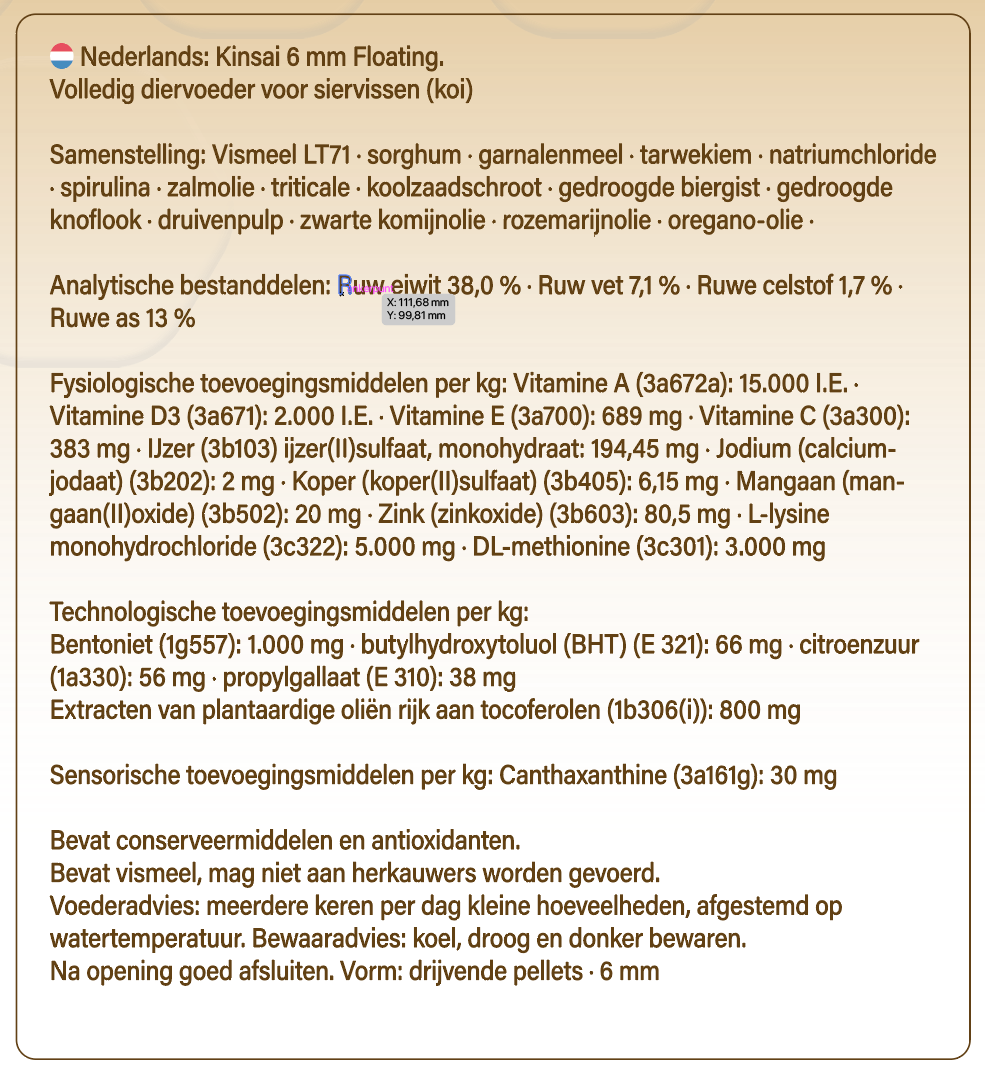
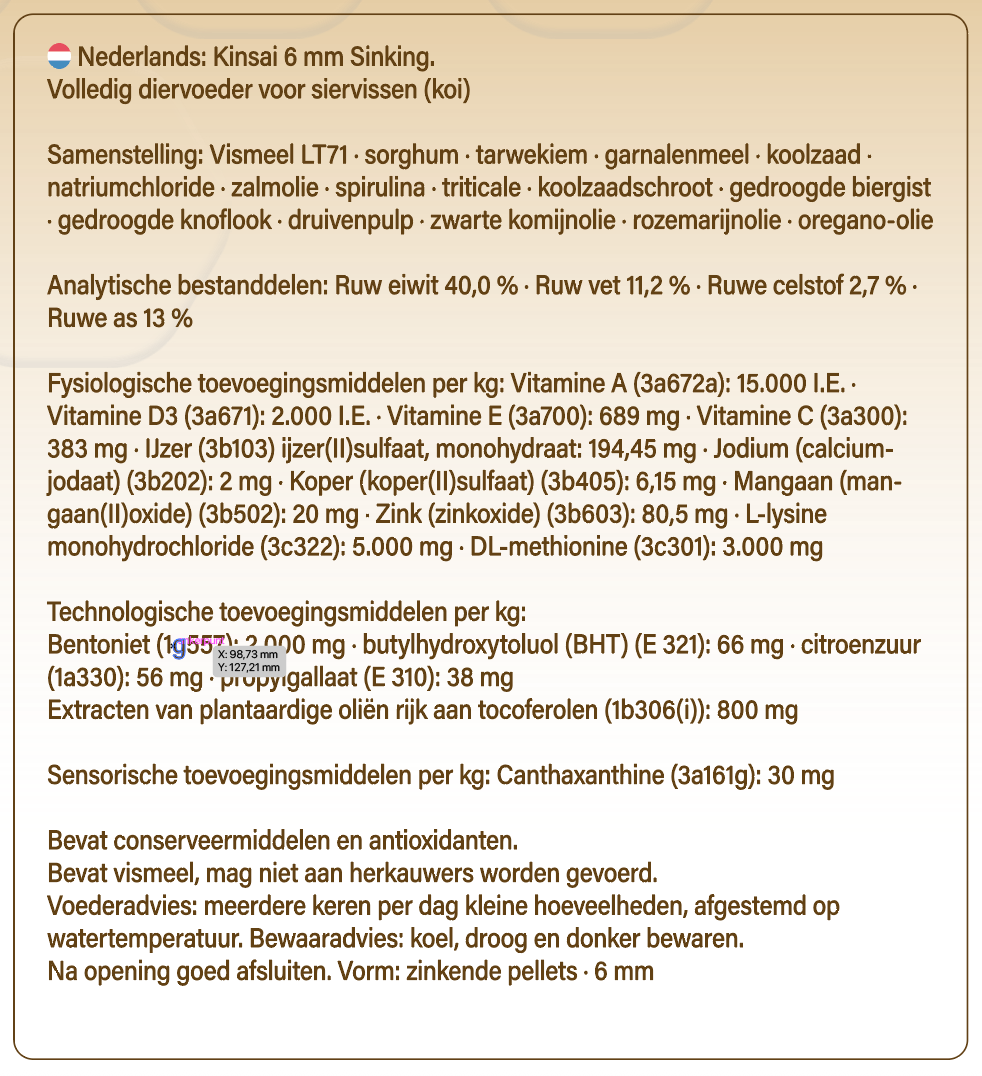
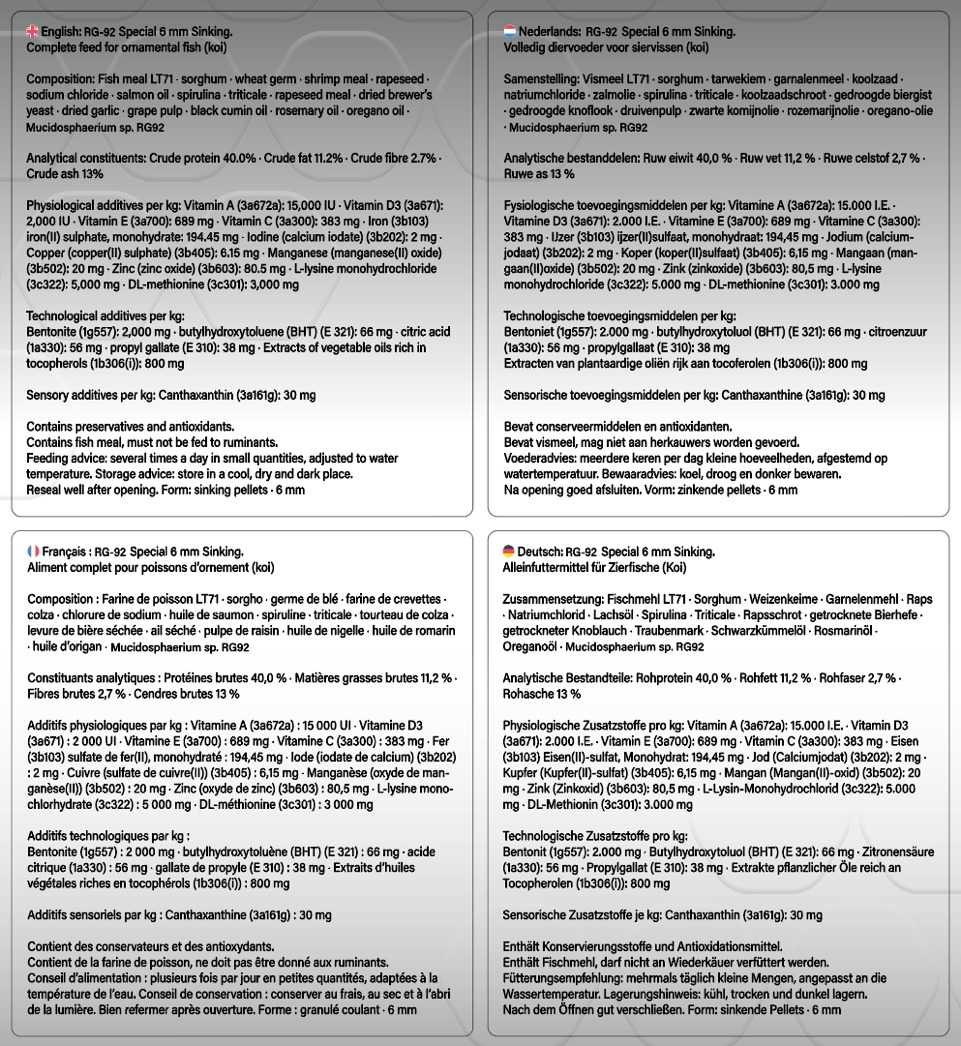
| KiGen Kinsai 6mm Koi Food | 6mm | 38% floating / 40% sinking | 7.1% floating / 11.2% sinking | The floating and sinking 6mm recipes differ. Figures are read separately from their own manufacturer labels. Manufacturer label information · Manufacturer label information · Checked 11 October 2026 |
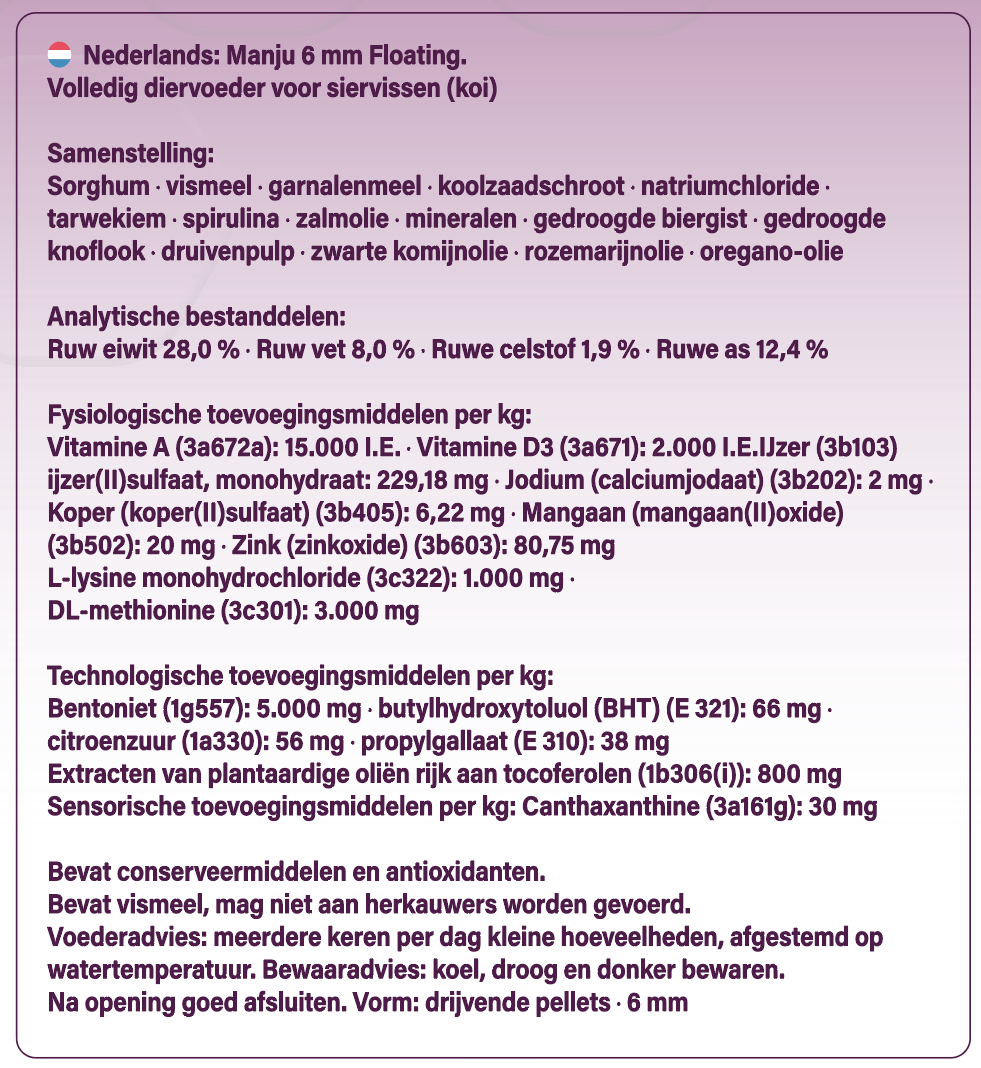
| KiGen Manju 6mm Floating Koi Food | 6mm | 28% | 8.0% | 6mm floating maintenance recipe. Follow its own feeding directions rather than treating it as interchangeable with wheatgerm foods. Manufacturer label information · Checked 11 October 2026 |
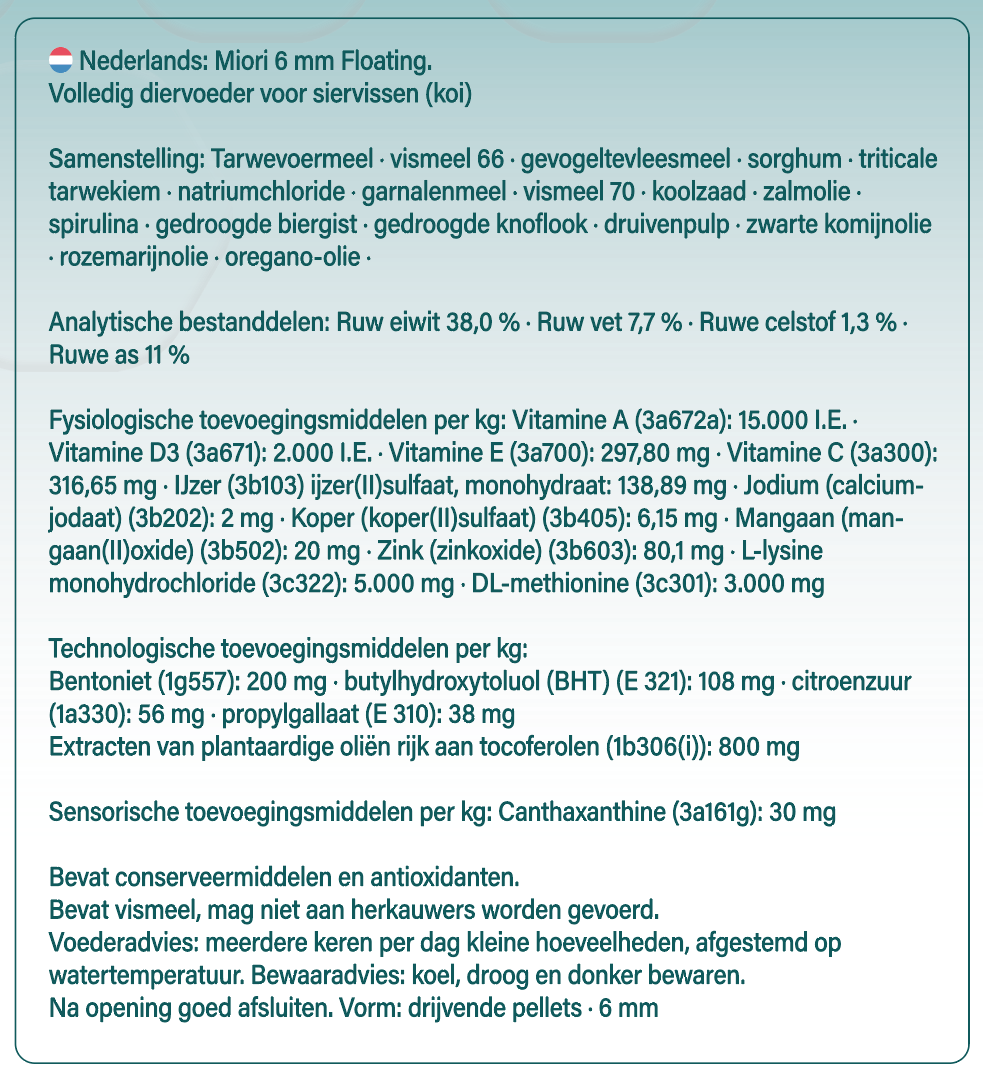
| KiGen Miori 6mm Floating Koi Food | 6mm | 38% | 7.7% | 6mm floating recipe containing fishmeal and poultry meat meal. Figures are the manufacturer’s label declarations. Manufacturer label information · Checked 11 October 2026 |
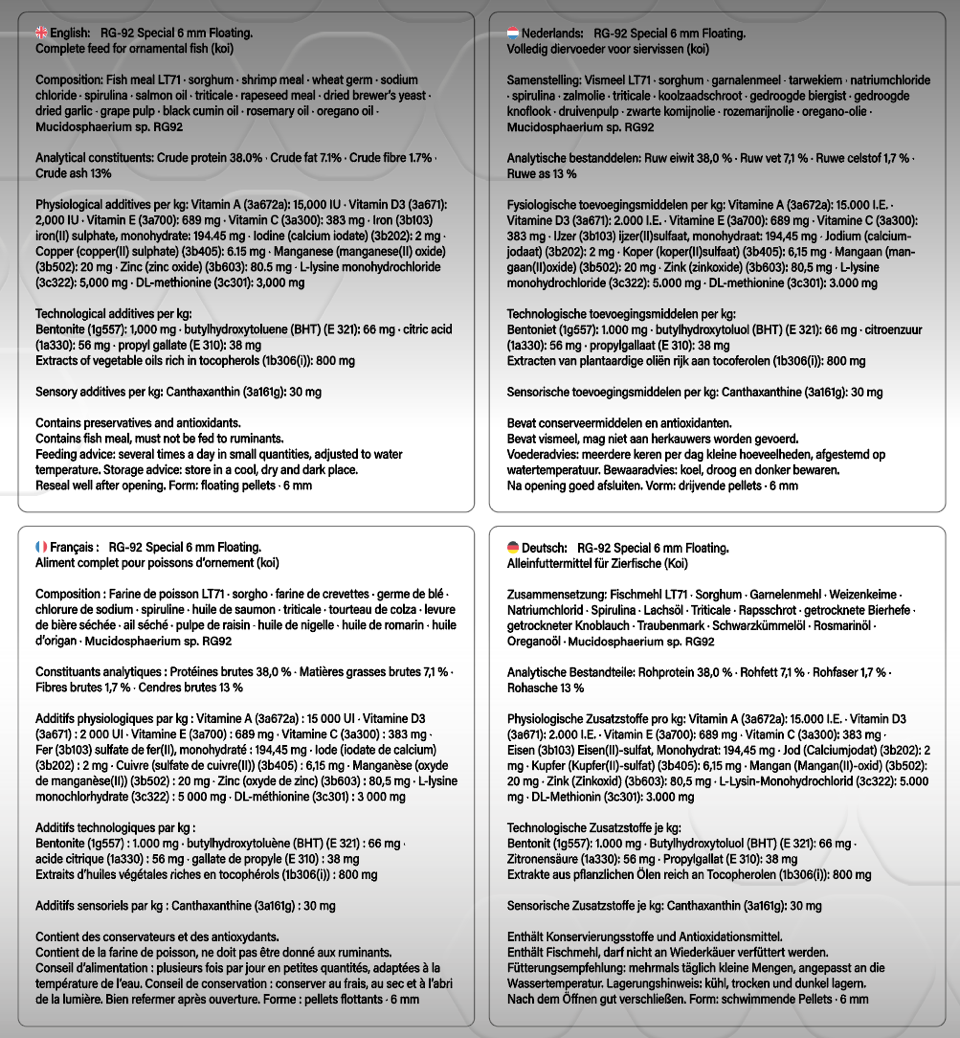
| KiGen RG-92 Special 6mm Koi Food | 6mm | 38% floating / 40% sinking | 7.1% floating / 11.2% sinking | RG-92 Special has separate floating and sinking 6mm recipes. These figures are from its own labels, not assumed from Kinsai. Manufacturer label information · Manufacturer label information · Checked 11 October 2026 |
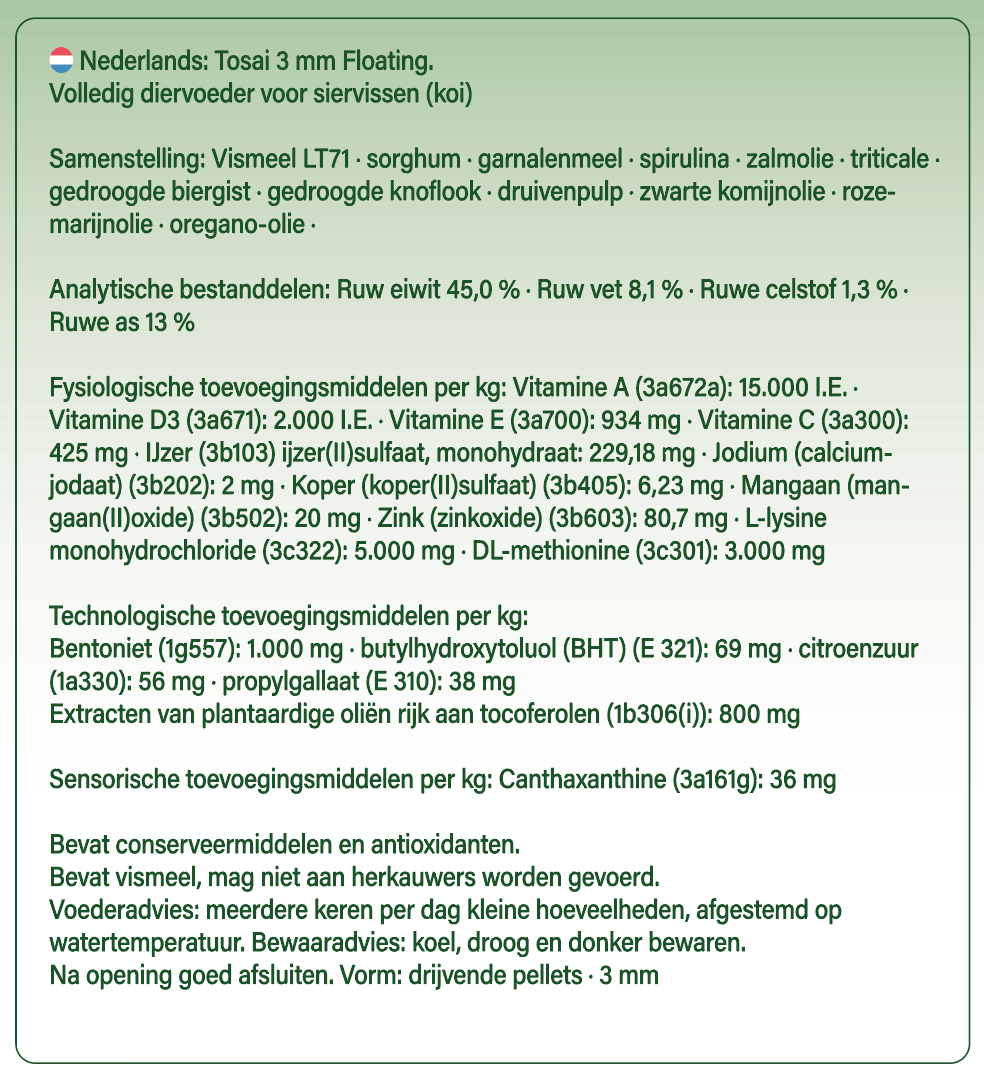
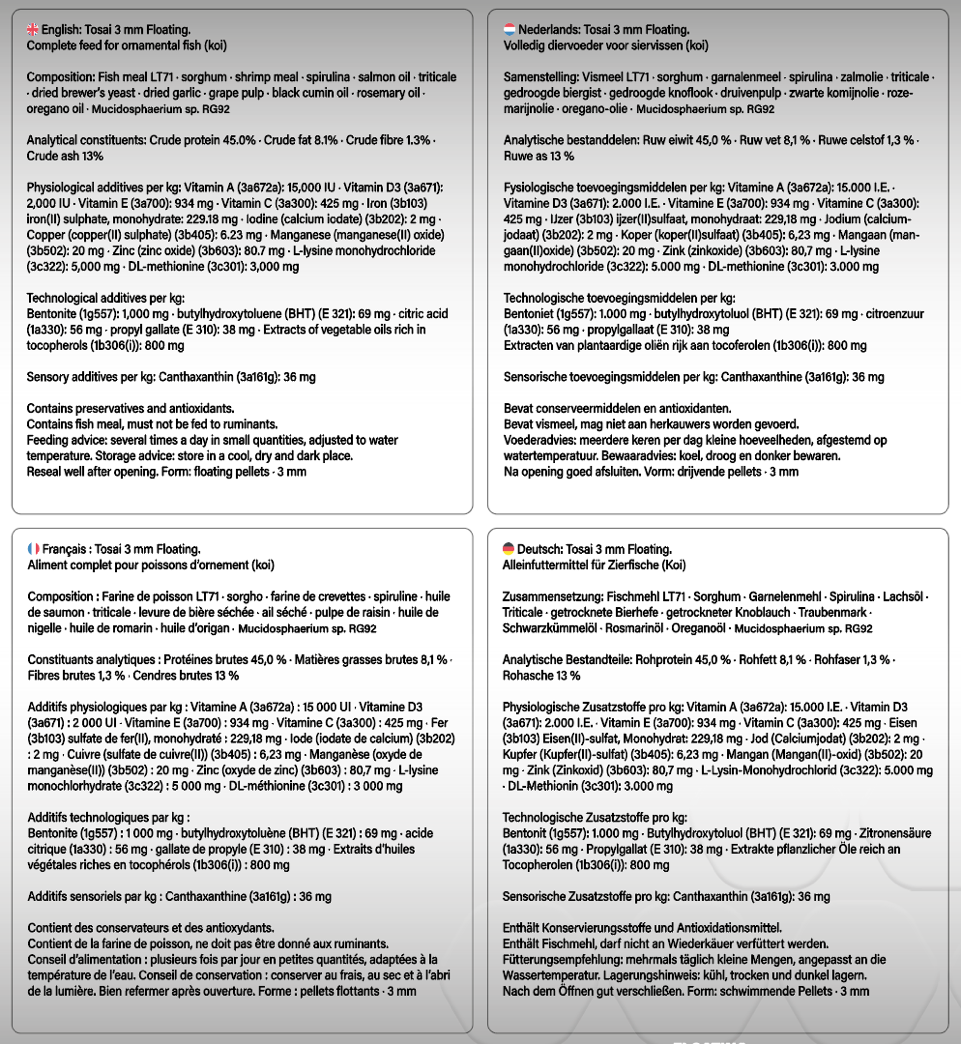
| KiGen Tosai 3mm Floating Koi Food | 3mm | 45% | 8.1% | 3mm floating food. Figures are the analytical constituents on the manufacturer’s Tosai label. Manufacturer label information · Checked 11 October 2026 |
| KiGen Tosai RG-92 3mm Floating Koi Food | 3mm | 45% | 8.1% | 3mm floating recipe with added RG-92. Its own label declares these figures; they are not borrowed from standard Tosai. Manufacturer label information · Checked 11 October 2026 |
Published declarations are linked above. Guaranteed minimums, typical figures and exact declarations are labelled as such where stated; they are not our laboratory measurements. A dash is not zero: we have not used an unverified number or calculated a blend’s analysis. Pellet options refer to the shop listings; check the selected format and supplied pack. Recipes and pack labels can change.
Protein figures describe the finished food. Floating and sinking Kinsai and RG-92 Special have different recipes, so choose the format as well as the bag weight. Listed sizes describe the range; check the product’s current availability before ordering.
For young koi: Tosai or Tosai RG-92
KiGen Tosai combines a 3 mm floating pellet with 45% protein for young-koi development. It is designed for young fish from approximately 12 cm, although comfortable pellet handling matters more than length alone. The floating format helps you watch appetite and see whether smaller fish are getting their share.
KiGen Tosai RG-92 is the small-pellet option with added RG-92 algae extract. It also contains 45% protein and comes in 1.2 kg and 5 kg bags. Choose between these two on the basis of the recipe you want; adding RG-92 does not remove the need for careful rationing, good oxygen levels and established filtration.
For regular feeding: Miori
KiGen Miori is a practical starting point for active koi that comfortably take a 6 mm pellet. Its 38% protein recipe combines fishmeal and poultry meal, with wheat feed meal, sorghum, triticale and wheatgerm among its declared cereal ingredients. It is intended for balanced growth, colour and everyday condition through the normal feeding season.
Miori is floating only. That suits keepers who want to observe feeding at the surface and remove any uneaten pellets. Its choice of 1.2 kg, 5 kg and 10 kg bags lets you match the quantity to a small collection or a pond with a higher regular consumption.
For maintenance and cooler active periods: Manju
KiGen Manju has 28% protein and an enriched micronutrient premix. It puts the emphasis on maintaining condition when a growth-focused ration is less appropriate, including cooler periods when koi are still actively feeding. The 6 mm floating pellet is available in 5 kg and 10 kg bags.
Manju is described as a year-round maintenance food, rather than simply a wheatgerm winter food. Year-round suitability does not mean feeding regardless of water temperature: its published guide says not to feed below 8°C. Appetite, temperature and water quality still determine whether and how much to offer.
For a premium 6 mm diet: Kinsai or RG-92 Special
KiGen Kinsai uses LT71 fishmeal and shrimp meal in a recipe developed for growth, body shape and colour. You can choose floating or sinking pellets, with 38% protein in the floating food and 40% in the sinking food. Both formats come in 1.2 kg, 5 kg and 10 kg bags.
KiGen RG-92 Special adds RG-92 algae extract to the premium Kinsai-based approach. It has the same choice of pellet formats and bag weights, with the same 38% floating and 40% sinking protein levels. You may see the name Marujyu Special in the January 2026 KiGen brochure; our product is listed under the current RG-92 Special name.
What goes into KiGen koi food?
The range brings together protein ingredients, energy sources and vitamin and mineral premixes, with different balances for different feeding needs. Several recipes use low-temperature fishmeal, identified as LT71. That is an ingredient grade, not a claim that the finished pellet contains 71% protein. Miori uses a different fishmeal-and-poultry blend, while Manju has a deliberately lower finished-feed protein level.
The published bag labels list sorghum alongside other recipe-specific cereal ingredients. These provide energy and help form the pellets. Spirulina and declared canthaxanthin are among the ingredients and additives used in the range’s colour-focused formulations. The individual product pages show the manufacturer’s label composition, protein, fat, fibre, ash and additive declarations, with separate figures for floating and sinking recipes. These label details take priority over the brochure’s use of millet; check the pack supplied for its applicable declaration and feeding instructions.
RG-92 is an extract derived from microalgae associated with Japanese hot springs. It is included during manufacture in Tosai RG-92 and RG-92 Special. It is not a live probiotic and should not be treated as a medicine or a replacement for sound pond management.
Floating or sinking pellets?
Floating pellets make feeding easy to observe. You can see which fish come up, whether they take the pellet cleanly and when interest starts to fall. That is useful for adjusting portions and noticing changes in individual behaviour. Tosai, Tosai RG-92, Miori and Manju are floating foods; Kinsai and RG-92 Special offer either format.
Sinking pellets give you another way to feed fish that prefer to take food below the surface. Introduce them in small amounts where you can follow their path and see the koi eating. Food that drops out of sight can still be left uneaten, so a sinking pellet is not a reason to increase the ration. Choose the format that lets you feed your collection confidently and monitor waste.
Feeding KiGen through the seasons
Base feeding on measured water temperature and the fish’s appetite, rather than the month alone. A heated pond and an unheated garden pond can need quite different routines on the same day. The individual KiGen product pages include the relevant temperature guidance where available; do not apply one formula’s ration table to every other food.
Calculate a daily allowance for the fish’s estimated combined body weight, then divide it into manageable feeds. A percentage in a feeding table is the total for the day, not the amount for each feeding. For example, 0.3% of an estimated 10 kg of koi is 30 g of food for the whole day. That calculation explains the units; it does not prescribe the correct ration for your pond.
Start conservatively, watch the fish eating and reduce the amount if pellets remain. Increase feeding only when appetite, oxygen supply and established filtration can support it. High water temperatures do not justify unlimited feeding: the published tables also reduce the ration in very warm water. Monitor ammonia and nitrite as feeding changes, especially after a cold period or work on the filter.
Changing food and choosing a bag size
Introduce a new food progressively so you can observe acceptance and adjust quantities. In a mixed-size collection, check that the smallest fish can handle the pellet and that larger koi are not taking every portion. A 3 mm food can be the more manageable choice for young fish even when the larger koi readily take 6 mm pellets.
Choose a bag you can use within the pack’s storage and best-before guidance. Larger bags suit higher consumption; a smaller bag can make more sense when trying a recipe or feeding a modest collection. Store food cool and dry, keep the bag closed and use a clean, dry scoop.
For alternatives across other brands and feeding needs, browse our wider koi food range.
KiGen koi food questions and answers
Which KiGen food is best for my koi?
Start with pellet size and feeding purpose. Tosai and Tosai RG-92 are the 3 mm young-koi options. Miori is a balanced 6 mm everyday food; Manju is the lower-protein maintenance choice. Kinsai and RG-92 Special offer premium 6 mm floating or sinking recipes. The best fit depends on your fish and conditions.
What is the difference between Tosai and Tosai RG-92?
Both are 3 mm floating foods with 45% protein for young koi. Tosai RG-92 includes RG-92 algae extract. Refer to each product’s own composition and feeding advice; the shared pellet size and protein percentage do not make their full recipes interchangeable.
What is the difference between Kinsai and RG-92 Special?
RG-92 Special follows the premium Kinsai-based approach with added RG-92 algae extract. Both are available as 6 mm floating or sinking pellets. In each range the floating food contains 38% protein and the sinking food 40%.
Is Manju suitable for winter feeding?
Manju is a lower-protein, year-round maintenance food that can suit cooler active periods. Its published guide says not to feed below 8°C. Do not feed inactive koi simply because the bag is described as suitable for all seasons.
Which KiGen foods are available as sinking pellets?
Kinsai and RG-92 Special have sinking options, both in 6 mm pellets. Tosai, Tosai RG-92, Miori and Manju are listed here as floating foods.
Does a higher protein percentage always mean a better food?
No. Protein needs depend on development, activity and feeding conditions. A growth-focused 45% food and a 28% maintenance food serve different purposes. Ingredient quality, the overall recipe and a sensible ration matter alongside the headline percentage.
Is RG-92 a probiotic or a pond treatment?
RG-92 is a hot-spring microalgae extract incorporated into the food during manufacture. It is not a live probiotic, a pond-water treatment or a substitute for diagnosis when fish are unwell.
Is RG-92 Special the same name as Marujyu Special?
The January 2026 brochure uses Marujyu Special for the premium RG-92 food. Our range uses the current RG-92 Special product name. Check pellet format and bag weight when comparing listings.
What bag sizes does KiGen come in?
Tosai and Tosai RG-92 come in 1.2 kg and 5 kg bags. Miori, Kinsai and RG-92 Special come in 1.2 kg, 5 kg and 10 kg bags. Manju comes in 5 kg and 10 kg bags. These are range sizes, not a statement that every option is currently in stock.
Can I use the same feeding chart for every KiGen food?
No. Tosai and Manju have different guidance from the other listed formulas, and the January 2026 brochure does not include a separate Tosai RG-92 chart. Use the instructions for your exact food and adjust to appetite, water temperature and water quality.
How should I store an opened bag?
Keep it closed in a cool, dry place, use a clean and dry scoop, and follow the storage and best-before information on the packaging. Avoid buying a bag so large that it remains open beyond the pack’s recommended use period.
Current pack prices and price per kilogram
Compare current pack prices and price per kilogram
Prices follow the current product prices and sale prices, using the net food weight. They use the same tax display as the shop and exclude delivery. Compare the same recipe and pellet size; a larger bag is only better value if you can use it while fresh.
This table compares the full category. The shopping filters apply to the product grid.
No conversion from litres or shipping weight is assumed. Where an exact supplied pack is still being checked, we do not show an estimated price per kg. Select a product for its current availability.