






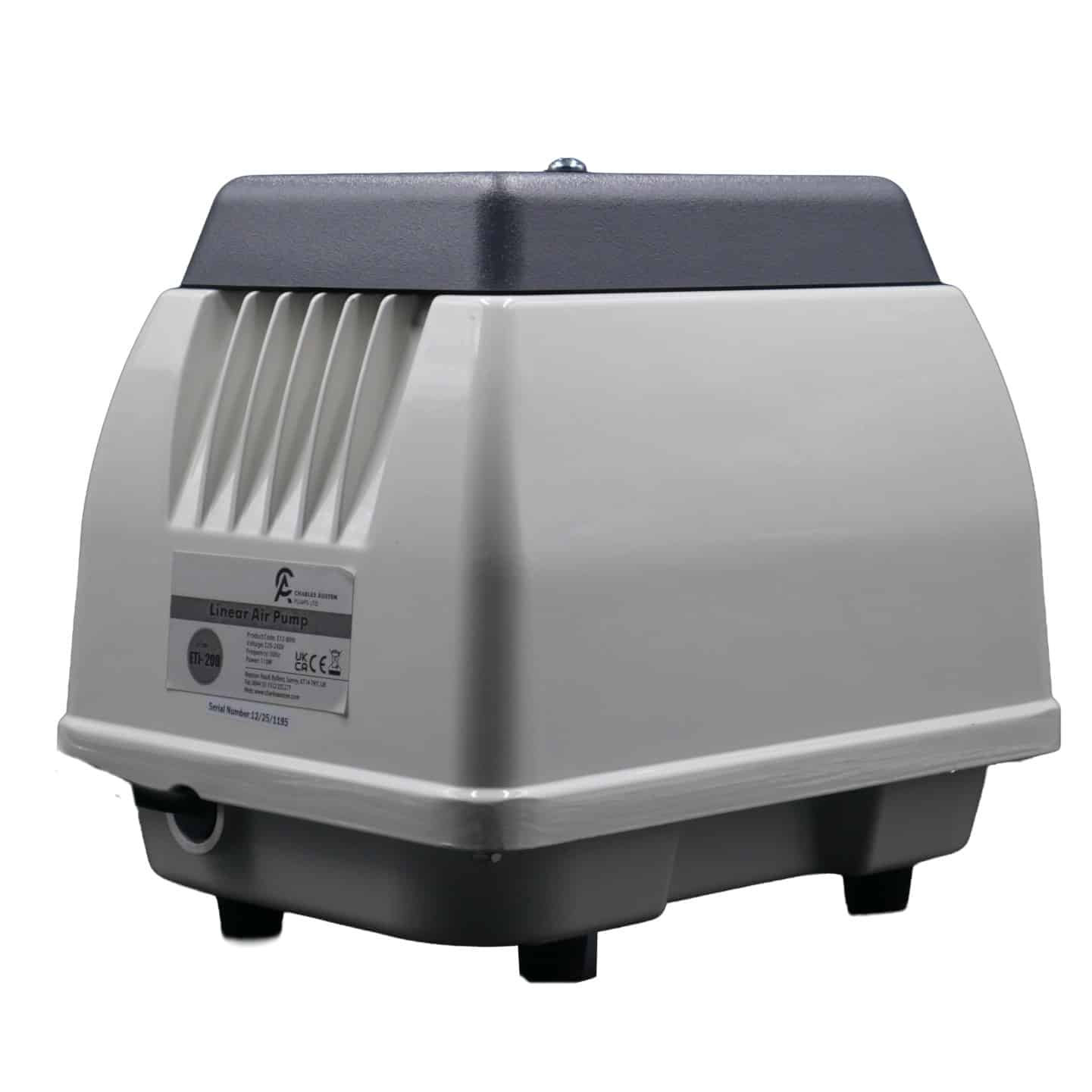
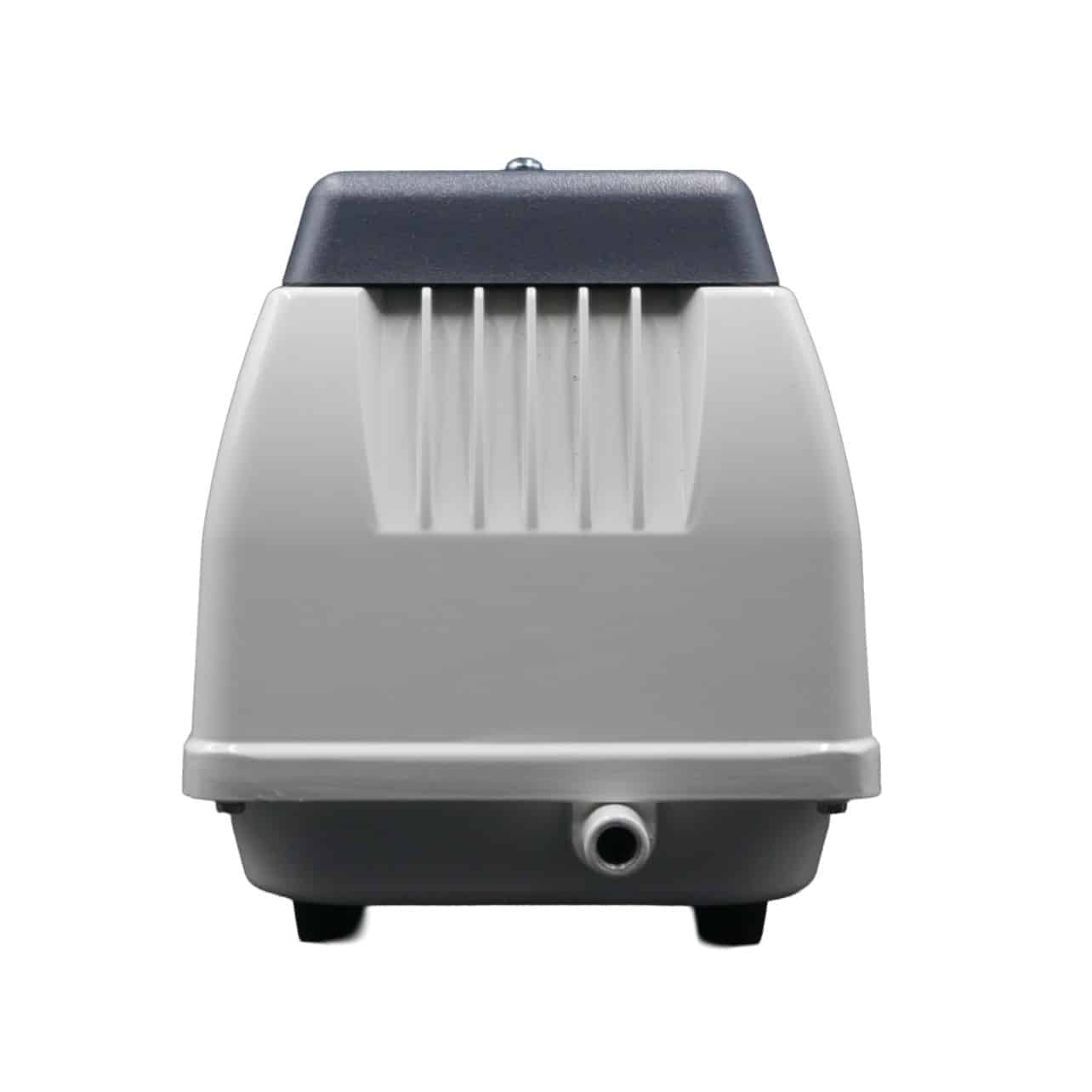
Charles Austen ETI80 Air Pump
| Brand | |
|---|---|
| Air Flow | 40 L/min |
| Air Pressure | 0.12 bar |
| Power | 30 W |
Charles Austen ETI80 Air Pump: linear diaphragm air pump for small ponds, larger reservoirs or several air stones operating through a correctly balanced manifold. Maximum output 40 L/min. Published pressure 0.12 bar. Rated power 30 W. Supplied by Charles Austen.
£112.99 (inc VAT)
Charles Austen ETI80 Air Pump
The Charles Austen ETI80 Air Pump is a compact oil-free linear diaphragm air pump for pond aeration, biological filters, hydroponic nutrient reservoirs and small wastewater-treatment systems. It delivers 40 L/min at the published duty pressure of 0.12 bar, using 30 W.
This model belongs to the new Charles Austen ETI range. The ETI model number must not be treated as the airflow figure: for example, ETI120 delivers 60 litres per minute, not 120. The exact duty point is therefore repeated throughout this page and compared with both the same-number standard ET model and the nearest standard ET model by airflow.
In ponds and koi systems, reliable aeration supports dissolved oxygen, water movement and the aerobic bacteria inside biological filters. In hydroponic reservoirs it helps circulate oxygen through the nutrient solution. In treatment systems, airflow supports the aerobic process used to break down waste. Final sizing must allow for diffuser depth, airline length, manifold losses and normal fouling.
Key features
- Oil-free linear diaphragm air delivery for aquatic and treatment applications.
- Published performance of 40 L/min at 0.12 bar.
- Rated electrical consumption of 30 W.
- Compact ETI-series format supplied through Charles Austen.
- Suitable for continuous aeration duties when correctly installed, ventilated and serviced.
- Model-specific comparison with the standard Charles Austen ET range.
Technical overview
| Model / MPN | ETI80 |
|---|---|
| Product type | linear diaphragm air pump |
| Supplier | Charles Austen |
| Brand | Charles Austen |
| Series | ETI Series |
| Maximum air output | 40 L/min |
| Maximum pressure / stated duty pressure | 0.12 bar |
| Power | 30 W |
| Energy at 24-hour operation | 0.72 kWh per day (calculated from rated wattage) |
| Installation format | Indoor or sheltered outdoor installation on a stable, ventilated surface |
| Same-number standard ET model | ET80 – 80 L/min at 0.12 bar |
| Closest standard ET by published airflow | ET40 – 40 L/min at 0.12 bar |
| Range position | 2 of 6 when the range is ordered by nominal output/capacity |
| Catalogue specification | 40 L/min @ 0.12 bar 30W |
The 0.72 kWh daily figure is calculated from rated wattage × 24 hours. Actual electricity cost depends on your tariff and operating schedule.
Compare Charles Austen ETI and standard ET air pumps
The closest same-number standard model is the Charles Austen ET80 Pond Air Pump, rated at 80 L/min at 0.12 bar. It is not a like-for-like airflow replacement for ETI80, which is rated at 40 L/min at 0.12 bar.
The closest standard ET model by published airflow is the Charles Austen ET40 Pond Air Pump, rated at 40 L/min at 0.12 bar. Compare power, casing, connection and installation requirements as well as airflow before substituting one range for the other.
Browse the dedicated Charles Austen ETI Series and the established Charles Austen ET Series.
Compare ETI models
| Model | Published airflow | Pressure | Power |
|---|---|---|---|
| Charles Austen ETI60 Air Pump | 30 L/min | 0.12 bar | 25 W |
| Charles Austen ETI100 Air Pump | 50 L/min | 0.12 bar | 47 W |
| Charles Austen ETI120 Air Pump | 60 L/min | 0.12 bar | 55 W |
| Charles Austen ETI150 Air Pump | 80 L/min | 0.12 bar | 85 W |
| Charles Austen ETI200 Air Pump | 100 L/min | 0.12 bar | 105 W |
How to size the ETI80
Start with the air requirement of every diffuser or moving-bed filter connected to the pump. Add the flows together, then check whether the pump can deliver that total against the resistance created by water depth, airline bore, non-return valves, manifolds and diffuser membranes. The ETI80 rating is stated at 0.12 bar, which is more useful than an unrestricted free-air figure, but the real installation still needs a safety margin.
If the calculated requirement is close to 40 L/min, choose the next ETI size or redesign the diffuser layout. A pump running against excessive restriction can become noisy, run hot and suffer shortened diaphragm life. Do not close unused manifold outlets unless the system retains a safe relief route.
Maintenance and servicing
Keep the pump on a stable surface with clear ventilation and protect it from flooding or water siphoning back through the airline. Inspect the intake filter, airline, manifold and diffusers routinely. Falling airflow can be caused by blocked diffusers or a leaking airline as well as worn diaphragms.
Charles Austen recommends planned servicing for its diaphragm air-pump ranges. Confirm the correct ETI service components for the exact model before ordering, and record the service date where aeration is critical. View the Charles Austen air-pump service-kit page.
Recommended air diffusers and airline
At 40 L/min, one single-disc diffuser station is the normal starting point; confirm the diffuser’s permitted airflow. Compare the Charles Austen DS1 Diffuser Station and Charles Austen DSW1 Diffuser Station. Diffuser ratings vary, so confirm the permitted airflow rather than selecting by disc diameter alone.
Use adequately sized sinking airline to limit pressure loss. The standard sinking airline suits shorter and lighter duties, while heavy-duty sinking airline is normally preferable for longer runs and higher-output pumps. Use a 2-way manifold or 4-way manifold when splitting the flow, keeping branches balanced.
Understanding the ETI duty point
Airflow and pressure must be read together. The published 40 L/min is paired with 0.12 bar; the installed airflow will be lower if the pump has to overcome greater water depth, a restrictive diffuser, narrow airline, long pipe runs, non-return valves or a heavily throttled manifold. Pressure is not an optional extra specification: it is what enables the air to reach the diffuser and pass through its membrane or pores.
The ETI80 model number is a range identifier, not its airflow. Its published duty is 40 L/min at 0.12 bar. This is why the same-number ET80 and the closest-flow ET40 are both shown: one comparison explains the naming, while the other is more useful when matching air delivery.
Installation and commissioning
For pond, treatment and multi-outlet work, size the diffuser area and manifold for the whole pump output. Dividing a pump across several balanced branches usually gives a more even air pattern than forcing all output through one small diffuser. Use the largest practical airline bore, keep branches similar in length and provide a safe route for surplus air rather than closing most manifold outlets.
After installation, check every outlet for a stable bubble pattern and listen for a change in pump tone. A branch with weak output may be restricted or longer than the others, while a pump that becomes noticeably louder or hotter can be working against excessive back pressure.
Keep the pump above the maximum water level where practical and protect it from flooding, direct spray and recirculated hot air. If it must sit below water level, use the correct non-return protection and route the airline so water cannot siphon into the pump during a power cut.
Performance checks and fault finding
If airflow falls, test the system methodically: inspect the intake, disconnect the manifold to compare unrestricted output, check the airline for leaks or kinks, and clean or replace fouled diffusers. Only diagnose internal pump wear after external restrictions have been ruled out. For critical aeration, keep a contingency pump or alternative oxygen source available during servicing.
Do not assume ET and ETI service parts are interchangeable because two models share a number. Confirm the exact pump code before buying diaphragms, valves or filters, and keep a record of service dates where continuous aeration protects livestock or treatment performance.

Reviews
There are no reviews yet.