






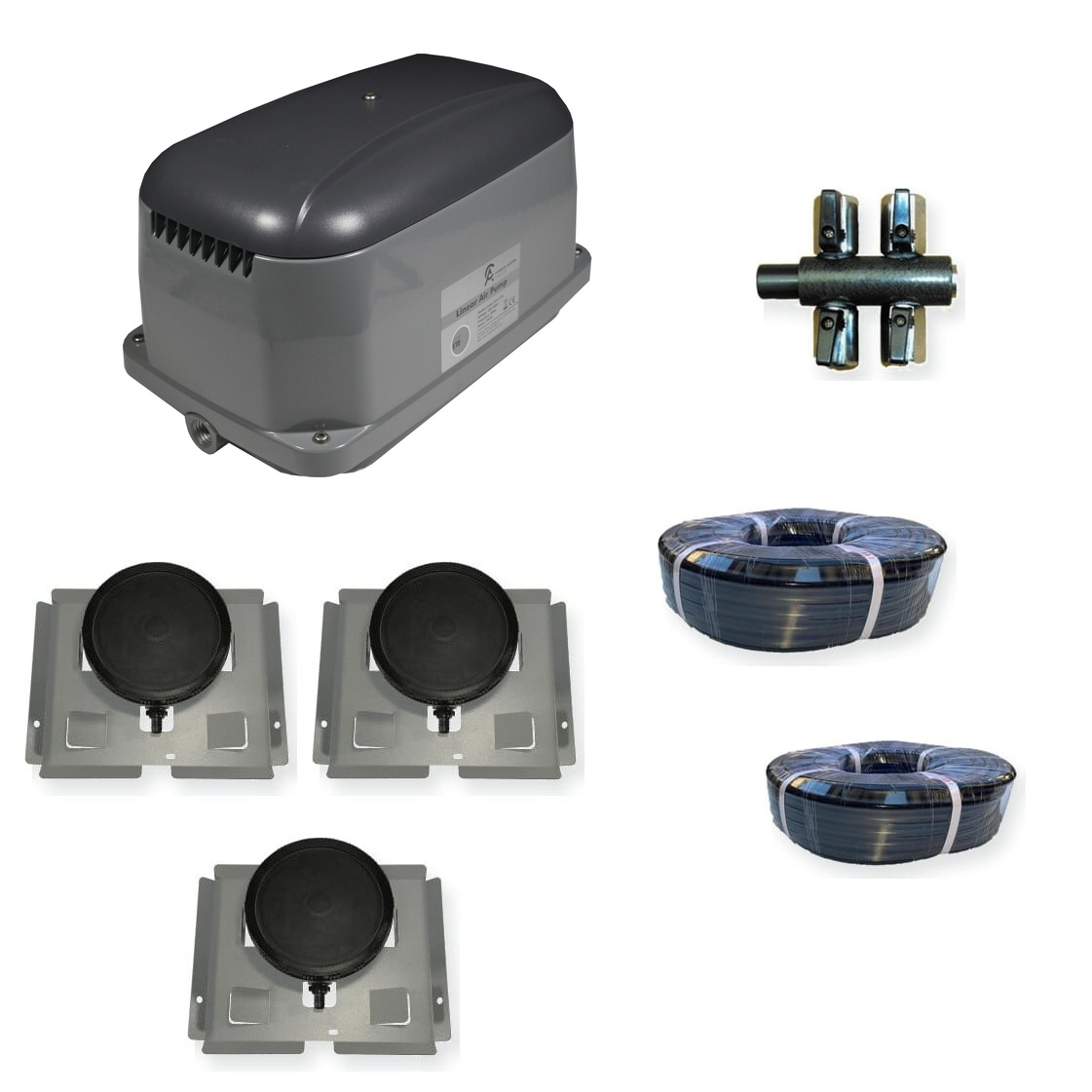
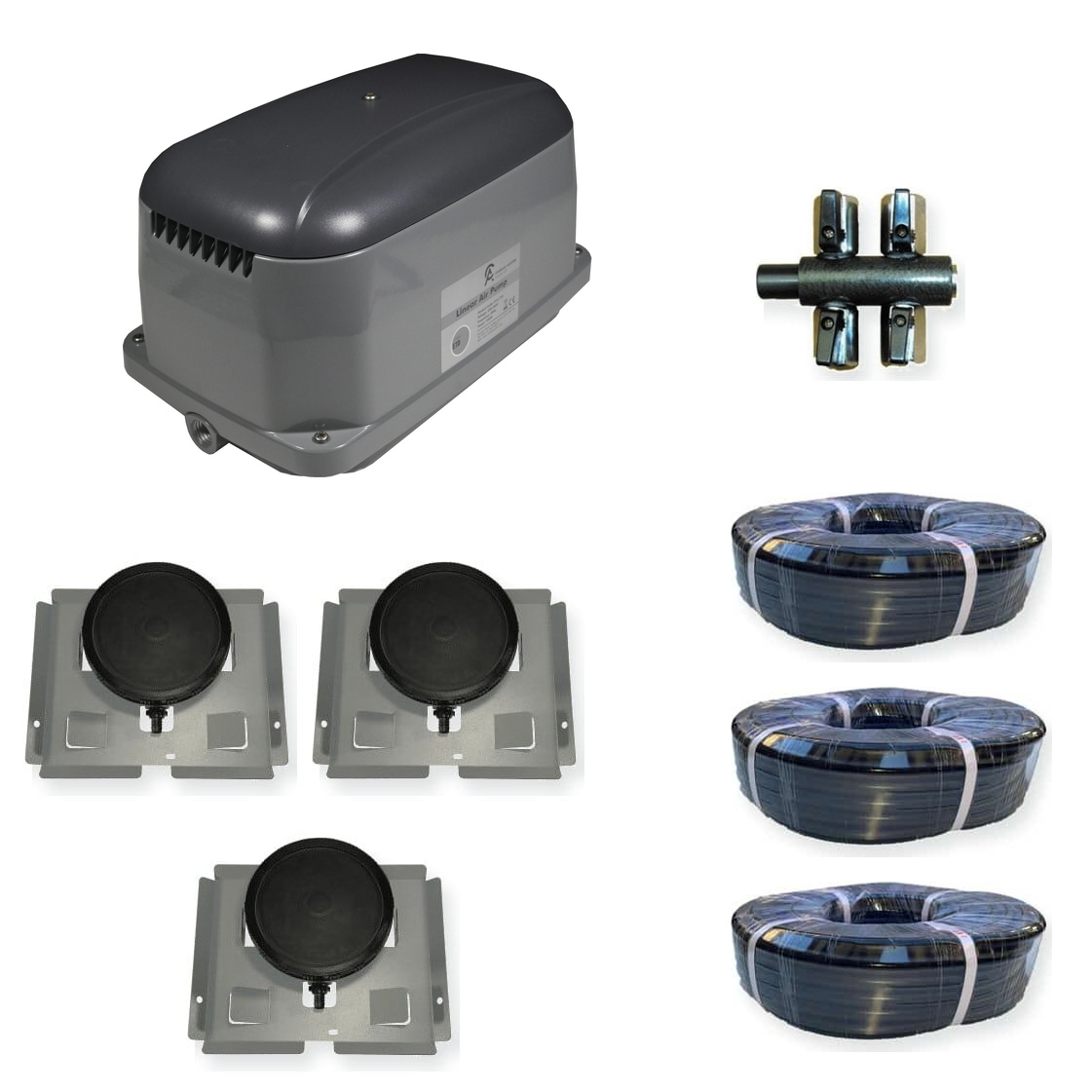
Charles Austen 150 Three-Zone DSW1 Pond Aeration Kit
| Brand | |
|---|---|
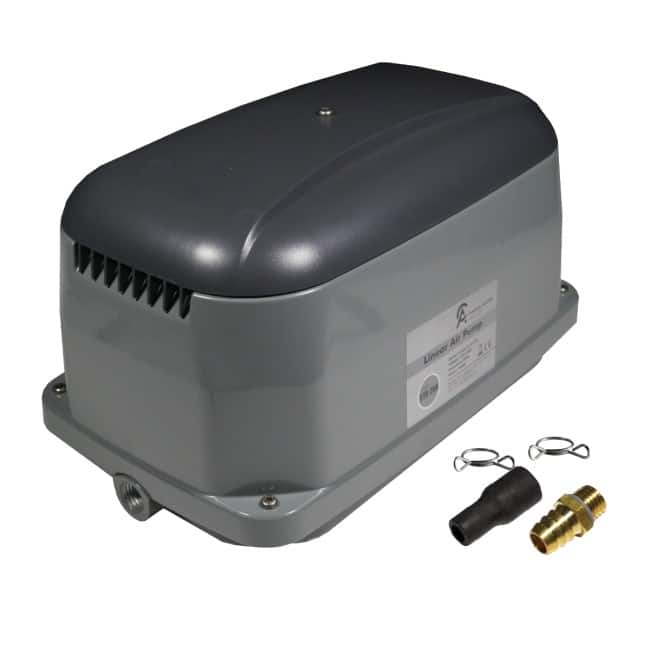
| Air Pump | Charles Austen ETi150, Charles Austen ETD150, Charles Austen ET150 |
| Power | 130 W, 90 W |
| Diffuser Layout | 3 x DSW1 stations |
| Weighted Airline | 60m total (3 x 15m runs plus 15m spare), 90m total (3 x 30m) |
| Air Flow | 150 L/min |
| Air Pressure | 0.15 bar, 0.2 bar |
| Water body size | Large pond / small lake |
Three self-sinking DSW1 stations for ponds with three distinct areas to aerate. Choose ET150, ETD150 or ETi150 and three 15 m runs plus 15 m spare, or three 30 m runs.
Price range: £910.48 through £1,178.94 (inc VAT)
Out of stock
Charles Austen 150 Three-Zone DSW1 Pond Aeration Kit
This kit positions three single-disc DSW1 diffuser stations independently around a pond. It is a good layout to consider when a long pond, an irregular shape or several bays make one central bubble plume a poor fit. Pick the ET150, ETD150 or ETi150 air pump for the resistance it needs to work against, then choose the airline option that reaches all three positions.
Which 150-series pump should you choose?
All three models are rated at 150 litres per minute, but not at the same pressure or power consumption. The ET150 is rated at the higher pressure point, which makes it the first of these three to compare for deeper stations or more restrictive runs. The ETi150 has the lowest rated power draw. It and the ETD150 are rated for the same flow at 0.15 bar, but that shared rating does not mean their full curves are identical.
| Pump | Rated airflow and pressure | Rated power |
|---|---|---|
| ET150 | 150 L/min at 0.20 bar | 130 W |
| ETD150 | 150 L/min at 0.15 bar | 130 W |
| ETi150 | 150 L/min at 0.15 bar | 90 W |
Airflow, depth and branch balance
Read total backpressure along the bottom of the graph, then follow each pump curve to its approximate airflow. One metre of fresh water adds about 0.10 bar of static pressure; two metres add about 0.20 bar, and three metres about 0.29 bar. The upper depth scale represents water pressure alone. The airline, manifold, fittings and diffuser membranes all add resistance, so measure depth from the surface to each diffuser and check the route as well.
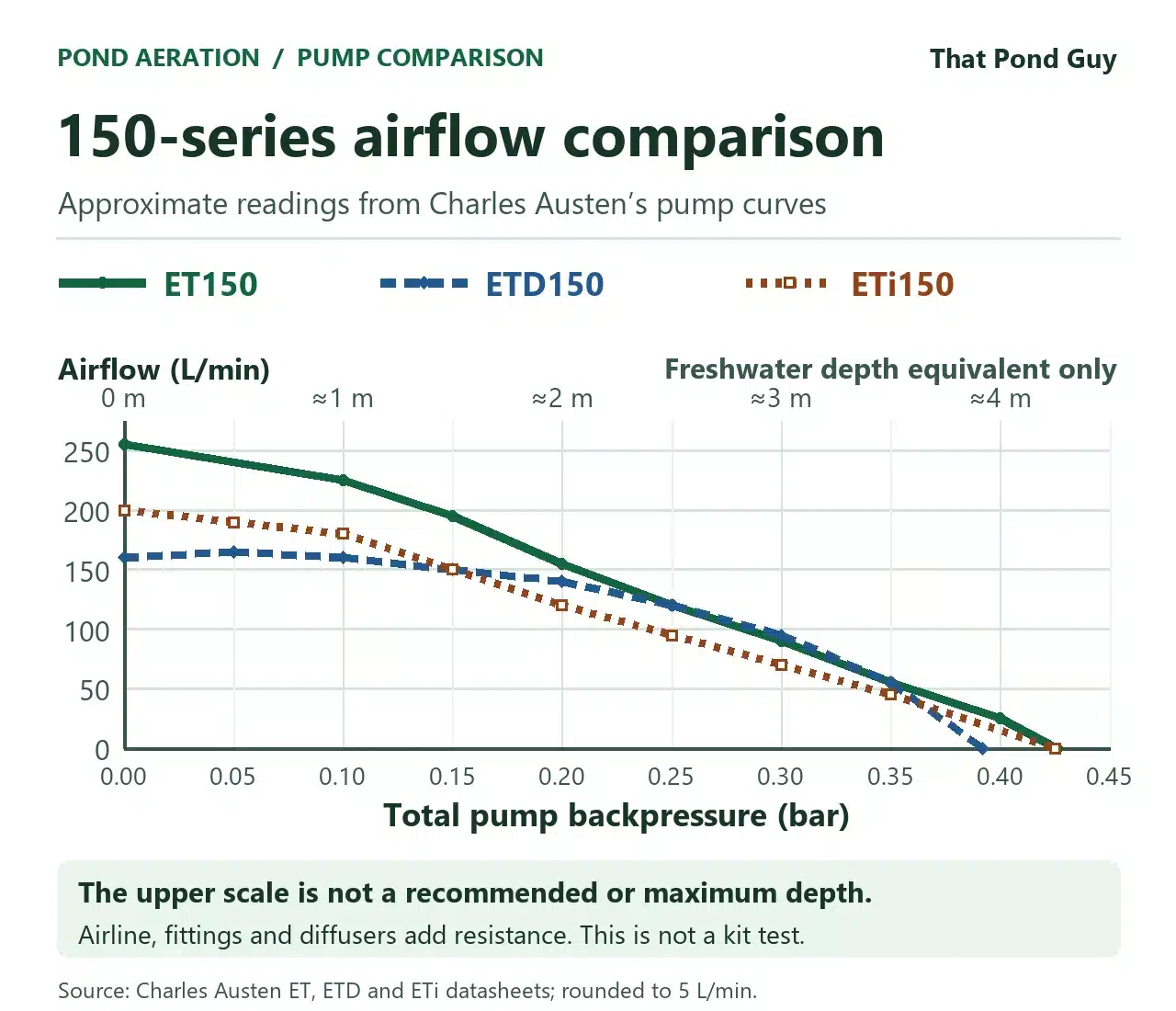
These are pressure equivalents, not recommended maximum depths. Check the complete installation against the pump curve. Equal-length airlines do not necessarily deliver equal flow if the stations are at different depths.
Each DSW1 contains one diffuser disc. At 150 L/min an even split would be about 50 L/min per station. With an indicative 30–60 L/min per head, three heads need about 90–180 L/min in total, with enough flow reaching each branch. Adding stations spreads the available air; it does not increase the pump output. Start with similar routes and depths where practical, then set the three branch valves and check the bubble patterns with the system running.
What the kit includes
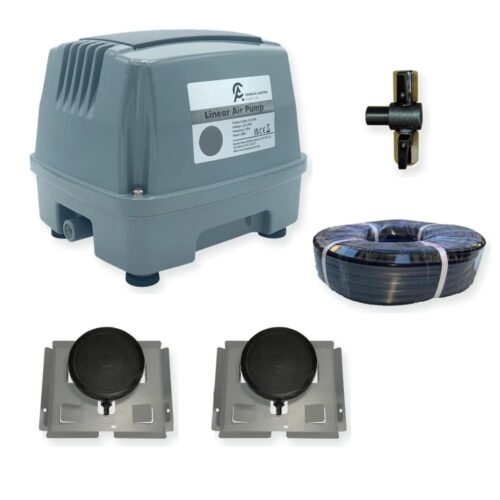
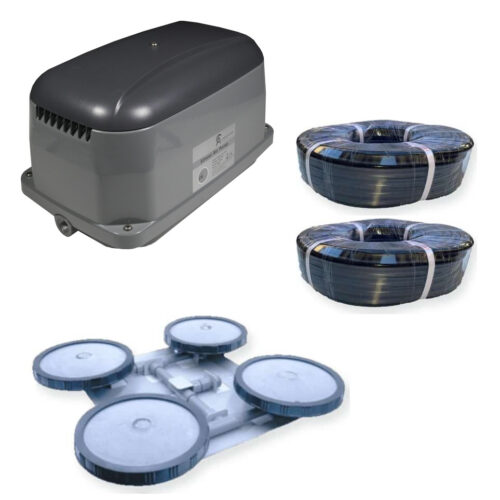
- One Charles Austen 150-series pump in the selected model.
- Three DSW1 single-disc diffuser stations, with one weighted airline branch to each.
- A four-way valved manifold with an 18 mm inlet and 14 mm outlets. The three stations each use one outlet; leave the unused fourth valve closed. The kit includes a matched pump-to-manifold connection and hose clips.
- 60 m total: three 15 m runs and a spare 15 m length. Choose this when all three routes fit within 15 m.
- 90 m total: three 30 m runs. Choose this when individual routes need more reach.
Measure from the manifold to each diffuser along its actual route, including the run across the bank and down into the water. The weighted airline has a nominal half-inch bore and is designed to stay down in the pond. Allow for extra resistance if planning longer runs and do not substitute narrow aquarium airline for the main branches.
Installation and ongoing checks
Site the pump above water level on a dry, firm and ventilated base, with a protected electrical supply and room to service it. Lower each diffuser on a separate line rather than its hose and keep the discs clear of deep, soft sediment. Secure the connections, check for leaks and keep an air path open while the pump is running. If circulation changes, inspect the air filter, membranes and airline for wear, fouling or restrictions before changing the valve settings. Introduce bottom aeration gradually in a pond with stagnant or poorly oxygenated deep water.
There is no single pond-volume limit that suits every installation. For a sizing check, have the diffuser depths, individual airline routes, pond dimensions and fish stocking to hand. You can also compare the different large pond and lake aeration kit layouts before deciding where to place the stations.







Reviews
There are no reviews yet.