





Pond Skimmers: Choosing the Right Type and Getting It Working Properly
Choosing a Pond Skimmer: Surface Area, Pumps and Position
A pond skimmer draws in a thin layer of surface water and catches floating debris before it has time to sink. Leaves, pollen and bits of plant material collect in a basket or chamber that you can empty. It is a useful way to keep the surface tidier and reduce the amount of rubbish reaching the bottom.
The right skimmer depends on the surface of the pond, the surrounding trees, the circulation and the equipment it will connect to. Pond volume alone will not tell you which one to buy. A sheltered formal pond and a broad, windy garden pond can need quite different arrangements.
We build, clean and maintain ponds, so access matters as much to us as appearance. A skimmer that is easy to reach and empty is likely to be much less frustrating than one hidden at the far end of the pond. Think about the cleaning before the installation is finished.
Our starting point: watch where the floating debris naturally collects, measure the water surface and decide how the skimmer will be powered or connected. Then choose the equipment. Buying the largest unit you can fit does not make up for poor positioning or insufficient flow.
What a pond skimmer actually does
The skimmer inlet sits at the water surface. Water moves through it, carrying floating material into a collection area. Depending on the design, the water then passes to a separate pump and filter, or a built-in pump returns it to the pond.
Some units stand inside the pond and connect by hose to a suitable pump. Others float on the surface with their own pump. A wall skimmer becomes part of the pond construction, with pipework leading away from the chamber. Those are different installations, even though all are described as pond skimmers.
The waste has only been removed from the pond system when you empty the basket or dispose of it through the intended waste route. Leaving a full basket in place defeats much of the point. A skimmer is easier cleaning, rather than an excuse never to look at the pond.
It also has a limited job. Debris already sitting on the bottom will not reliably travel up to a surface inlet. Fine suspended particles, dissolved waste and the biological needs of fish require the rest of the pond’s maintenance and filtration to work properly.
Do you need a skimmer?
If you regularly net leaves from the surface, a skimmer is worth considering. It can also help where pollen, seed husks and windblown debris gather in corners. Look at what is arriving and how quickly it accumulates, rather than adding equipment simply because another pond has it.
On a new koi pond, it makes sense to plan surface removal alongside the bottom drains and returns. That gives you a chance to arrange pipework and maintenance access properly. Adding a wall skimmer after the pond has been built can be a more involved job.
A small wildlife pond is a different decision. Some natural plant material and habitat are part of the pond, and careful hand removal may be more appropriate than a powered intake. Consider wildlife, the scale of the problem and whether machinery is needed at all.
If the water is green, identify the cause first. A skimmer may collect floating debris but it does not replace a suitable UV clarifier for suspended green-water algae. Our pond-algae guide explains why green water and blanketweed need different treatment.
Surface area matters more than a litre figure
Manufacturers commonly give skimmer coverage in square metres. That is the area of the water surface. A pump or filter may be described using litres per hour or pond volume, so take care not to compare unlike figures.
For a rectangular surface, multiply length by width. A pond measuring four metres by three metres has twelve square metres of water surface. That is a useful starting measurement, but it does not describe an island, a long narrow arm or a corner sheltered behind dense planting.
For an irregular pond, break the surface into manageable shapes and make a sensible estimate. Sketch the obstructions and separate areas as well. A single inlet may not draw floating material around a tight bend just because the total area is below the figure on its box.
Leaf load matters too. A small pond under several trees can need more frequent basket emptying than a larger pond in an open position. Manufacturer coverage is a selection guide, not a guarantee that every pond of that area will remain spotless without attention.
The main types of pond skimmer
| Type | Why consider it? | Check before buying |
|---|---|---|
| Floating with a built-in pump | A self-contained option for an existing pond | Surface coverage, minimum water depth, cable route and cleaning access |
| Standing in the pond | Surface intake connected to a separate suitable pump | Depth adjustment, actual flow available and hose compatibility |
| Built into the pond wall | A fixed inlet that can be planned into a new pond or major renovation | Operating water level, wall and liner details, pipework and service access |
| Larger specialist surface system | For a broader or more demanding installation | The full hydraulic design and maintenance arrangement, rather than coverage alone |
Browse our pond skimmer range after deciding which installation you can accommodate. A floating unit and a gravity-connected wall skimmer are not direct substitutes just because their names include a similar coverage number.
Floating skimmers: useful for an existing pond
A floating skimmer can be an option when you want surface collection without cutting an opening into the pond wall. It still needs an appropriate location, safe power provision and access. Check the model’s minimum depth and how it is restrained or positioned.

The UK Oase SwimSkim 25 specification table lists a maximum surface area of 25m², 40W consumption and a maximum pump capacity of 2,500 litres per hour. Those are different measurements: 25m² is its stated surface coverage, while 2,500 litres per hour is a pump figure.
Oase also describes an aerator function. That can be part of the unit’s operation, but it is not a reason to assume the oxygen needs of a stocked koi pond have been met. Our air-pump and diffuser guide covers dedicated aeration.
We would check where the unit will sit in relation to viewing areas and planting. Floating equipment is visible in the pond. If you want a completely unobstructed formal surface, a different type may be worth planning rather than trying to conceal a floating unit behind foliage.
Standing skimmers: check the pump connection carefully
A standing skimmer rests on the pond floor and draws through an inlet at the surface. The AquaSkim 20 and 40 have no built-in pump: they connect to a compatible separate filter and watercourse pump. The base needs a stable position at a suitable depth, and the inlet must move or adjust as its design requires. Keep the collection basket accessible.
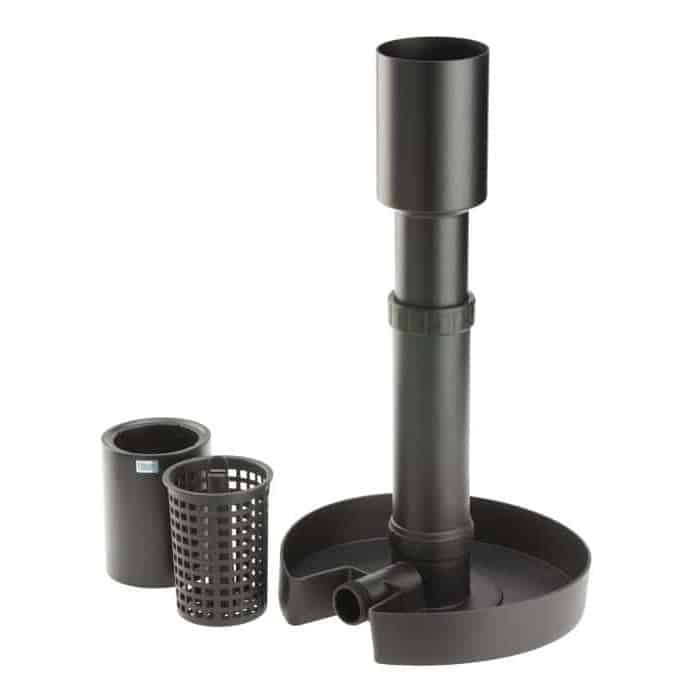
The Oase AquaSkim 20 is designed for a surface of up to 20m² and allows for water-level changes of up to 100mm. It needs a separate compatible pump. Oase currently names the AquaMax Eco Premium 5000–9000 models as suitable partners; match the actual pump generation and its connection instructions before buying.
The larger AquaSkim 40 covers up to 40m² and allows for water-level changes of up to 120mm. Oase currently names AquaMax Eco Premium 9000–17000 models and the Twin 30000 as suitable partners. That gives you a starting point for choosing a pump, rather than a measured flow through one intake branch.
Those ranges should not be read as a promise that any pump with a matching number on its box will work. The available flow through the skimmer branch depends on the pump setting, pipe or hose route and any other intake sharing that pump.
Comparing three common Oase options
| Model | Published surface limit | Pump arrangement |
|---|---|---|
| SwimSkim 25 | 25m² | Built-in pump; 40W, up to 2,500 litres per hour |
| AquaSkim 20 | 20m² | Separate compatible filter pump; Oase names AquaMax Eco Premium 5000–9000 models |
| AquaSkim 40 | 40m² | Separate compatible filter pump; Oase names AquaMax Eco Premium 9000–17000 and Twin 30000 |
The coverage and named pump pairings come from Oase’s UK product information. Pump names and generations matter, so keep the instructions for the actual equipment you are connecting. A recommendation for a particular pump does not tell you how its flow will divide between a floor intake and a skimmer.
Use the information for the named model when comparing sizes. The AquaSkim 20 and 40 have different surface limits, despite belonging to the same family. Neither should be chosen from a general family description alone.
Wall skimmers and new koi ponds
A wall skimmer needs planning around the normal pond water level. Its opening, chamber and connecting pipework form part of the construction. Choose it before the wall finish, liner or fibreglassing details are settled, rather than treating it as a decorative fitting to add at the end.
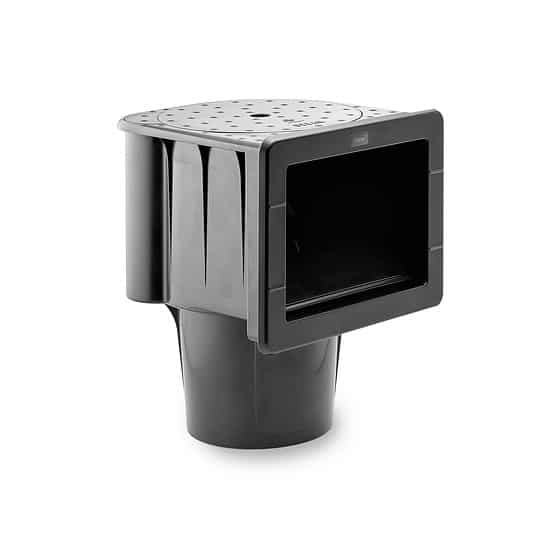
Our range includes wall skimmers, extensions and faceplates. Check what is included in the item you are buying. A faceplate, extension or wide-mouth component is not necessarily a complete skimmer. Compare the product description and matching part numbers before ordering a group of pieces.
Plan access above the collection chamber and around the valves. You should be able to empty the basket and inspect the line without dismantling the pond surround. If a lid will be covered by decking or paving, work out how that access remains usable.
A gravity-fed connection needs a suitable pipe route and water-level arrangement. A pump-suction connection raises different design questions. Do not change between them on the assumption that the same outlet size makes every arrangement interchangeable. Our drum-filter guide explains the wider distinction between pump-fed and gravity-fed systems.
Position it where the water brings the debris
Spend some time watching the pond before fixing the position. Look at:
- Where leaves gather on a breezy day.
- How water moves after leaving the filter.
- Whether a corner stays still.
The most convenient place to hide a skimmer is not always where it will collect the most. Wind direction changes, and pond shapes can create awkward pockets. Returns, waterfalls and aeration can also influence surface movement. Use those observations when arranging the inlet rather than expecting it to pull everything across the pond from any position.
Planting needs space in that plan. Lily leaves or dense marginal growth can obstruct the route floating debris would otherwise follow. Leave access around the inlet and avoid placing a newly planted basket where it interferes with a moving float or flap.
On a larger or divided surface, you may need more than one collection point or a different circulation layout. Do not add a second skimmer without checking whether the pump and pipework can provide the necessary flow to both. Two weakly supplied inlets may not solve the original problem.
Matching flow without guessing from the pump box
The maximum flow printed on a pump is normally an upper figure under stated conditions. The water actually moving through your installation depends on the pipework, height, fittings and pump setting. The skimmer needs its share of that real flow.
If a compatible pump has two intakes, check how flow is divided and controlled. An intake drawing from the pond floor and a surface-skimmer intake are doing different jobs. Reducing one branch too far can affect collection at that point.
Do not connect an arbitrary branch to a pump that was not designed for it. Follow the pump and skimmer instructions together, including any controls or fittings needed. Check the model generation as well as the brand name; a newer pump with a similar name may have a different connection or operating range.
Our pond-pump guide explains why maximum flow and maximum head are not working figures you can simply combine. For a skimmer, the useful question is how much water will pass through that branch in the finished system.
Pipework and water level: small details with a big effect
- Connections: use the correct pipe or hose type and actual connection size. A nominal inch size on flexible hose is not automatically the same fitting as an imperial pressure-pipe connection. Check whether the part needs a hose clamp, union, seal or another specified connection.
- Pipe route: keep it serviceable and avoid unnecessary restrictions. Long runs, tight bends and a build-up of debris can reduce flow. On a retrofit, look at the whole route before deciding that the skimmer itself is too small.
- Water level: a surface inlet cannot work properly if it is left above the water or held too deeply below it. Floating parts need to move freely. Check what happens at the lowest normal running level as well as just after topping up.
If the level is falling because the pond leaks, solve that problem rather than continually moving the inlet. If evaporation or filter cleaning changes the level, account for those changes within the equipment’s stated adjustment range. Never assume that a floating ring has unlimited travel.

Keeping fish, food and wildlife in mind
Watch the skimmer during feeding. Floating food can follow the same route as leaves, so some of a meal may disappear into the basket before the fish reach it. Adjust the feeding position and routine to suit the pond instead of continually adding more food.
- Use the guards, baskets and safety features intended for the equipment. Inspect them when cleaning. Do not remove a protective part simply to increase suction, or assume a modification is safe because it seems to improve debris collection.
- Check collection areas carefully for trapped pond life when emptying them. For wildlife ponds, the potential effect of a powered intake is part of deciding whether to use one in the first place. A small seasonal leaf problem may be better dealt with by hand.
For a swimming pond, the pump, electrical installation and suction arrangements require appropriate specialist design. A garden-pond skimmer being physically large enough does not establish that an improvised system is suitable for people swimming in the water.
How often should you empty a skimmer?
Check it frequently when first installed so you learn how quickly it fills. There is no useful universal weekly interval. A basket that is nearly empty in summer can fill rapidly during autumn leaf fall or after strong winds.
Follow the manufacturer’s isolation and cleaning instructions, then:
- Remove the collected material and check that the inlet and floating parts are free.
- Refit everything correctly. A basket that has not seated properly may let debris bypass it.
- Look at the water movement after restarting.

Keep a simple note of unusual changes. If the basket suddenly needs emptying much more often, there may have been a leaf fall or a change in plant growth. If collection stops, there may be a blockage, a water-level problem or reduced flow. Treat the change as something to investigate.
Our pond-maintenance guide covers the wider routine. A skimmer should make that routine more manageable, while bottom debris, filter waste and plant maintenance still need attention.
Before freezing weather: check the winter instructions. For the SwimSkim 25, the instructions say to remove the unit in freezing conditions and store it frost-free. Follow the model’s storage directions, including how to protect its pump and electrical connections.
Running costs and the work it saves
For a unit with its own pump, use the actual power consumption to estimate electricity use.
A 40W unit running continuously uses 0.04 kilowatts multiplied by twenty-four hours: 0.96kWh per day. Multiply that by your electricity price per kWh. At an illustrative rate of 25p per kWh, that would be 24p per day, or £7.20 over thirty days.
That is an example calculation, not a quoted tariff or a prediction of your bill. Check your own rate and the model’s actual operation.
A standing skimmer without its own motor does not have a separate electrical consumption figure in the same way. It relies on the connected pump, whose setting and operation affect the whole system. Do not describe it as cost-free to run simply because there is no plug on the skimmer body.
We would also consider maintenance. Easier leaf removal can be valuable, but it does not justify promising a fixed saving in cleaning hours or treatment costs. The benefit depends on what reaches your pond and how well the equipment is installed and maintained.
When a skimmer is not collecting properly
| What you see | Check first | Next step |
|---|---|---|
| Debris gathers elsewhere | Wind, returns, obstructions and the inlet position | Reassess the collection route before buying a bigger unit |
| Little surface draw | Basket, hose, inlet movement, water level and available flow | Clean and inspect the system using the manufacturer’s instructions |
| Air is entering the line | Water level, floating parts and the intended pump arrangement | Stop and identify the cause rather than increasing the pump setting blindly |
| The basket fills very quickly | Leaf load and debris arriving after wind or maintenance | Shorten the checking interval and assess capacity if it is a persistent problem |
| The bottom remains dirty | Where the settled waste is collecting | Review bottom circulation and cleaning; surface skimming has a different job |
If the pump is noisy, running dry or behaving unusually, follow its stop and fault instructions. Do not leave it operating while you try random valve positions. Isolate equipment safely before handling or clearing it.
Why the larger model is not always the better choice
Imagine a pond with twelve square metres of surface water and an existing pump arrangement that can provide only a modest flow to a new skimmer branch. A skimmer with a larger coverage figure may sound reassuring, but it may also need more flow than that branch can supply. The small surface area does not cancel out the flow requirement.
For that twelve-square-metre pond, the AquaSkim 20 may be worth considering, provided the pump and depth suit it. The larger 40 needs assessing with its intended pump arrangement too. If the surface inlet barely draws water because the floor intake is taking most of the flow, buying the larger skimmer body will not necessarily solve the problem. Check the intake setting, restrictions and compatibility first.
Conversely, a pump capable of a high maximum flow does not prove that all of it should pass through the skimmer. Its other intake, the filter’s permitted flow and the pipework still matter. We would check the system as a whole before recommending a setting.
That is why we ask what equipment you already have. It can be cheaper and simpler to choose a self-contained unit for a particular retrofit than to rebuild an unsuitable pump connection. On another pond, making use of a correctly designed separate intake may be the more sensible option. The coverage figure narrows the choices; it does not finish the decision.
Can you make a homemade pond skimmer?
You can find plenty of improvised ideas, but a container that catches a few leaves is not automatically a safe or reliable permanent intake. Think about what happens when the water level changes, the basket blocks, a fish approaches or the pump draws more than the opening can supply.
For a pond with fish, an expensive liner or a connected filter system, we would favour equipment with proper instructions, guards and available replacement parts. Saving on the skimmer body is poor value if the result damages a pump or creates a leak that is difficult to reach.
You can still improve the situation before committing to new equipment. Remove floating leaves by hand, observe where they gather and record the water level and existing pump details. Those simple checks help you choose a suitable installation without turning the pond into a trial of improvised suction fittings.
Can you retrofit one without rebuilding the pond?
Often there are options worth investigating, but the right answer depends on the existing pond. A suitable floating unit or standing skimmer may be more practical than cutting a wall. Check depth, the pump arrangement and the safe cable or hose route before choosing.
To help us assess a retrofit:
- Photograph the current pump, its label, the filter and the pond from above.
- Measure the water surface and the depth at a possible skimmer position.
Those details make it much easier to assess a retrofit than a photograph of floating leaves alone. Do not assume a wall-mounted component can simply be sealed into any finished pond. The wall, liner or fibreglass detail and pipework all need to remain watertight and serviceable. For a substantial renovation, it may be worth planning the skimmer with the rest of the filtration upgrade.
We would rather check those details before supplying a unit than leave you adapting several incompatible fittings after it arrives. Start with the installation you can support, then compare the suitable products.
Keep the purchase easy to maintain
Before ordering, find out whether replacement baskets, moving inlet parts and pump spares are available for the exact model. Keep the instruction book and model details with your pond records. A similar-looking spare from another generation may not fit.
We would also check the finished access with a simple question: can the person looking after this pond empty the basket comfortably? If the answer relies on climbing over planting or standing on a slippery edge, improve the layout. The best-looking installation is of little use if routine cleaning becomes a job everyone avoids.
A short list before you order
- Write down the surface area, pond depth, normal water-level changes and main debris problem.
- Decide whether you need a self-contained unit, a standing intake connected to a suitable pump or a wall skimmer planned into the construction.
- Check the exact pump and model instructions, connection sizes, basket access and what is included.
- Keep room for plants without obstructing the inlet, and make sure you can reach the equipment safely when it needs cleaning.
Our skimmer range includes different approaches for different ponds. If you would like help, send the measurements and photographs of the equipment you already have. That is a much better starting point than choosing solely from the pond’s litre capacity.
