





Pond Maintenance: Cleaning, Filters, Plants and Water Care
Looking after your pond through the year
A pond does not need to be spotless to be well looked after. It needs a routine that suits what is living in it, removes the waste that is causing problems and keeps the essential equipment working. Sometimes that is a few simple jobs. Sometimes an overgrown or neglected pond needs a planned recovery clean.
We work on ponds with very different shapes, planting and filtration. The useful starting point is the same: look at the pond before deciding what to remove or replace. A wildlife pond, a lightly stocked garden pond and a heavily fed koi pond should not all receive the same maintenance.
This is our broad pond-care guide. It helps you decide what needs doing, which jobs can be kept small and when a larger intervention makes sense. The linked guides cover individual filters, water tests, seasonal care and particular problems in more detail.
What sort of pond are you maintaining?
| Pond type | What matters most | What to avoid |
|---|---|---|
| Planted garden pond with fish | Fish condition, appropriate filtration, waste removal and healthy planting. | Treating a clear surface as proof that every water parameter is suitable. |
| Dedicated koi pond | Reliable mechanical and biological filtration, aeration and water tests at the actual feeding load. | Choosing the routine from pond volume alone or turning essential support off between visits. |
| Wildlife pond | Habitat, access, suitable plants and selective work with limited disturbance. | Routine draining, stripping all the silt or imposing a koi-pond treatment schedule. |
| Large pond or lake | The whole waterbody, sediment, inflows, oxygen and practical access. | Scaling a small ornamental-pond chemical routine up by guesswork. |
| Swimming pond | Purpose-designed filtration, water management and bathing safety. | Assuming clear water or a fish-pond UV proves the water is safe to swim in. |
If you have inherited the pond with a house, keep the existing filtration and air running while you identify the switches and valves. Find the model numbers and previous routine before making changes. Our inherited pond guide gives a first-day plan.
For a dedicated koi system, use the koi pond maintenance guide alongside this one. If the pond is primarily a habitat, the wildlife maintenance guide is the more appropriate detailed route.
The small checks that prevent bigger jobs
Start by watching, before feeding or cleaning. Look at the fish, the water level and the normal returns. Is the air reaching the diffusers? Has a hose moved? Is a skimmer basket full? A quick inspection often tells you which job actually needs attention.
Check the pond safely from firm ground. Keep children away from open water and unattended equipment, and do not reach into powered pumps or open electrical housings. See our pond safety guide for the wider walk-round.
| When | Check or task | Let the pond set the frequency |
|---|---|---|
| When visiting the pond | Observe fish, level, air, returns and obvious leaks. | A fault or unusual behaviour needs attention immediately. |
| During feeding | Use a measured portion and watch where it goes. | Remove accessible leftovers; do not feed to a fixed calendar amount. |
| Regularly during fish keeping | Test relevant water parameters and record them. | Test more often after changes, new fish or a problem. |
| As waste collects | Empty baskets and clean mechanical stages correctly. | Leaf fall and feeding can shorten the interval considerably. |
| As planting grows or dies back | Remove suitable decaying material and thin selectively. | Identify the plants and check for wildlife before disturbing them. |
| At service intervals | Follow the pump, UV, filter and air-pump manuals. | Use the exact model and generation for parts and instructions. |
A checklist is a reminder to inspect, not an instruction to clean everything on it. A basket may need emptying daily during leaf fall while a different filter stage does not need touching. Record what was done and whether the flow returned to normal.
Water problems can develop gradually, but they can also happen quickly. A power failure, contamination, an open waste valve or overnight oxygen loss can change a pond in hours. Do not assume yesterday’s normal result guarantees today’s conditions.
Leaves, sludge and the material you cannot see from the edge
Leaves and uneaten food are easier to remove before they sink and break down. Check the areas where flow carries them: behind baskets, against a corner, in a skimmer and along a stream. A clear central area can hide an accumulation elsewhere.
Use an appropriate net or pond tool from a secure position. Avoid scraping sharp edges across a liner or pulling at plants, hoses and cables together. Take manageable amounts so you can see what you are lifting.
In a wildlife pond, inspect material for animals and leave undisturbed habitat. Some sediment is part of the pond, not automatically a defect. The Freshwater Habitats Trust’s garden-pond guide explains why dredging can sometimes do more harm than leaving an established pond alone.
In a fish pond, waste retained around equipment or across an inaccessible bottom can justify more deliberate removal. First decide whether it can be removed in stages, whether a vacuum is appropriate and how much water the work will take out.
Using a pond vacuum
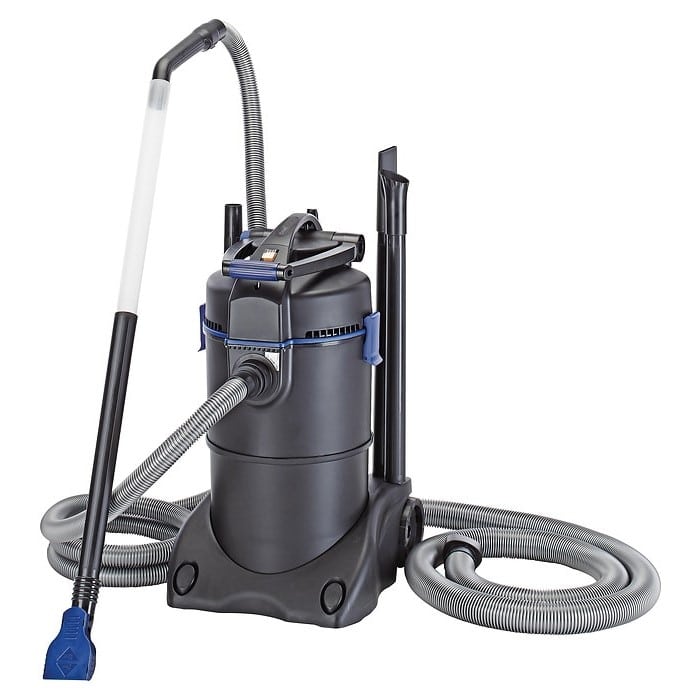
A pond vacuum is useful for suitable loose waste, but the hose, nozzle, suction depth and discharge route need to match the job. Keep the machine body on dry land as its manual requires; only the appropriate suction parts go into the water.
Plan the waste route before starting. Returning vacuum water through a coarse debris bag does not make it chemically clean, and very fine material may pass through. Discharging to waste removes water that must be replaced safely.
The Oase PondoVac 3 is one of the options in our range. Compare it with other models in the pond vacuum guide, which covers operating method, depth, discharge and accessories rather than judging a machine by motor wattage alone.
Do not disturb a large amount of old sediment at once around fish without a holding and water-management plan. Stirring it into the water and waiting for the filter to catch everything can create a much larger load than routine maintenance.
Filter cleaning means removing waste while protecting the biology
The mechanical stage traps particles. The biological stage supports organisms that process dissolved nitrogen waste. A UV clarifier helps with suspended green-water algae passing through it. These jobs work together, but they are not interchangeable.
Clean captured waste using the filter’s intended method. Avoid sterilising established biological media or washing it in untreated chlorinated tap water. OATA’s garden-pond guidance describes using removed pond water for routine media cleaning and increasing tests after changes.
Follow the correct manual before moving valves or opening a housing. A pressurised filter, bead filter, ScreenMatic, Nexus and drum all have different procedures. Stop and isolate the relevant equipment where instructed, and confirm the proper running position when finished.
Our pressure-filter guide, ScreenMatic guide, Nexus guide and drum filter guide cover those differences. Use them to find the right process, not to apply one brand’s cleaning sequence to another.
Check real flow, not just whether the pump is on
A pump can run while delivering much less water because its inlet is blocked, a hose is kinked or the filter is obstructed. Compare the return with its normal appearance. If performance has changed, investigate the restriction before deciding the pump is too small.
Keep safe access to inlet strainers, baskets and valves. A component buried under planting or squeezed behind a shed may be technically installed but difficult to maintain. Access is part of an equipment upgrade, not an afterthought.
When choosing a replacement, compare what the pump delivers through your height and pipework. The maximum flow printed on the box is not necessarily what reaches the pond. Our pump sizing guide explains that in plain terms.
Do not replace every piece of media together
Media wears, clogs or needs servicing in different ways. Some mechanical foams may need replacement while biological media remains useful. Check the model instructions and replace in a way that preserves the pond’s established processing where possible.
After substantial cleaning, media replacement or a fault, test ammonia and nitrite more closely. A bacterial starter can support establishment where appropriate, but it is not proof that the filter can immediately handle the previous feeding load.
Water tests, top-ups and water changes
For fish ponds, keep routine results for ammonia, nitrite, nitrate, pH and the relevant hardness checks. Temperature belongs beside them. Oxygen and chlorine require separate suitable measurements when those questions are being investigated.
The NT Labs Pond Lab Multi-Test Kit covers six main parameters in one kit. It does not test literally everything. Use our water-testing guide to compare it with individual tests and Hanna instruments.
Test more often after an intervention or unusual fish behaviour. If fish are gasping or losing balance, check air and circulation promptly while investigating the water. Use the ammonia and nitrite response guide rather than trying a general tonic first.
A top-up is not a water change
Evaporation removes water while leaving much of the dissolved material behind. Adding enough to restore the level is a top-up. Removing water and replacing it to manage accumulated dissolved substances is a water change. Both may be needed, for different reasons.
Check the incoming water and use appropriate conditioning or a properly maintained purifier for mains water. Record the amount added. Avoid a large sudden change in temperature or chemistry, and supervise the hose rather than leave it running unattended.
A wildlife pond may tolerate a seasonal drop and generally benefits from suitable rainwater where topping up is justified. That advice should not be transferred blindly to a heavily stocked koi pond. Pond type and water chemistry both matter.
Keep a reliable pond-volume record for treatment and planned changes. Our volume guide covers shelves, irregular shapes and metered fills. A physical volume should not be inflated by a filter-sizing allowance for sunlight or fish.
Plants, blanketweed and green water
A well-planted pond can still need selective maintenance. Remove suitable dying leaves before they become waste, divide overcrowded baskets when appropriate and keep access to equipment. Do not pull every submerged plant out because some strands of algae are tangled through it.
Identify the plant and its growth habit. A lily is not a marginal, and rootless hornwort is not planted in the same way as a rooted basket plant. Use our water lily guide and oxygenating plant guide for the species and depth decisions.
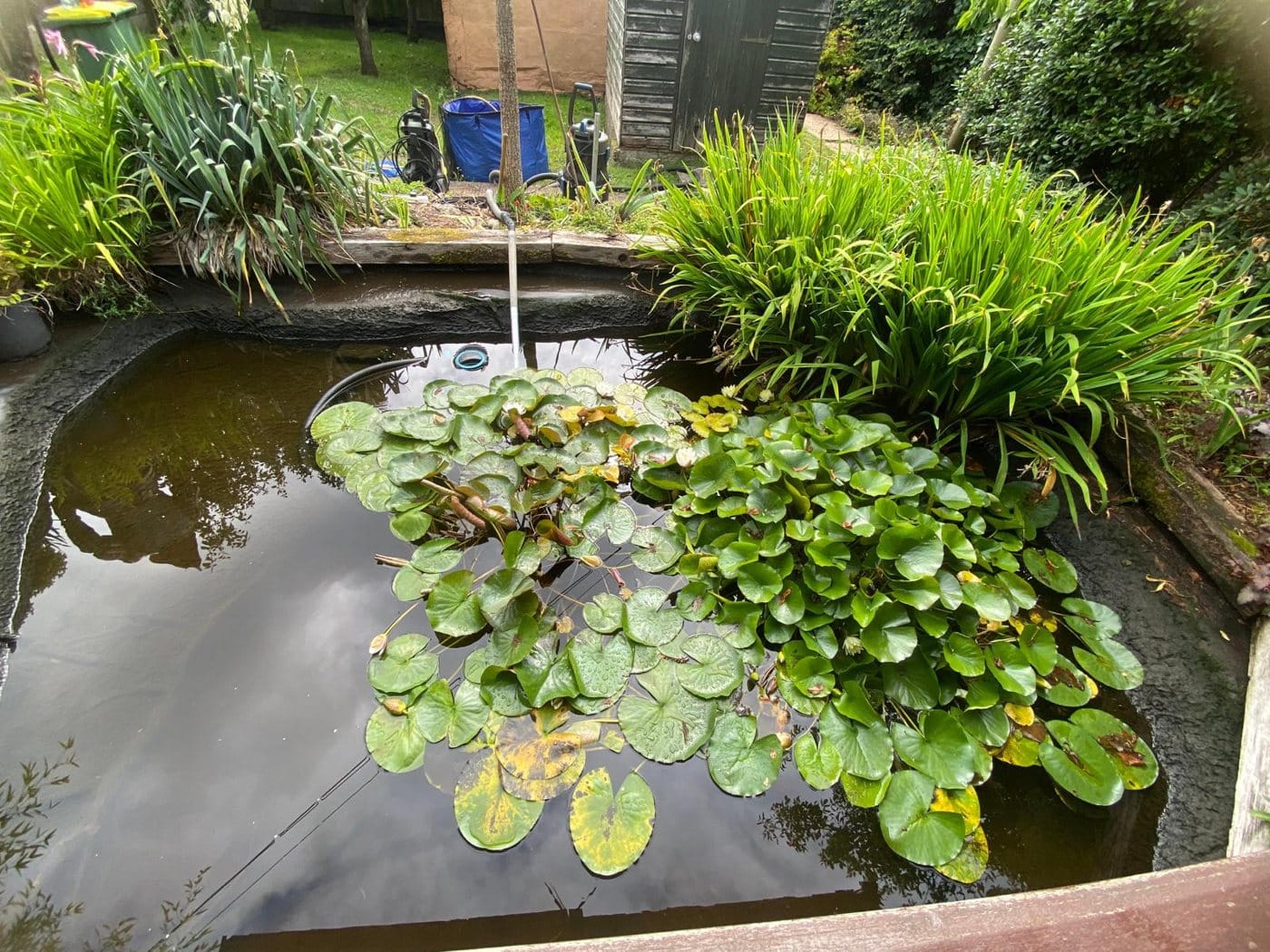
A green pond is not a diagnosis. Green water throughout the pond, attached string algae and small floating duckweed need different checks. Our algae guide helps identify the problem before choosing equipment or treatment.
For blanketweed, remove accessible heavy growth and check feeding, retained waste and the treatment’s exact restrictions. Our blanketweed guide compares the different formulas. Do not assume a product suitable for adult koi is also suitable during amphibian spawning.
Use the RHS wildlife-pond advice for a habitat-focused approach. A wildlife pond can have a dense underwater structure and some sediment without needing to be converted into a clear, sparsely planted koi display.
Does the pond actually need a full clean?
A complete clean is a substantial intervention. It can be appropriate when accumulated waste cannot be managed sensibly in place, the pond has been neglected, a repair requires access or equipment and planting need a planned reset. It should have a clear purpose.
Appearance alone is not enough. Before draining, ask what is causing the problem and whether smaller work will deal with it. A broken UV, overflowing stream or blocked basket needs its own repair; a complete clean without fixing that cause may only give a brief improvement.
| Situation | Start with | When to assess a larger intervention |
|---|---|---|
| A few floating leaves | Net or skim them out before they sink. | If a large hidden accumulation is already affecting the pond. |
| One blocked mechanical stage | Follow its cleaning instructions and check flow afterwards. | If access or the filter arrangement makes proper maintenance impractical. |
| An overgrown basket | Identify and divide or thin selectively. | If roots, sediment and access issues affect much of the pond. |
| Green water | Check UV condition, flow and the cause of suspended algae. | If separate waste or repair issues also require it. |
| A neglected, heavily silted fish pond | Assess fish, water, holding arrangements and waste removal. | A planned recovery clean may be appropriate. |
| An established wildlife pond | Leave useful habitat and assess carefully. | Only when the ecological need justifies the disturbance. |
What needs planning before fish are moved?
Have a suitable holding system, safe access, aeration and a water plan ready before lowering the pond. Consider how long the work may take, the fish’s size and the conditions if the weather changes. A small unfiltered tub is not a general holding solution for a pond of adult koi.
Keep equipment and handling appropriate to the fish and minimise unnecessary catching. Do not mix fish, water or wet equipment between unrelated ponds. Cover open holding systems safely against jumping while maintaining the required air and observation.
Plan replacement water, lining or repair work and the filter restart together. New water is not automatically safe for fish, and a visually clean filter may have lost biological capacity. Record the work and monitor the pond after it is running again.
Where will the dirty water and sludge go?
Check the waste route before starting. Do not discharge muddy pond water into a neighbouring ditch, stream or natural watercourse. Consider the volume, access, nearby property and any relevant drainage requirements.
Keep invasive plants and potentially contaminated material contained while identifying the appropriate disposal route. The garden-pond advice from the Freshwater Habitats Trust discusses spoil disposal alongside sediment removal. A pump capable of moving the waste does not determine where it can lawfully or safely be put.
Adjust the work through the year
In spring, check the system before increasing the food. Fish appetite can rise while biological processing is still developing. Keep the tests with the feeding record rather than make the same increase on the same date every year.
In summer, pay closer attention to aeration, water level, heavy feeding and rapid plant growth. Keep suitable air running overnight. The air pump and diffuser guide covers the equipment, while our hot-weather guide covers the day-to-day checks.
In autumn, catch leaves before they become a bottom-cleaning job and inspect exposed equipment before frost. In winter, keep observing the pond and follow the exact equipment’s cold-weather requirements. Do not switch off the only filtration simply because the fish are quieter.
For a more detailed seasonal plan, use the spring, summer, autumn and winter guide. Habitat work also needs the actual wildlife and suitable timing considered before substantial disturbance.
Choose tools around the work you will actually do
A useful basic set is modest: a suitable surface net, a thermometer, appropriate water tests, access to equipment instructions and a simple maintenance record. Add a vacuum or specialist handling equipment when the pond and job justify it.
Do not buy chemicals as a general maintenance checklist. A dechlorinator has a specific role for incoming water; a bacterial starter supports a biological process; an algae treatment has its own target and restrictions. None replaces emptying a full basket or repairing a failed pump.
For fish feeding, use portions rather than an unrestricted handful. Our feeding routine guide explains the five-minute check and automatic feeders. Avoided waste is easier to manage than uneaten food already at the bottom.
For larger equipment decisions, the equipment guide helps match the pump, filter, air and pipework. An upgrade should make the maintenance practical as well as provide capacity on paper.
When professional maintenance is useful
Get help where fish holding, difficult access, electrical faults, heavy sediment, substantial leaks or an unfamiliar filtration system make the work unsuitable to tackle alone. Ask for the job to be explained in terms of the pond’s actual condition.
Useful information includes photographs of the whole pond and equipment, water-test results, approximate dimensions and the problem you want solved. If a fish is unwell, separate the maintenance question from the need for a proper health assessment.
After a visit, retain the model numbers, work completed and ongoing checks. A professional clean does not remove the need to watch the pond between visits. Equally, good routine care should not be made harder by an installation that cannot be reached or serviced.
You can discuss pond maintenance with us through the contact page. The aim is a pond you understand and can look after, with the right help for the jobs that need it.
