





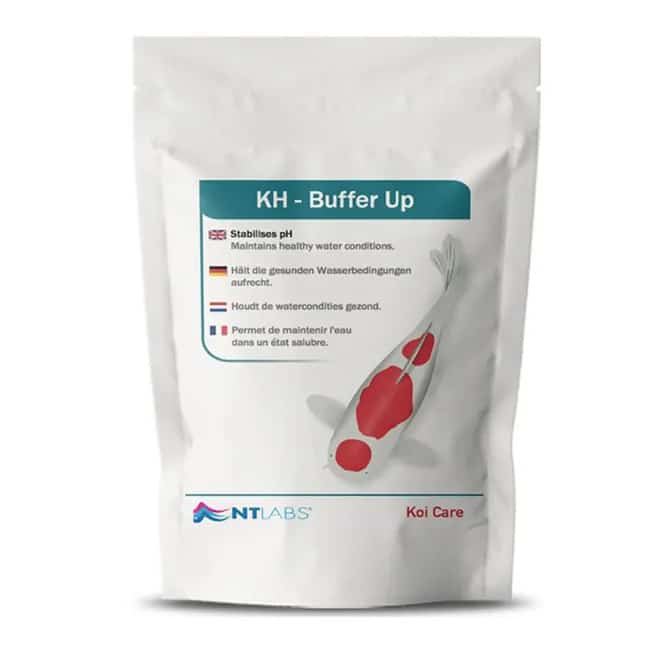
NT Labs KH Buffer Up
| Size | 1.5kg, 5kg, 20kg |
|---|---|
| Brand | |
| Treatment Type | Carbonate hardness and pH buffering |
| Target Problem | Low carbonate hardness (KH) and pH stability |
| Product Form | Powder |
| Seasonal Use | Year round |
| Treatment Purpose | KH replenishment |
NT Labs KH Buffer Up powder for measured carbonate-hardness adjustment and pH buffering. Choose 1.5kg, 5kg or 20kg; test first and use the pack instructions.
Price range: £16.81 through £112.91 (inc VAT)
NT Labs KH Buffer Up — Pond Carbonate Hardness
NT Labs KH Buffer Up is a powder used to replenish carbonate hardness in pond water. Choose it when testing identifies a need to support the pond’s KH and pH stability. It is a water-chemistry product, so start with the test results and actual water volume rather than using it simply because the pond looks cloudy.
The available pack choices are 1.5kg, 5kg and 20kg. The small pack is 1.5kg, as identified in the manufacturer’s 2026 guide; it is not a 1kg bag. Select the pack around the adjustment and maintenance work indicated by your testing and the instructions supplied with the product.
Pack details
| Brand | NT Labs |
|---|---|
| Product | KH Buffer Up |
| Purpose | Replenish carbonate hardness and support pH stability |
| Form | Powder |
| Pack choices | 1.5kg, 5kg or 20kg |
| 1.5kg guide coverage | 10,200 litres at the manufacturer’s stated treatment basis |
Pack coverage is a buying guide. The amount needed for an individual pond depends on the measured KH, water volume and adjustment specified by the product instructions. It is not a reason to add an entire pack to every pond of that volume.
What KH tells you
Carbonate hardness is part of the water’s buffering system. The manufacturer explains that processes in an ageing pond can use up this buffering reserve, leaving the pH less stable. Testing KH helps identify that situation before deciding which water-chemistry product is appropriate.
KH, pH and general hardness describe different properties. A KH buffer should not be selected as though it were a general clay treatment, an algae remover or a product intended to clear suspended debris. Work from the parameter that needs attention rather than grouping every powder together.
Compare the appropriate tests
Our NT Labs Pond Hardness Test Kit is an option for checking hardness according to its instructions. Our NT Labs Pond pH Test Kits measure acidity and alkalinity on their respective chart ranges. Use the correct test and scale for each result.
If you are reviewing several aspects of water quality, compare the NT Labs Pond Lab Multi-Test Kit. Read the kit’s included tests and instructions rather than assuming that every test set measures the same parameters. A visible water colour or a clear pond is not a substitute for the required readings.
Plan the adjustment
Record the pond’s KH and pH before making a change, together with the date and the water volume being used in the calculation. Keep litres and imperial gallons clearly identified. If you have a reliable fill-volume record, use it as a starting point and account for the actual water held in the system.
Review the recent maintenance history too. A water change, heavy rainfall or a change in the pond’s normal operation can be useful context when comparing results. Keep those notes with the next test readings so that you can assess the trend rather than reacting to one unrecorded result.
Use the supplied instructions
Measure and apply KH Buffer Up according to the label on the pack supplied. If the instructions express a dose as a volume of powder, do not assume that the same number of millilitres equals that number of grams. Use the stated measuring method and treatment basis.
Follow the manufacturer’s preparation and application method, including any directions for dissolving the powder before adding it. Keep the required circulation and aeration operating as directed for the pond. Do not improvise an increased dose to make a correction happen more quickly.
Retest rather than guessing
Follow the product guidance for gradual adjustment and the interval before reassessing the water. NT Labs explains that significant changes in pH should be made gradually, including changes intended to improve water conditions. The aim is a stable, appropriate result rather than a rapid change to an arbitrary target.
Record subsequent readings and compare them with the starting result. A maintenance routine should reflect the pond and the replacement water being used, not a dose copied from another pond. Recheck the calculation if the water volume, test method or measuring units have changed.
KH and GH products have different roles
For a separately identified general-hardness product, see NT Labs GH Minerals Up. Use the corresponding test result when considering it. KH Buffer Up is selected for carbonate hardness and pH buffering; a different product’s pack coverage or instructions should not be applied to it.
Keep the product labelled and store it according to the packaging instructions. Retain the pack size and treatment notes for the next maintenance check. This listing supplies the selected KH Buffer Up powder pack, with test kits and other pond-care products available separately.




Reviews
There are no reviews yet.