





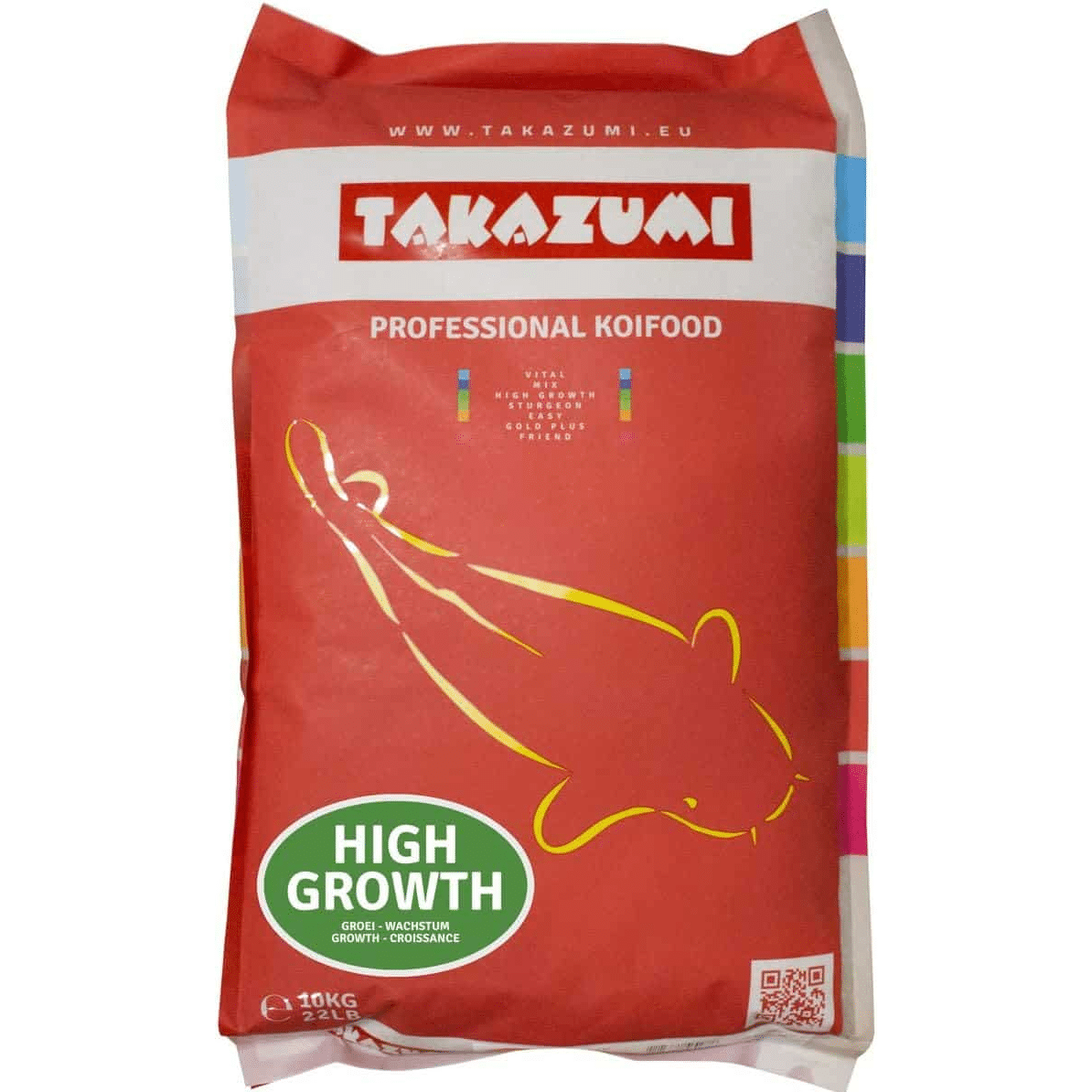
Takazumi High Growth
| Bag Size | 1kg, 2.5kg, 4.5kg, 10kg |
|---|---|
| Brand | |
| Pellet Size | 5mm |
| Food Type | Growth |
| Feeding Season | Summer / Warm Weather |
| Pellet Behaviour | Floating |
| Protein sources | Fishmeal |
Complete floating growth food with minimum 45% protein and 12% oils and fats. For water at 15°C and above. Choose 1kg, 2.5kg, 4.5kg or 10kg.
Price range: £14.95 through £105.95 (inc VAT)Choose an option to see its price per kg.
Takazumi High Growth Koi Food
A protein rich floating food for active koi in water at 15°C and above
Takazumi High Growth is a complete koi food formulated for growth during suitable warmer water conditions. The declared analysis includes a minimum of 45% crude protein and 12% oils and fats. Its floating pellets let you observe feeding at the surface, making it easier to judge appetite and see whether every fish has an opportunity to eat.
High Growth is available here in 1kg, 2.5kg, 4.5kg and 10kg packs. Select the quantity that fits your collection and the length of the feeding period ahead. Takazumi specifies a minimum water temperature of 15°C for this formula, so choose your supply around the pond’s actual conditions rather than simply buying the largest pack.
Where High Growth fits into a feeding programme
This is the Takazumi option to consider when growth is a particular feeding objective and the fish are feeding actively in sufficiently warm water. It differs from an everyday ration in its protein and oil levels. Those figures describe the food’s formulation; they are not a promise of a particular increase in length or weight.
Growth depends on the fish, their genetics, temperature, water quality and the wider pond system. A growth food works within those conditions. Increasing the ration beyond what the koi readily eat will not overcome limited filtration or poor water quality, and a fish that is reluctant to feed needs attention to the cause rather than simply a richer food.
Composition and nutritional analysis
The manufacturer’s composition lists fish meal, fish and vegetable oils, cereals and cereal products, wheat germ, amino acids, natural minerals, trace elements and a premix. The declared figures below help you compare High Growth with other foods in the range.
| Crude protein | Minimum 45% |
|---|---|
| Crude oils and fats | Minimum 12% |
| Carbohydrates | 21.3% |
| Crude fibre | 2.3% |
| Crude ash | 7% |
| Phosphorus | 1.4% |
| Pellet behaviour | Floating |
| Feeding temperature | 15°C and above |
Read these figures alongside the directions on the current pack. A percentage is a proportion of the food, not a daily feeding recommendation. Select the overall ration to suit the fish and avoid assuming that a higher protein number means a greater quantity should be fed.
Check the water temperature before feeding
Use a pond thermometer to establish whether conditions suit High Growth. The 15°C threshold refers to water temperature, not the forecast air temperature. In an unheated pond, a warm day can be followed by a much cooler night, so reassess the feeding programme when the weather changes.
When the water falls below the stated feeding temperature, move to an appropriate seasonal food with its own feeding instructions. Takazumi Gold Plus and Takazumi Vital provide different options within the range. Choose according to water temperature, appetite and the purpose of the ration.
Introduce the food and monitor the response
Make a change of food gradually, following the pack guidance, rather than combining an abrupt switch with a large increase in quantity. Start with portions you can observe. Watch how quickly they are taken, whether smaller fish can reach them and whether any pellets are left behind.
During a stronger feeding period, keep routine water testing and filter maintenance consistent. Record the amount fed if you are increasing it, so you can relate a change in pond conditions to the actual feeding load. If uneaten food appears or the fish become less interested, reduce the ration and reassess conditions before continuing to increase it.
Practical use with a pond feeder
A feeder can make portion timing more consistent, but its settings still need checking with the food you put into it. Measure the quantity dispensed into a dry container before using a new setting. Observe the fish during several feeds and make sure pellets remain accessible instead of drifting straight into a skimmer.
Keep the feed chamber dry and check for trapped or damaged pellets. An automatic schedule should be reviewed when temperature, appetite or the number of fish changes. Occasional supervised feeding is still useful, because it shows how individual koi are responding rather than relying only on the amount leaving the feeder.
Which pack should you choose?
The 1kg pack suits an introduction to High Growth or a small collection. The 2.5kg size provides more food while keeping the commitment modest. The 4.5kg and 10kg packs suit established users with a higher regular consumption, provided the food can be stored properly and used within its stated date.
Estimate the quantity needed from your measured daily use. At 100g per day, for example, a 1kg pack contains about ten days of food and a 2.5kg pack about twenty five days. This calculation helps with purchasing only; it is not a suggested ration for every pond. Allow for feeding to slow when conditions change.
Comparing High Growth and Takazumi Mix
Takazumi Mix combines High Growth with Gold Plus and has a different declared analysis and temperature recommendation. It is a useful comparison if you are considering growth and colour within one blended food. Buy the formula that fits your programme rather than treating the two names as interchangeable.
For feeding at different levels of the pond, Takazumi EasyMix combines floating and sinking food. High Growth itself is a floating formula. Browse our koi food range to compare those formats and seasonal alternatives.
Storage between feeds
Store High Growth closed, cool and dry, away from direct sunlight. Use a clean, dry scoop and protect the open pack from rain, splashes and condensation. Retain its original label and best before information if decanting a smaller working quantity. Follow the supplied pack’s storage instructions and avoid buying more than your expected feeding programme can use while fresh.



Reviews
There are no reviews yet.