






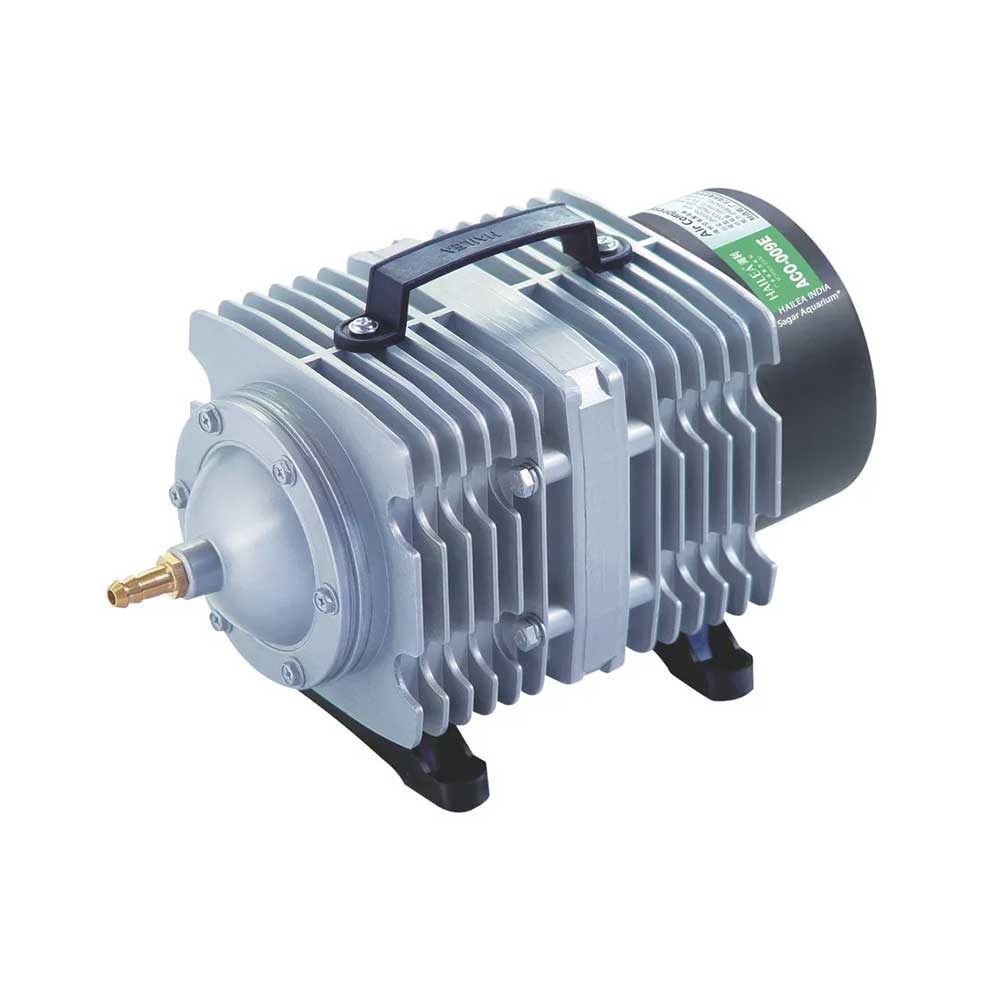
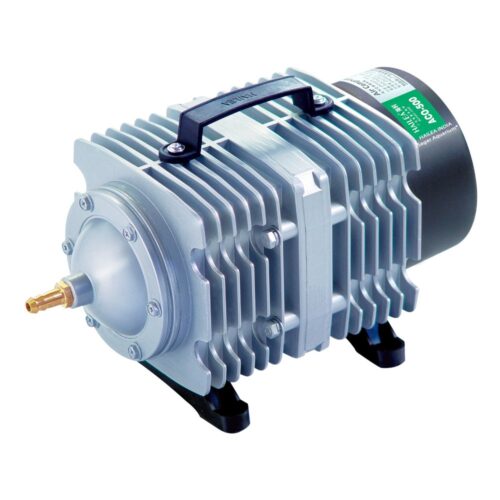
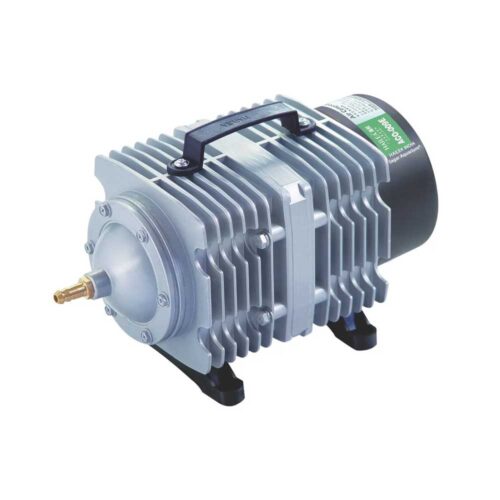
Charles Austen ACO388D Piston Air Pump
| Brand | |
|---|---|
| Air Flow | 80 L/min |
| Air Pressure | 0.3 bar |
| Power | 70 W |
Charles Austen ACO388D Piston Air Pump: electromagnetic piston air compressor for pond aeration, treatment tanks and multi-diffuser systems that need a stronger air supply. Maximum output 80 L/min. Published pressure 0.3 bar. Rated power 70 W. Supplied by Charles Austen.
£84.06 (inc VAT)
Charles Austen ACO388D Piston Air Pump
Charles Austen ACO388D Piston Air Pump is an electromagnetic piston air compressor intended for pond aeration, treatment tanks and multi-diffuser systems that need a stronger air supply. Its published maximum output is 80 L/min at up to 0.3 bar, using 70 W. This page identifies the exact model, duty figures and selection limits so it can be compared accurately with the other products in the range.
Charles Austen is both the product brand and supplier. The figures below come from the current 2026 supplier catalogue, supported by manufacturer guidance where a current technical page is available. Maximum figures are not the same as guaranteed installed performance: pipework, depth, pressure, media loading and maintenance all affect the result.
Who is the ACO388D best suited to?
This model is best considered for pond aeration, treatment tanks and multi-diffuser systems that need a stronger air supply. It sits 5 of 9 when the range is ordered by nominal output/capacity. That makes it easier to judge whether it is a compact entry model, a mid-range choice or one of the higher-output options before comparing price alone.
Key product features
- Oil-free compressed air for aquatic and hydroponic systems
- Higher pressure capability than small aquarium diaphragm pumps
- Suitable for manifolds and several aeration points
- Published power, pressure and maximum airflow for duty comparison
- Exact SKU and manufacturer part number: ACO388D.
- Supplied through Charles Austen and linked to compatible models for easier range comparison.
Technical specification
| Model / MPN | ACO388D |
|---|---|
| Product type | electromagnetic piston air compressor |
| Supplier | Charles Austen |
| Brand | Charles Austen |
| Series | AC Piston Series |
| Maximum air output | 80 L/min |
| Maximum pressure / stated duty pressure | 0.3 bar |
| Power | 70 W |
| Energy at 24-hour operation | 1.68 kWh per day (calculated from rated wattage) |
| Installation format | Dry, ventilated external installation |
| Range position | 5 of 9 when the range is ordered by nominal output/capacity |
| Catalogue specification | 80 L/min 0.3 bar 70W |
Technical figures are nominal supplier ratings. The calculated 24-hour energy figure, where shown, is rated wattage × 24 hours and does not include tariffs or intermittent thermostat operation.
Understanding the published specification
Airflow and pressure must be read together. The published 80 L/min is paired with 0.3 bar; the installed airflow will be lower if the pump has to overcome greater water depth, a restrictive diffuser, narrow airline, long pipe runs, non-return valves or a heavily throttled manifold. Pressure is not an optional extra specification: it is what enables the air to reach the diffuser and pass through its membrane or pores.
The catalogue specification for this exact model is 80 L/min 0.3 bar 70W. Where the page includes a calculated daily-energy figure, it is provided only to make continuous-running products easier to compare; it is not an electricity-cost estimate and does not replace the rated power shown above.
How to size this model correctly
Use a correctly sized manifold and do not throttle most of the available output. Piston compressors are chosen by required airflow at working pressure, not only by their maximum free-air figure.
For critical livestock, treatment or commercial systems, allow spare capacity and consider redundancy. If the required duty is close to the model’s maximum, moving to the next size normally provides a more useful operating margin than running a smaller unit continuously at its limit.
Installation and commissioning
Installation format: Dry, ventilated external installation. Keep access available for cleaning and servicing, use appropriately sized hoses or airline, and avoid unnecessary bends or restrictions. Aquatic electrical equipment should be protected by a suitable RCD and installed in accordance with the supplied instructions.
After installation, check every outlet for a stable bubble pattern and listen for a change in pump tone. A branch with weak output may be restricted or longer than the others, while a pump that becomes noticeably louder or hotter can be working against excessive back pressure.
Commission the complete system by checking actual flow, pressure, water level or temperature at the point of use rather than assuming the headline maximum will be achieved. Recheck after filters, diffusers or pipework have had time to accumulate normal fouling.
Compatible system components
For pond, treatment and multi-outlet work, size the diffuser area and manifold for the whole pump output. Dividing a pump across several balanced branches usually gives a more even air pattern than forcing all output through one small diffuser. Use the largest practical airline bore, keep branches similar in length and provide a safe route for surplus air rather than closing most manifold outlets.
Compatibility should be confirmed from the complete installation: connection size, hose or airline bore, voltage, control method, permitted flow and future servicing access can all affect whether two individually suitable products work correctly together.
Maintenance and service life
Keep the intake unobstructed, check the manifold and relief route, and investigate rising noise or temperature. Never allow water to siphon back into the compressor.
Record the installation date and normal operating performance. A visible reduction in output, increasing noise, rising temperature or repeated tripping should be investigated rather than compensated for by restricting or altering other parts of the system.
Performance checks and fault finding
If airflow falls, test the system methodically: inspect the intake, disconnect the manifold to compare unrestricted output, check the airline for leaks or kinks, and clean or replace fouled diffusers. Only diagnose internal pump wear after external restrictions have been ruled out. For critical aeration, keep a contingency pump or alternative oxygen source available during servicing.
Compare any suspected fault with the clean, newly commissioned condition. Changes across every outlet or return normally point to the main unit or a shared restriction; a problem affecting one branch is more likely to be local pipework, airline, a valve, diffuser or connected accessory.
Compare similar air pumps
The table below links to five nearby models so the buyer and search crawler can move through the range without returning to a search page.
| Model | Key published duty | Product type |
|---|---|---|
| ACO328 | 70 L/min · 0.3 bar · 50 W | Air Compressor |
| ACO009 | 110 L/min · 0.35 bar · 102 W | Air Compressor |
| ACO318 | 60 L/min · 0.2 bar · 32 W | Air Compressor |
| ACO308 | 45 L/min · 0.18 bar · 22 W | Air Compressor |
| ACO208 | 35 L/min · 0.15 bar · 18 W | Air Compressor |
Complete the system and explore the range
The supplier and customer-facing brand for this listing is Charles Austen. The links below connect this model to its dedicated range, relevant system components and the wider Charles Austen catalogue.
- Browse the Charles Austen AC Piston Series
- Browse all Charles Austen products
- Charles Austen air-pump service kits
- Pond and lake diffuser stations
- Standard sinking airline
- Heavy-duty sinking airline
Technical information sources
Core model figures were checked against the current 2026 Charles Austen supplier catalogue. Family features, installation points and application guidance were cross-checked against current manufacturer technical material where available.


Reviews
There are no reviews yet.