






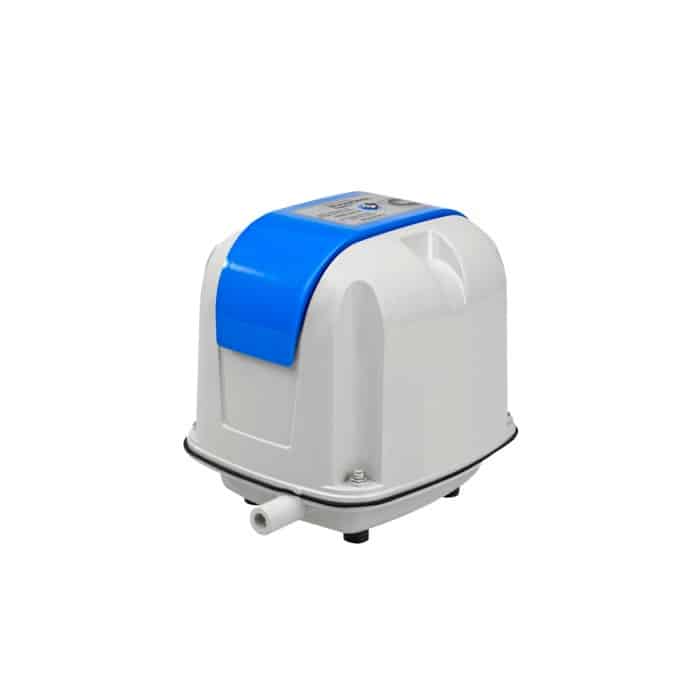
Thomas / Yasunaga AP-60N and AP-60/80 Air Pumps
| Model | AP-60N, AP-60/80 |
|---|---|
| Brand |
Choose the Thomas / Yasunaga AP-60N or AP-60/80 oil-less diaphragm air pump. Rated delivery is 47 or 60 L/min at 200mbar, with 31W or 41W input respectively. Both use an 18mm outlet and a 230V, 50Hz supply. Read the model comparison and installation guidance below.
£306.99 (inc VAT)
Thomas / Yasunaga AP-60N and AP-60/80 Air Pumps
Oil-less linear diaphragm pumps with rated airflow for demanding aeration systems
The Thomas / Yasunaga AP-60N and AP-60/80 are mains-powered air pumps for installations that need dependable airflow against resistance. Both use a linear diaphragm drive and an oil-less pumping system. They supply air to a connected distribution system; they do not circulate pond water or replace the water pump and filter.
The distinction between these two models is particularly useful when choosing a pump for deeper air stones or an existing filter’s aeration circuit. At the manufacturer’s rated pressure of 200mbar, the AP-60N delivers 47 litres per minute and the AP-60/80 delivers 60 litres per minute. Those are matched operating figures, with a stated pressure, rather than numbers inferred from the model names. Select the exact model from the options before ordering.
Compare the two models
| Specification | AP-60N | AP-60/80 |
|---|---|---|
| Supplier code | AP801 | AP802 |
| Thomas part number | 52500478 | 52500485 |
| Airflow at 200mbar | 47 L/min | 60 L/min |
| Power at 200mbar | 31W | 41W |
| Current at 200mbar | 0.26A | 0.34A |
| Operating pressure range | 100–300mbar | 100–300mbar |
| Electrical supply | 230V, 50Hz | 230V, 50Hz |
| Outlet diameter | 18mm | 18mm |
| Pump weight | 5.8kg | 5.8kg |
The figures above come from the Thomas AP-series technical sheet. The AP-60/80 supplies 13 litres per minute more than the AP-60N at the stated duty point, with 10W additional input. Neither model should be described as delivering its named number of litres at every depth. Compare the pressure and flow required by your actual air circuit with the manufacturer’s complete performance curve.
Why pressure matters when selecting an air pump
An air pump has to overcome more than the resistance of the hose. The depth of the diffuser, its condition, the number of branches and restrictions at fittings all affect delivery. A pump that produces an impressive unrestricted flow may deliver considerably less when connected to a demanding circuit. That is why the 200mbar comparison is a more useful starting point than a free-air figure.
For an existing installation, identify the minimum airflow required by the filter or diffuser arrangement before replacing the pump. For a new system, consider the complete air route. Avoid assigning a universal pond-volume rating to either model: fish stocking, water temperature, filtration and diffuser placement also influence aeration needs. Our air pumps range allows you to compare other outputs where the required duty falls outside this pair’s specification.
Planning the airline and connections
Both pumps have an 18mm outlet. The Thomas installation manual calls for the main hose’s internal diameter to be at least the pump outlet’s external diameter, with a hose length no greater than 10 metres. Plan a suitable main air route before dividing the supply into smaller branches. Connecting a narrow airline directly to a larger pump without considering the restriction can undermine the purpose of choosing the higher-capacity model.
Inspect the existing hose for flattened sections and tight bends, and match the fittings to the actual dimensions. A nominal fitting description alone is not always enough to establish a sound connection. Choose appropriate air pump accessories for the intended layout. Air stones, distribution fittings and the rest of the pond’s airline system should be selected separately to suit the application.
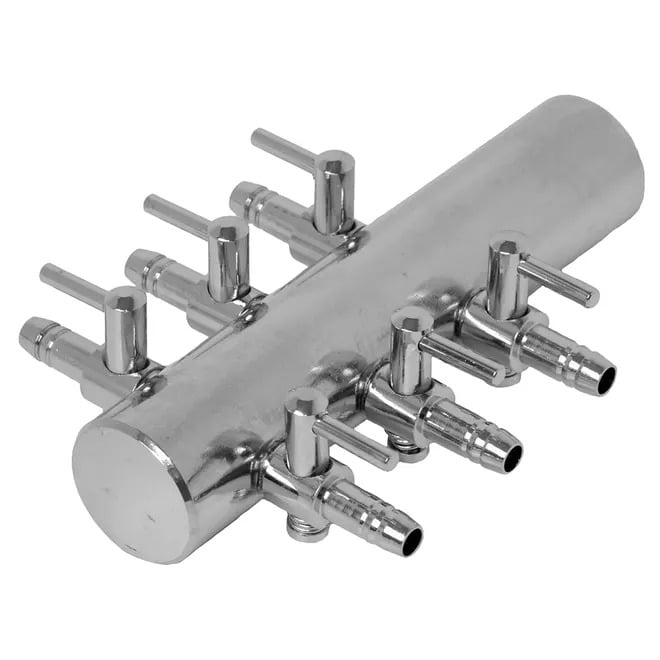
Where a circuit needs several small branches, compare our air pump manifolds with an 18mm inlet. Check the combined branch capacity and the requirements of your diffusers before choosing a manifold; matching the inlet alone does not establish that a complete air circuit is suitable.
Positioning and installation
The operating manual specifies a dry, well-ventilated indoor location, with the pump horizontal on its mounting feet and supported by a firm, slip-resistant base. For pond and aquarium aeration, it also requires the pump to be above the water level to help prevent water entering it. Keep access to the air intake and service cover clear when deciding where to place the unit.
Do not place the pump in the water or leave it where water can spill onto it. A small unventilated box can also create a different problem by restricting cooling. The published operating-air temperature range is -10°C to +40°C; follow the complete manual for the installation environment and electrical connection. Match the supply to the rating plate and use a properly earthed electrical connection.
Power consumption and continuous use
The published 31W and 41W values apply at the rated pressure. For perspective, 24 hours at those stated inputs would use approximately 0.744kWh and 0.984kWh respectively. This is a calculation from the rated figures, not a measured running-cost promise for your installation. Actual consumption depends on the operating conditions, and the electricity tariff determines the cost.
Choose the pump that meets the air demand at the required pressure. Selecting the lowest wattage without checking airflow can leave a circuit undersupplied. Equally, an unnecessarily large pump should not simply be restricted without regard to its permitted operating range. Thomas specifies operation within the published pressure range and advises against running the pump at zero pressure.
Maintenance and built-in protection
These AP models have thermal protection and a diaphragm protection switch. The thermal protection can reset after the pump cools, while the diaphragm switch responds to a diaphragm failure or an external impact. A stopped pump therefore needs its cause investigated; repeatedly restarting it is not a substitute for checking the installation and condition of the working parts.
The manufacturer recommends cleaning the air-filter element every three months and replacing it every twelve months. Isolate the electrical supply before maintenance and follow the servicing requirements in the manual. Little or no airflow, unusual noise or a persistent protection trip should be investigated by suitably trained service personnel. Keep the exact model and part number with your installation records so replacement service parts can be identified correctly.




Reviews
There are no reviews yet.