






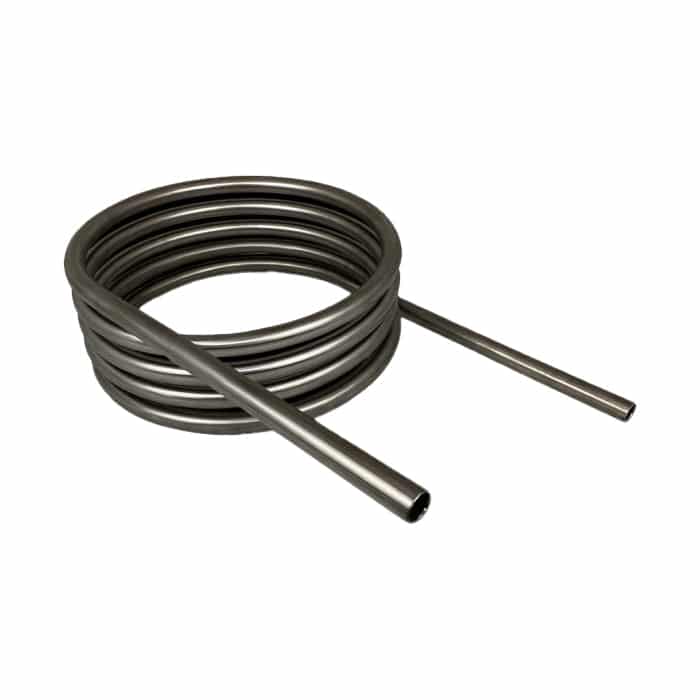
30kW Titanium Submersible Pond Heat Exchanger – 22mm
| Brand | |
|---|---|
| Heat Transfer Rating | Approximately 30kW at approximately 50°C temperature difference |
| Primary Connection | 22 mm |
| Heat Output | Approximately 30kW at approximately 50°C temperature difference |
| Material | Titanium |
| Heating type | Heat exchanger |
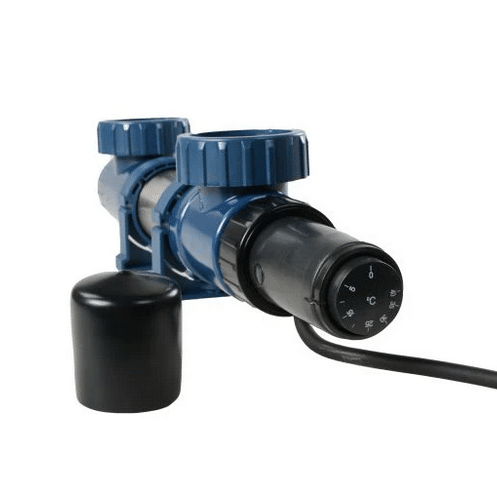
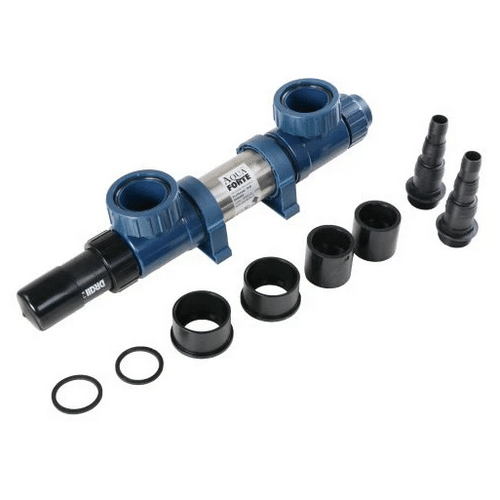
30kW titanium submersible pond heat exchanger with 22mm primary connections for a professionally designed boiler or heat-pump circuit. Requires correct flow, controls and guarding.
£349.99 (inc VAT)
30kW Titanium Submersible Pond Heat Exchanger – 22mm
Air-Aqua titanium heating coil for a professionally designed pond circuit
This Air-Aqua 30kW titanium submersible heat exchanger transfers heat from a boiler or heat-pump primary circuit into pond water without placing a conventional inline restriction in the pond pipework. The titanium wetted surface offers strong corrosion resistance for demanding koi, aquaculture and salt-tolerant applications.
It is supplied with 22mm primary connections and must be matched to a correctly controlled heating circuit. Air-Aqua quotes approximately 30kW heat transfer at a temperature difference of approximately 50°C. The actual transfer depends on the installed conditions; a lower-temperature heat source must not be assumed to deliver the nominal rating.
When a submersible exchanger is useful
- Titanium pond-water contact surface
- 30kW nominal heat-transfer class
- 22mm primary heating connections
- Avoids putting the main pond flow through a compact inline heater
- Suitable for a controlled external boiler or heat-pump circuit
- Can be positioned in a compatible high-flow chamber
Specifications and dimensions
| Nominal heat-transfer rating | Approximately 30kW at approximately 50°C temperature difference |
|---|---|
| Primary connections | 22 mm |
| Wetted material | Titanium |
| Installation | Submersible secondary side |
| Product reference | HE853T |
| Brand | Air-Aqua |
| Overall drawing dimensions | 590 × 370 × 130mm |
Designing the heating circuit
A competent heating engineer should calculate pond heat loss, primary temperatures, pump duty, expansion, pressure relief, isolation and temperature control. The exchanger needs good pond-water movement across its surface and must be protected from fish contact and physical damage.
Use independent thermostatic control with appropriate over-temperature protection. Insulate the pond and exposed pipework, and consider a cover: reducing heat loss often provides a larger running-cost saving than increasing the nominal exchanger size.
Frequently asked questions
Does it include a boiler?
No. It is a heat exchanger for connection to a separately designed heat source and primary circuit.
Can it run from domestic heating?
Potentially, but the circuit, controls and separation must be designed by a competent heating engineer.
Why titanium?
It provides excellent corrosion resistance on the pond-water side.
Will it heat any pond?
No. Performance depends on heat loss, primary temperature and flow, pond-water movement and the chosen set point.
Can fish touch it?
Install it in a protected chamber or with a suitable guard so fish cannot contact a hot or rigid surface.
Complete or compare the system
Useful sections: pond heat exchangers · pond heating.
Choosing and installing a submerged heating coil
Match the temperature conditions
A heat exchanger transfers energy from one water circuit to another; it does not generate its own heat. The available temperature difference is therefore a central part of selection. Ask your heating engineer to compare the primary supply temperature, return temperature and intended pond temperature with the conditions behind the rating. A coil connected to a low-temperature source cannot automatically be treated as equivalent to the same coil supplied by a hotter boiler circuit.
This distinction also matters when comparing an exchanger with an air source heat pump or a direct electric heater. A heat pump’s quoted output comes from specified air and water conditions. A direct electric heater’s rating describes electrical heating input. The exchanger’s nominal figure describes transfer between circuits. These numbers may all be expressed in kilowatts, but they answer different questions and should not be used as a simple pond-volume conversion.
Allow space around the coil
The drawing gives an overall length of 590mm, width of 370mm and depth of 130mm, with 22mm tube ends. These measurements are the starting point for checking a chamber, not the complete installation clearance. Allow additional room for connections, support, access and removal. Check the route into the chamber as well as its internal dimensions before ordering: a coil that fits inside still needs to pass through the opening.
Keep pond-water movement around the submerged surface in mind. Avoid a position that can become isolated when a valve closes or a chamber is drained. The system designer should account for cleaning and maintenance conditions as well as normal running. Supporting the primary pipework separately also avoids using the coil connections to carry the weight of long pipe runs.
Budget for the complete system
The purchase price of the exchanger is only one part of the installation. Include the heat source, suitable circulation, temperature sensing, controls, pipework, insulation and professional commissioning in the project budget. An existing domestic boiler does not automatically mean that a pond connection is straightforward or that all of its rated output is available for the pond.
After installation, record the pond temperature and actual energy use through changing weather. This helps distinguish an undersized heat source from excessive heat loss or a control problem. A cover and protected pipework can reduce the demand that the heating system has to meet. For a comparison of complete heating approaches, return to our pond heating guide before committing to the surrounding equipment.







Reviews
There are no reviews yet.