





Charles Austen ETI Series Air Pumps
A graduated range of linear diaphragm pumps for ponds, filters, reservoirs and multi-outlet aeration
The ETI range gives a useful ladder of air outputs without jumping straight to a very large compressor. Our current selection runs from the ETI60 at 30 litres per minute through the ETI80, ETI100, ETI120 and ETI150 to the ETI200 at 100 litres per minute.
All six models are listed with a published pressure of 0.12 bar. That makes the comparison easier, but it does not remove the need to account for depth and restriction. Free air at the pump is not the same as useful air through a diffuser at the bottom of a pond.
These are clean, oil-free linear diaphragm pumps. They suit continuous aeration where a quiet, serviceable pump is preferable to a small aquarium unit working flat out.
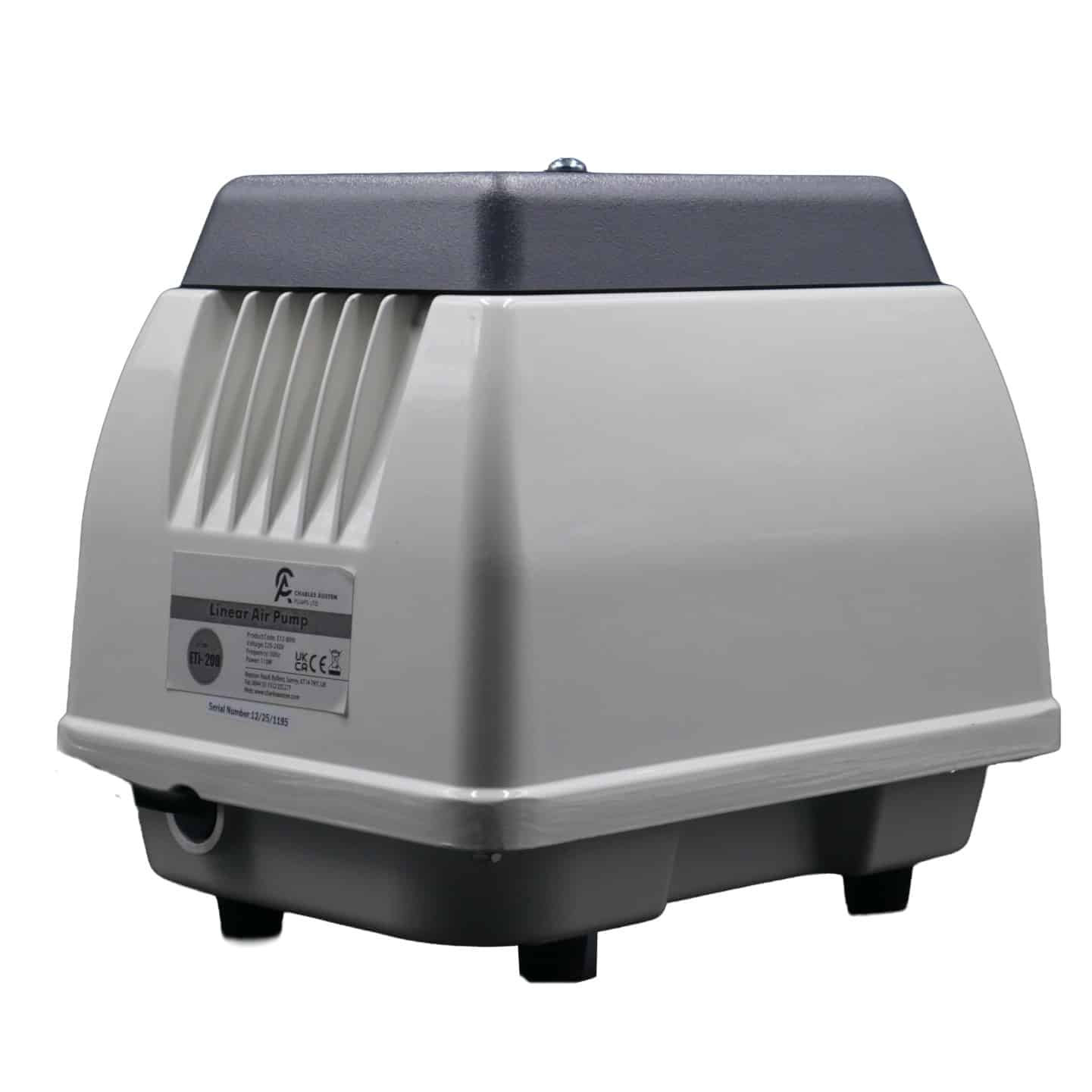
Models in the Charles Austen ETI range
Compare the ETI60, ETI100 and ETI200 as reference points across the range. The correct choice depends on required airflow at pressure, not the model number alone.
Understanding the ETI model steps
The ETI60, ETI80 and ETI100 are rated at 30, 40 and 50 l/min. The ETI120, ETI150 and ETI200 step up to 60, 80 and 100 l/min. Current product data lists power inputs of 25, 30, 47, 55, 85 and 105 W respectively. Those figures let you compare the range, but the final choice still depends on where the pump will operate on its pressure curve.
For a small pond with one or two sensible diffusers, the lower models may be enough. Several deep diffusers, a moving bed or a longer manifold normally points towards the larger end.
Matching the pump to the job
For pond aeration, decide what the air must achieve: surface movement, deep circulation, emergency oxygenation or filter agitation. A moving-bed filter can consume most of a pump output on its own. If pond diffusers share the same supply, allow for both duties at once.
For aquaculture, reservoirs or several tanks, use a ring main or properly sized manifold so branches can be balanced without strangling the pump. Where one outlet is much deeper than the rest, it may need separate control.
A tidy installation lasts longer
Keep the pump dry, ventilated and clear of dust. Support the airline so condensate cannot run back to the pump, and inspect non-return valves rather than assuming they last forever. Clean or replace blocked diffusers; forcing air through a fouled membrane raises pressure and wastes electricity.
Linear diaphragm pumps are serviceable. Plan for diaphragm and filter maintenance, especially if aeration is essential to fish welfare or biological treatment.
What we would ask before recommending one
Tell us more than the pond size. We want the deepest air-stone position, diffuser type, number of outlets, airline bore and whether any moving-bed media is connected. With those details, we can distinguish a comfortable ETI installation from one that is marginal from day one.
Useful Related Categories
If you are planning the complete installation, these sections are usually the most useful next step: All pond air pumps · Air manifolds · Air stones and diffusers · Air-pump service kits.
Frequently Asked Questions
What outputs are available in the ETI range?
The current range on this page spans 30, 40, 50, 60, 80 and 100 litres per minute across ETI60 to ETI200.
Which ETI pump is best for a koi pond?
There is no single model for every koi pond. Depth, stocking, filter aeration, diffuser type and pipework determine the useful output required.
Can an ETI pump run several diffusers?
Yes, if its working output is adequate and the diffusers are connected through a correctly sized, adjustable manifold.
Is the ETI series suitable for continuous use?
It is designed for dependable aeration duties, but installation, ventilation and servicing must follow the current manufacturer instructions.
What does 0.12 bar mean for my pond?
It is a published pressure reference for the range. The pump still has to overcome water depth and the resistance of airline, valves and diffusers.
Can I use the ETI60 on a deep pond?
Possibly for a modest diffuser load, but depth reduces delivered air. Check the actual duty rather than relying on the 30 l/min headline.
When should I move up to an ETI150 or ETI200?
When the system has several outlets, deeper diffusers, a demanding moving bed, long pipework or a need for sensible reserve capacity.
Do I need a manifold?
A manifold is the cleanest way to divide and balance air between multiple outlets. Choose one with a main bore appropriate to the pump output.
Can I throttle unused outlets?
Balance outlets carefully, but do not close the system so heavily that the pump works against excessive back pressure.
Should the pump sit above water level?
That is usually the safest arrangement where practical. Otherwise use suitable backflow protection and follow the installation instructions exactly.
Why has my airflow reduced over time?
Blocked inlet filters, worn diaphragms, fouled diffusers, kinked airline and failed non-return valves are common causes.
Can ETI pumps aerate a filter and pond together?
Yes, provided the combined duty is calculated. We normally prefer separate adjustable branches so the filter cannot rob all the air from the pond.
Are these pumps oil-free?
Yes. Linear diaphragm technology supplies clean, oil-free air.
How much spare capacity should I allow?
Enough to cope with normal diffuser fouling and seasonal demand without grossly oversizing. The right margin depends on how critical the aeration is.
Can you help compare the ETI models?
Yes. Send us your diffuser count, working depth, airline layout and intended use and we can narrow the range sensibly.
