





Charles Austen ETD Series
Charles Austen ETD Series Air Pumps
High-output, oil-free aeration for large ponds, treatment systems and demanding installations
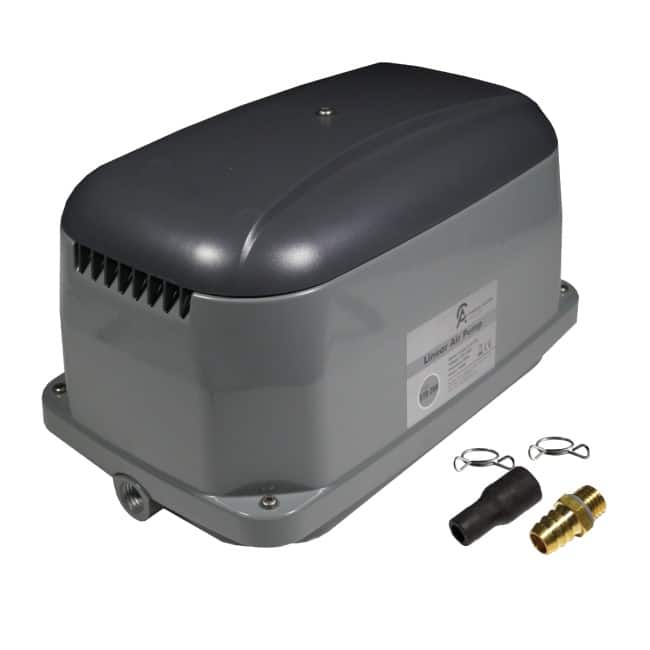
The Charles Austen ETD range is the step up when an ordinary pond air pump no longer has enough reserve. The ETD150 and ETD200 are double-diaphragm units rated by the manufacturer at 150 and 200 litres per minute respectively at 0.15 bar. They are intended for substantial aeration duties, including larger ponds and wastewater treatment systems.
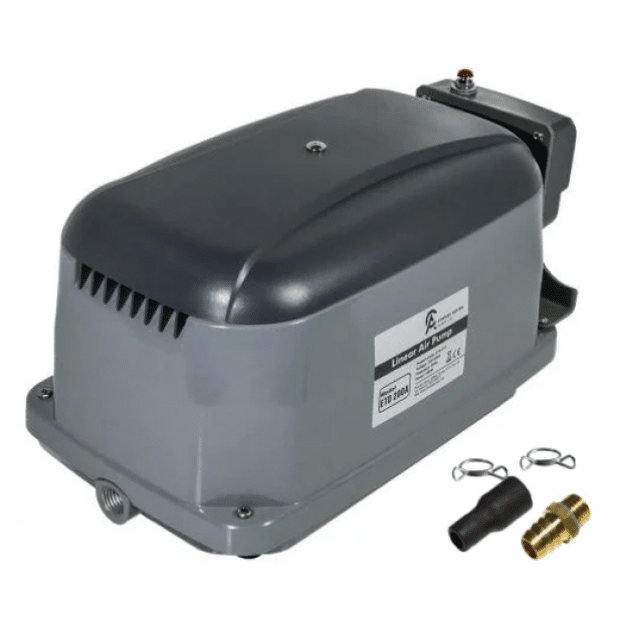
Alarmed ETD150A and ETD200A versions add low-pressure monitoring. That matters where loss of air could threaten a treatment process, a heavily stocked holding system or a biological filter before anybody notices that the bubble pattern has changed.
These are serious air pumps, but they still need a properly designed airline. Correct bore, sensible diffuser loading and protection from water ingress make a much bigger difference than squeezing an impressive free-air number into restrictive pipework.
ETD150 or ETD200?
The ETD150 is rated at 150 l/min at 0.15 bar and the ETD200 at 200 l/min at 0.15 bar. Manufacturer data lists 130 W for the ETD150 and 160 W for the ETD200, with a stated noise figure of 45 dB(A). The correct choice depends on the working pressure and the total diffuser demand, not on the model number alone.
Where the system is close to the ETD150 limit, the ETD200 normally gives a more comfortable margin. Where air demand is well within the smaller unit and electricity use matters, the ETD150 may be the neater answer.
When the alarmed A models are worth choosing
The A suffix models incorporate low-pressure alarm functionality. They are a good fit where an airline failure, detached hose or diaphragm problem needs to be noticed promptly. An alarm cannot replace routine inspection, but it adds useful supervision to an installation that may otherwise run unattended.
Before ordering, decide where the alarm will be heard and how the pump will be protected. A warning device hidden in a remote plant room is much less useful than one incorporated into a sensible monitoring plan.
Pipework, manifolds and diffuser design
At these flow rates, narrow airline becomes a bottleneck. Use appropriately sized main airline, keep runs direct and divide the air through a manifold designed for the volume. The diffuser layout should circulate the whole area without forcing every litre through one overly restrictive disc.
Back pressure and water ingress are common causes of poor performance or damage. Check non-return protection, avoid submerged joins where possible and do not close manifold outlets until the pump is left working against excessive resistance.
Servicing and long-term reliability
Charles Austen recommends regular servicing and states that Pro Series motor warranty validation requires annual servicing; diaphragms and filters are consumable parts. We would rather make that clear at the point of sale than pretend an air pump can be forgotten indefinitely. Keep a compatible service kit available where the system is critical.
For a large or valuable system, design for failure as well as normal operation. An alarmed pump, spare diaphragm kit or standby air supply costs far less than discovering an aeration fault after a hot night.
Useful Related Categories
If you are planning the complete installation, these sections are usually the most useful next step: All pond air pumps · Charles Austen service kits · Air manifolds · Air stones and diffusers.
Frequently Asked Questions
What is the difference between the ETD150 and ETD200?
The principal published difference is output: 150 l/min versus 200 l/min at 0.15 bar. The ETD200 also has the higher stated power input.
What does the A suffix mean?
The ETD150A and ETD200A are the low-pressure alarm versions, intended to provide warning when operating pressure falls abnormally.
Are ETD pumps suitable for large koi ponds?
They can be, especially for multi-diffuser or filter aeration duties, but the system must be sized from working pressure, depth and total air demand.
Can an ETD pump run a moving-bed filter?
Yes, where the selected model provides enough air to keep the specified media volume moving while maintaining any other connected aeration points.
Are these oil-free air pumps?
Yes. The ETD series supplies clean, oil-free air using diaphragm technology.
Can I connect the pump to small aquarium airline?
Not as the main delivery line. These high-output pumps need appropriately sized airline and manifolds to avoid restriction and excessive back pressure.
How noisy are the ETD150 and ETD200?
Charles Austen publishes 45 dB(A) for both models. Actual perceived noise also depends on mounting, enclosure ventilation and vibration transfer.
Can the pump be enclosed to make it quieter?
Only in a ventilated, dry housing that does not trap heat. Never seal a continuously running air pump in an unventilated box.
How often should an ETD pump be serviced?
Follow the current Charles Austen instructions. The manufacturer recommends regular servicing and links annual servicing to validation of its Pro Series motor warranty.
What parts normally wear?
Diaphragms and inlet filters are service items. Their life depends on operating pressure, temperature, dust and installation conditions.
Why is correct back pressure important?
Too much restriction reduces airflow and can shorten diaphragm life. Too little pressure may also matter to an alarmed or treatment installation, so the complete system should be commissioned properly.
Should I keep a spare service kit?
It is sensible for critical aeration, treatment plants, stocked holding systems and remote sites where downtime would be risky.
Can one ETD pump aerate several ponds or tanks?
Yes, if the manifold and pipework are correctly sized and each branch can be balanced. Build in isolation valves and consider what happens if one line fails.
Do I choose by pond gallons?
No. Pond volume is useful context, but depth, diffuser type, filter demand and pipe resistance are required to size an air pump responsibly.
Can you help specify the installation?
Yes. Send us the depth, number and type of diffusers, airline route and whether the air is supporting a pond, filter or treatment process.
