







Koi Pond pH, KH and GH: Testing and Keeping Water Stable
Keeping koi pond pH steady
If your pond’s pH keeps falling, check the KH before reaching for a pH treatment. A pH test tells you how acidic or alkaline the water is. KH tells you how well it can resist a change. Looking at both makes it much easier to work out why the pH will not stay steady.
When we are helping with a pond problem, we ask for water readings as well as details of the filter. Clear water can still have very little KH left. And if your tap water is naturally hard, that does not automatically mean the pond needs a treatment.
Here we explain what pH, KH and GH mean, which kits to use and what to check before adding a buffer or pH treatment. Keeping a simple record of your readings is a good place to start.
Test before adding a buffer or pH treatment. Record pH, KH, GH, ammonia, nitrite and temperature, and check the water used for top-ups. If fish are distressed or pH has changed sharply, get advice on the complete set of readings before making a large correction.
What do pH, KH and GH tell you?
| Reading | What it measures | What it helps you check |
|---|---|---|
| pH | How acidic or alkaline the water is. It is a separate reading, without hardness units. | The pond’s current condition and changes through the day or over time. |
| KH / alkalinity | The water’s capacity to neutralise acid and resist pH changes. Pond kits commonly call this carbonate hardness. | Whether there is enough buffering left to keep pH steady. |
| GH / general hardness | Mainly dissolved calcium and magnesium. | The mineral hardness of the pond and its replacement water. |
Hardness and alkalinity are different measurements, even though both may be reported as calcium-carbonate equivalents. Adding sodium bicarbonate can increase alkalinity without supplying calcium or magnesium, so a KH correction does not automatically correct GH. Test them separately.
The US Geological Survey explains general water hardness, and its alkalinity guide explains the acid-neutralising reserve. The word “alkaline” can cause confusion: a high pH reading does not tell you how much buffering the water contains.
What should your pond readings be?
OATA’s guidance for outdoor pond fish gives pH 6.5–8.5, GH 8–18 degrees and KH 5–15 dKH as broad reference ranges. Use these as a guide when looking at your results. There is no need to keep adjusting a settled pond just to put every reading in the middle of the range.
For KH, NT Labs describes 6–8 dKH as desirable and advises maintaining at least 4 dKH. A low or steadily falling result deserves attention before buffering is exhausted. This matters particularly if you feed heavily or top up with soft water.
Look at the fish, the tap water, how much you feed and any recent changes. If a pond has stayed steady within a suitable range, repeatedly adding chemicals to chase a slightly different number can create unnecessary changes. Repeat an unexpected reading with a fresh sample before deciding what to add.
Degrees, ppm and mg/L: compare the same units
One degree of hardness is approximately 17.8 mg/L as calcium carbonate. In dilute pond water, ppm and mg/L are used interchangeably for these hardness results. The conversion applies to GH and KH readings, but the two tests still measure different things. pH has its own scale and cannot be converted this way.
| Degrees of GH or KH | Approximate mg/L or ppm as CaCO3 |
|---|---|
| 4 | 71 |
| 6 | 107 |
| 8 | 142 |
| 10 | 178 |
Write the units next to every result. “KH is 100” and “KH is 6” can describe almost the same alkalinity when the first number is in mg/L and the second is in degrees. A treatment or test instruction that uses a different unit needs converting before you compare it.
A steady pH can hide a falling KH
Suppose your pH looks much the same each week, but KH falls from 8 to 6 and then 4 dKH. These example readings would make us check why the KH is falling, rather than wait for the pH to follow it down. Check the source water, feeding and maintenance, confirm the tests and plan how the buffer will be replenished.
Write the results down, even if you only use a notebook by the test kit. A few weeks of readings can show a change that you would miss by checking one result on its own. If you have recently increased feeding, our ammonia and nitrite guide explains the other readings to watch alongside KH.
Which test kit do you need?
For a good all-round kit, we would include the NT Labs Pond Lab Multi-Test Kit. It measures pH, KH, GH, ammonia, nitrite and nitrate, so you can check hardness alongside the main fish-waste readings with one kit. NT Labs lists up to 200 tests combined; that means across the kit, rather than 200 of each test.
If you already have some of those tests, individual kits may be all you need. A pH pen only measures pH, so you will still need separate KH and GH tests. The PondLab kit does not measure dissolved oxygen or chlorine; use suitable separate equipment when those readings are needed.
| Product | What it covers here | Buying point |
|---|---|---|
| NT Labs Pond Lab Multi-Test Kit | pH, KH, GH, ammonia, nitrite and nitrate. | A useful all-round liquid-drop kit for regular pond checks. Up to 200 tests combined. |
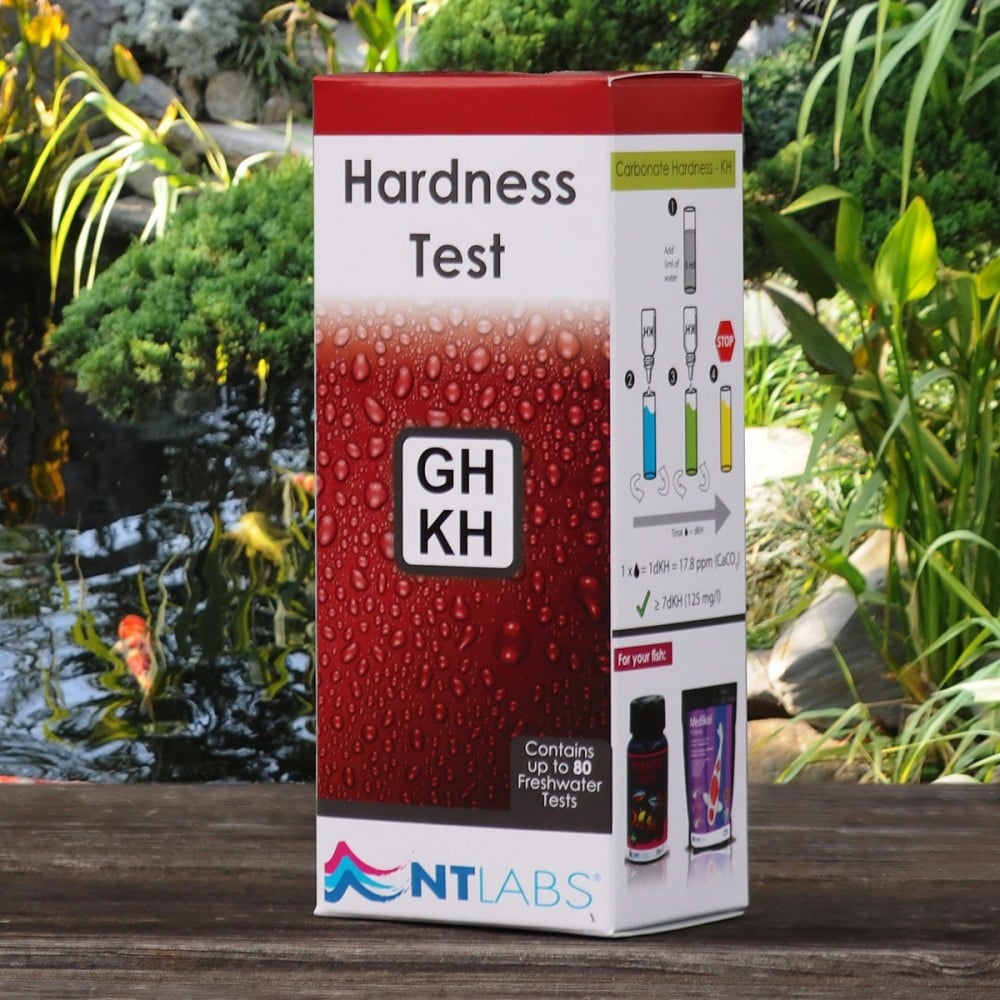
| NT Labs Pond Hardness Test Kit | Separate KH and GH tests. | Useful alongside an existing pH and fish-waste test kit. Follow the different KH and GH procedures. |
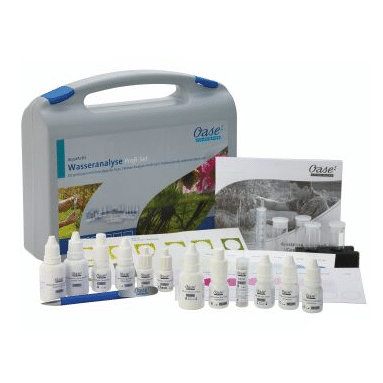
| Oase Water Analysis Profi Test Set | pH, GH and KH alongside other pond-water tests. | A wider kit when you want several readings together; check the included tests and available refills. |
| Hanna HI-3811 Alkalinity Test Kit | Alkalinity by titration. | Its results are reported in mg/L; compare the stated range and calcium-carbonate units with your pond records. |
| Hanna HI98100 Checker Plus pH Tester | pH measurement. | Needs calibration and electrode care, plus separate hardness tests. |
The manufacturers provide the useful detail: Oase lists the Profi-Set contents; Hanna explains the HI-3811 method and units; and the Checker instructions cover calibration and electrode care. You can also browse our water-testing range. Check suitability rather than assuming every marine or pool test is interchangeable with a pond test.
Where does a Hanna alkalinity Checker fit?
If you prefer a number on a screen to judging a titration endpoint, the Hanna HI775 Freshwater Alkalinity Checker is another option. It reports alkalinity in ppm as calcium carbonate, rather than degrees KH. Keep that unit in your record and convert only when comparing it with instructions written in degrees.
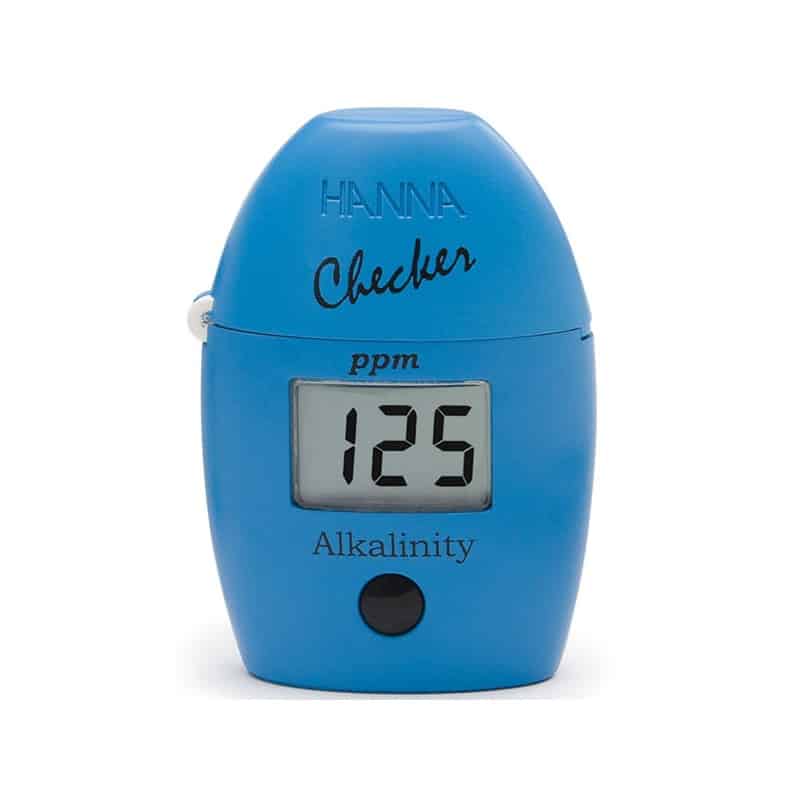
The HI775 uses a reagent reaction and optical reading from a vial. It is not an electrode that you dip into the pond. The manufacturer lists a 0–500 ppm range; use its exact freshwater method and HI775-26 reagents. Do not substitute a similarly named marine alkalinity model or reagent.
Follow any interference instructions in the method, including chlorine handling where required. Wipe the vial, avoid bubbles and use the stated sample and reagent amounts. A digital display does not remove the need for careful preparation.
The Hanna HI3811 remains a titration alternative. A HI98100 pH tester measures pH instead, with calibration buffers and electrode care. None of these single-parameter instruments replaces a GH test. Choose the measurement you need before choosing the instrument.
Getting an accurate test result
It is easy to mistake a testing error for a pond problem. Use the sample volume, reagent sequence, mixing and waiting time specified for your kit. Keep the equipment for each test separate where supplied, rinse as instructed and avoid contamination from previous tests or treatments.
- Measure the sample accurately. Read the level at eye height and use the supplied syringe or marked tube.
- Hold dropper bottles as instructed. Count only the reagent drops that the particular method uses to calculate the result.
- Mix between additions. A titration needs the specified final colour change; it is different from matching a pH sample to a colour card.
- Read colours in suitable light. Follow the chart’s instructions and avoid coloured lighting that changes what you see.
- Check reagents and meters. Observe expiry and storage instructions. Calibrate a pH meter and maintain its electrode as its manual requires.
- Repeat an unexpected result. A second clean sample or another suitable test can help establish whether the reading is real.
For example, the NT Labs KH method uses a 5 ml sample and counts the drops needed to change blue to yellow, including the first drop. A six-drop result is 6 dKH, about 107 mg/L as CaCO3. Its GH procedure uses different reagents and a different endpoint. Use the manufacturer’s instructions for the exact kit rather than transferring that drop count to another brand.
Keep a simple record of date, time, pH, KH, GH, ammonia, nitrite and temperature. Add notes for rain, water changes, feeding changes, maintenance and treatments. Weekly testing is a useful routine for an established pond, with more frequent checks during a problem, a new filter’s maturation or significant changes.
Why does KH fall even when the filter is working?
The biological filter converts fish waste through the nitrogen cycle. That process produces acid and consumes alkalinity. So the filter can be working properly while KH gradually falls, especially if your top-up water is low in KH too.
The Southern Regional Aquaculture Center explains this relationship between filtration, pH and alkalinity. Increasing feeding or fish load changes what the complete system has to handle. Check KH alongside ammonia and nitrite after making those changes.
Why does pH change between morning and afternoon?
Plants, algae, fish and bacteria change the balance of carbon dioxide in the water. Photosynthesis can reduce it in daylight, allowing pH to rise; respiration continues overnight and can lower pH. KH helps resist the change. The FAO’s pond-water guide describes this daily cycle.
For routine comparisons, test at a similar time. If you are investigating swings, take an early-morning and later-afternoon reading over several days, with KH and weather notes. Aeration helps gas exchange, but it does not replenish KH or GH. Our pond aeration guide explains that part of the setup.
Test your top-up water too
Test the top-up water’s GH and KH as well as the pond. A water-company report is useful background, but the actual supply and any treatment fitted to it matter. Check whether the outside tap receives untreated mains water, household-softened water or water from another source.
If the source has useful KH, suitable water changes can help replenish the pond’s buffering. If the source is very low in KH, water changes alone may not provide enough. Rain can dilute minerals too, although the effect depends on the amount entering the pond and its starting conditions.
Mains replacement water also needs appropriate chlorine and chloramine treatment. Dechlorinating it does not automatically correct GH or KH. Plan the volume and temperature change, and keep the filter and fish protected during the work. Our wider koi water-quality guide covers the other checks.
A household ion-exchange softener is not a simple substitute for a pond-water plan: changing calcium and magnesium does not answer the alkalinity, salt or fish-suitability questions. Reverse-osmosis water also needs deliberate blending or remineralisation and monitoring. Get advice before introducing either to an established koi pond.
Compare pond and source water on the same basis
Use clean equipment and note where each sample came from. Water at the garden tap may differ from a softened kitchen supply, collected rainwater or a separate treatment outlet. A regional hardness description is useful background, but it is not the same as testing the supply you actually put into the pond.
Keep GH and alkalinity in separate columns, even when both are expressed as mg/L as calcium carbonate. Those matching units do not mean the tests measure the same substance. If you are changing instruments, run a careful comparison and keep both method names with the results before interpreting an apparent jump.
What should you do about low KH?
Confirm the reading, check pH and ammonia, and establish the pond’s actual water volume. Then choose a pond buffer intended for the measured problem. Our pH, KH and mineral treatments include products with different purposes; some address alkalinity, some general hardness, and some both.
NT Labs KH Buffer Up is intended to replenish carbonate hardness. Follow the current pack’s dose, preparation and limits, using the correct pond volume and units. Its manufacturer guidance describes dissolving the powder in pond water before adding it.
Measure the dose carefully, allow it to mix through the pond and retest as the instructions say. Write down what you added and when. Do not combine several buffers or pH products at once, or keep adding more because the water has not reached a chosen number immediately. A severely depleted buffer or pH crash needs prompt, informed assessment.
Check ammonia before raising pH. Increasing pH changes the proportion of ammonia in its more toxic, un-ionised form. If ammonia is present or the fish are distressed, get advice on correcting the complete problem while maintaining aeration and investigating the filter. Do not make a large pH change in isolation.
University of Florida guidance on ammonia explains how pH and temperature affect this risk. Our ammonia and nitrite guide covers the pond checks. Keep the test’s reporting units with the result when asking for help.
What about high pH or high GH?
Confirm a high pH reading and compare morning with afternoon before choosing a treatment. Test the source water and KH, and review algae, recent additions and new construction materials where relevant. A new cement-based feature needs the correct preparation and curing; it should not be left to alter pond chemistry unchecked.
Do not use acid simply to chase a lower number. It consumes alkalinity and can create a sharp change. Find out why the pH is high before repeatedly adding pH-down and then buffer to correct the next change. Get advice if readings are outside a suitable range or vary substantially.
High GH on its own does not prove that KH is high or that pH is unstable. If GH is low and needs correcting, choose a freshwater pond mineral product that suits the measured deficiency. Salt, a KH-only buffer and general mineral supplements do different jobs. Retest both hardness readings after an adjustment.
How often should you check GH and KH?
Test often enough to know how your pond changes. Weekly readings can establish a useful routine in a settled pond, while falling KH, increased feeding, a new filter or a change in water supply needs closer attention. The right interval depends on the change you are following, not simply the day of the week.
After using a product, follow its mixing and retesting instructions. Keep the amount and time in the same record so someone else does not add another dose without realising. If readings remain unexpected, check the method and source water rather than repeatedly alternating between a pH treatment and a buffer.
For a sudden high or low pH result, our separate pH troubleshooting guide covers the investigation in more detail. This guide is the reference for understanding the different hardness readings and planning how the pond’s mineral supply is maintained.
Questions we hear about pond hardness
Can KH be low when the water is hard?
Yes. GH and KH tell you different things, so one cannot stand in for the other. Test both before buying a treatment. The NT Labs hardness kit includes separate procedures for those two readings; a pH-only meter will not answer either question.
Does more aeration raise KH?
No. Aeration exchanges gases with the air and can change pH where carbon dioxide is involved, but it does not add the alkalinity that a KH test measures. Keep the aeration the fish and filter need, and investigate low KH separately.
Should every koi pond be adjusted to the same pH?
We would look at stability, the fish and the full readings before deciding anything needs adding. Do not use a treatment just to copy a number from somebody else’s pond. Our pond water-quality guide puts pH alongside the other checks that matter.
Common readings and what to investigate
| What you find | What to check | Useful next step |
|---|---|---|
| pH falls over several days | KH trend, source-water KH, feeding and recent changes. | Confirm all readings and plan to restore depleted buffering where needed. |
| pH rises through the day | Morning/afternoon pattern, algae, KH and aeration. | Keep timed records and investigate substantial swings. |
| GH looks high but KH is low | Units and separate test procedures. | Treat the measured alkalinity problem; do not assume GH supplies the missing buffer. |
| Ammonia is present with a pH problem | Temperature, oxygen, filter function and test reporting units. | Address the complete water-quality problem before a large chemical correction. |
| A meter disagrees with a drop test | Calibration, electrode condition, reagent age, range and technique. | Repeat carefully with suitable equipment before dosing. |
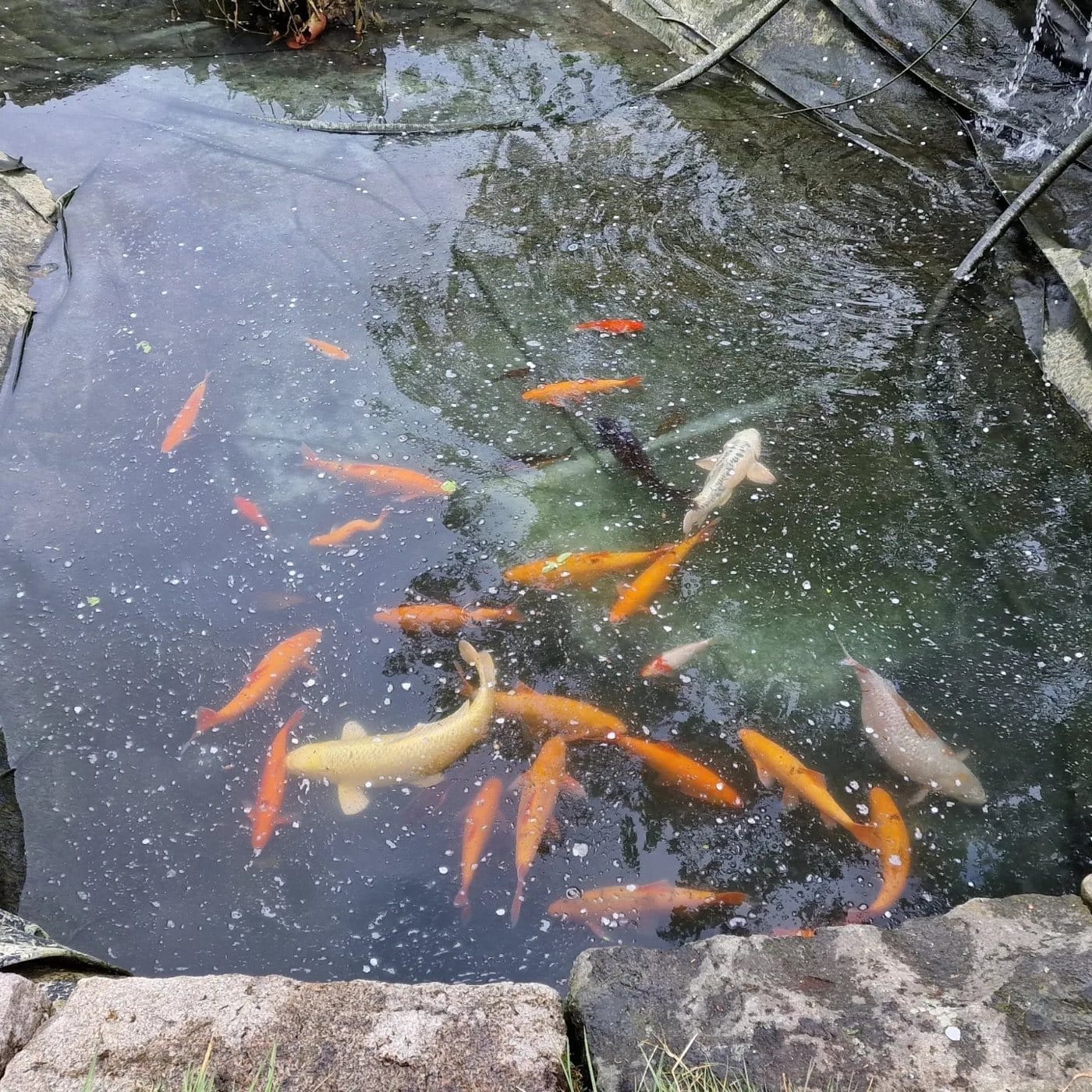
If you would like help, send us your readings, when you took them and what the fish are doing. Tell us the pond size, what you feed, which filter you have and whether anything has changed recently. A photograph of the pond and equipment helps too. We can give much more useful advice with those details than with a pH number on its own.
Browse our pond water-testing equipment or contact us about your pond. For ongoing help, our pond maintenance service covers the wider system and routine care.
