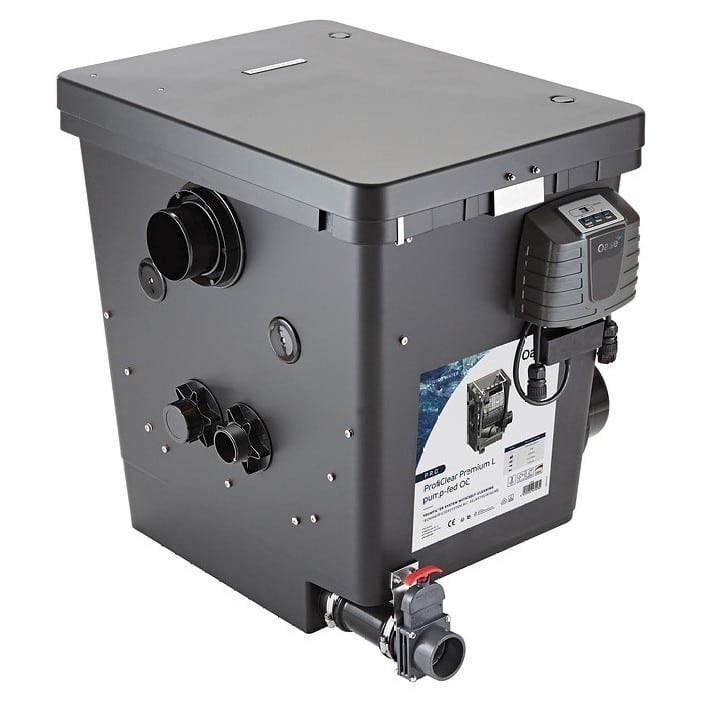
Oase ProfiClear Premium L Modular Filter System – Frequently Asked Questions
Below are the most common and in depth questions we receive about the Oase ProfiClear Premium L Modular Filter System. These answers are based on real world installations across large koi ponds and advanced ornamental systems.
What is the Oase ProfiClear Premium L Modular Filter System?
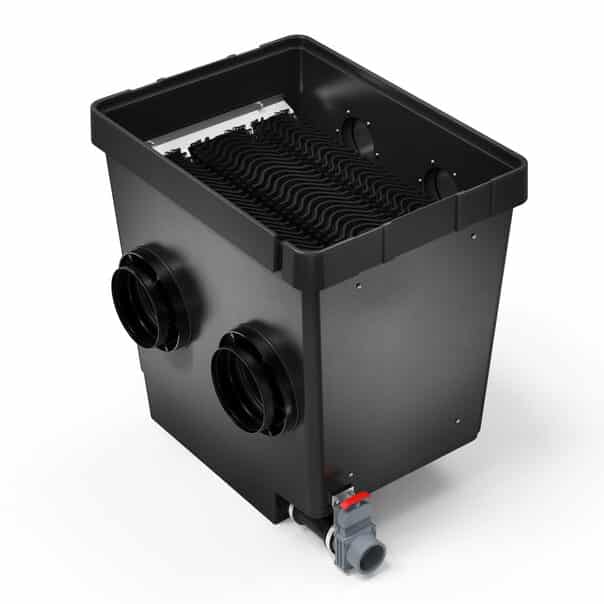
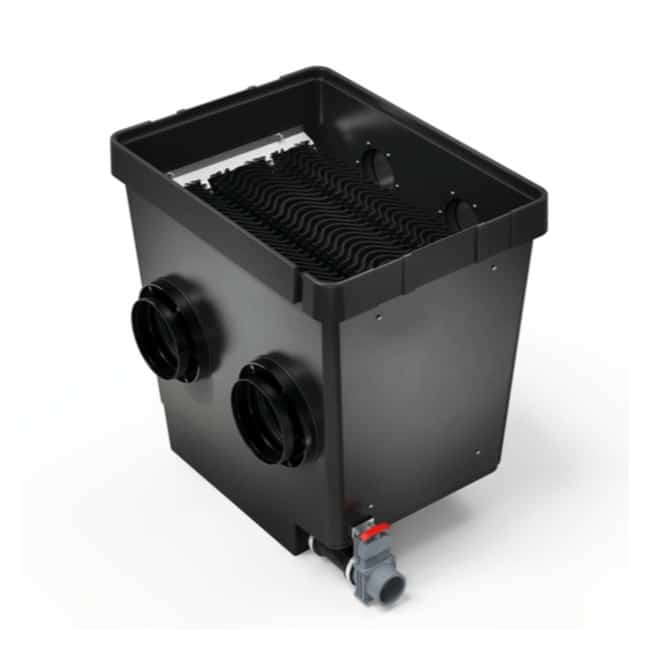
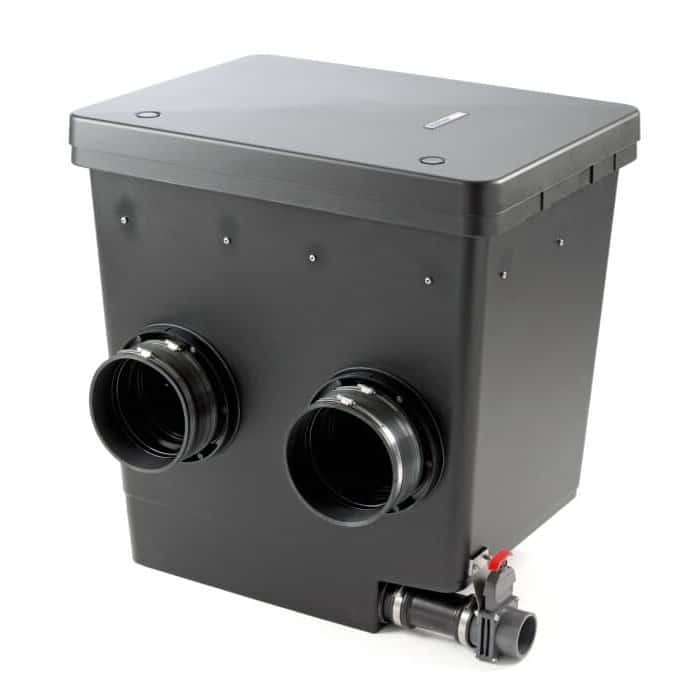
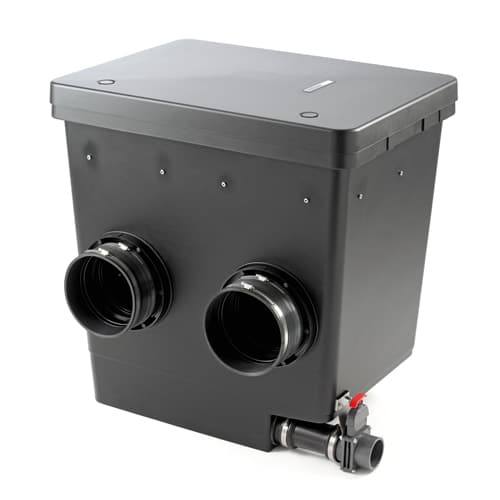
The Oase ProfiClear Premium L Modular Filter System is a professional drum based pond filtration platform designed for large koi ponds and heavily stocked ornamental ponds. It combines automated mechanical drum filtration with high capacity biological filtration using Hel X media.
Unlike fixed filters, the modular structure allows the system to be expanded or adjusted depending on pond size, fish stocking density and hydraulic layout.
How does the ProfiClear Premium L drum filter work?
Water enters the drum chamber where fine mesh screens capture solid waste down to 60 microns. When the screen becomes blocked, the system activates an automatic cleaning cycle that rinses debris away without interrupting water flow.
This keeps mechanical filtration consistent and significantly reduces manual maintenance compared to foam or multi bay filters.
Is the ProfiClear Premium L suitable for heavily stocked koi ponds?
Yes. The ProfiClear Premium L is designed to cope with high waste loads generated by koi.
The drum stage removes solid waste before it breaks down, while the moving bed biological stage supports large colonies of beneficial bacteria that convert ammonia and nitrite into safer compounds.
It is ideal for serious koi keepers running higher feeding levels.
What pond size can the ProfiClear Premium L handle?
Capacity depends on configuration rather than a single fixed number. It is commonly used on large private koi ponds and substantial ornamental systems.
Sizing depends on:
- Total pond volume
- Fish stocking density
- Feeding rate
- Desired turnover rate
- Number of biological modules installed
Correct specification ensures stable long term water quality.
What is the difference between ProfiClear Premium Compact, L and XL?
ProfiClear Premium Compact is a more integrated solution suited to medium and large ponds with a smaller footprint.
ProfiClear Premium L offers modular expansion for larger koi ponds and serious private installations.
ProfiClear Premium XL is designed for estate, commercial and very high volume installations requiring maximum scalability.
Choosing between them depends on pond size, growth plans and available filter space.
Can the ProfiClear Premium L be used on a swim pond?
While typically used for koi and ornamental ponds, it can be used on swim ponds where high capacity mechanical and biological filtration is required.
However, full swim pond design should also consider circulation zones and regeneration areas.
Does the ProfiClear Premium L require a bottom drain?
No, but it performs best in gravity fed systems using bottom drains and skimmers.
It can also be installed as a pump fed system in retrofit situations where bottom drains are not present.
Can the ProfiClear Premium L be installed above ground?
Yes, depending on configuration. Gravity fed systems are typically installed at water level. Pump fed systems offer more flexibility in positioning.
Installation planning should consider pipe runs and access for servicing.
How often does the drum filter clean itself?
The drum activates its rinse cycle automatically when the screen becomes restricted. Cleaning frequency depends on:
- Fish load
- Feeding rate
- Debris levels
- Seasonal changes
Heavily stocked ponds may trigger more frequent rinses during summer feeding.
Does the ProfiClear Premium L reduce blanketweed or green water?
The drum stage removes suspended solids but does not directly kill algae.
For green water control, it should be paired with a correctly sized UV clarifier. Nutrient control through effective biological filtration also helps reduce algae growth over time.
What maintenance is required on the ProfiClear Premium L?
Maintenance is significantly reduced compared to traditional filters.
However, regular checks should include:
- Inspecting spray bars and drum mesh
- Checking pump flow and head pressure
- Ensuring biological media movement is active
- Replacing UV bulbs annually if fitted
Routine inspection prevents performance drop.
What pumps should be paired with the ProfiClear Premium L?
High efficiency, high output pumps are required to maintain proper turnover in large ponds.
Pump selection should be based on:
- Head height
- Pipe diameter
- Target litres per hour
- Total system resistance
Incorrect pump sizing is one of the most common causes of underperformance in large drum systems.
Is the ProfiClear Premium L energy efficient for a large pond?
When properly specified, yes.
Because the drum only cleans when necessary and modern pumps can regulate flow, overall energy usage can be controlled effectively even in large systems.
Energy efficiency is heavily influenced by correct hydraulic design.
Can I expand the ProfiClear Premium L in the future?
Yes. One of the biggest advantages of the L platform is modular expansion.
If fish load increases or pond volume grows, additional biological modules can be added to increase processing capacity.
Planning for future expansion is often advisable in koi pond builds.
Is the ProfiClear Premium L worth upgrading from a traditional multi bay filter?
In most cases, yes.
Drum filtration removes solid waste far more efficiently and with less manual cleaning. Biological processing is also more controlled due to constant oxygenation in the moving bed stage.
For serious koi ponds, upgrading to a drum based modular system often improves water clarity and reduces maintenance workload.
Why is correct specification so important for modular drum filtration?
Modular systems must be balanced correctly.
Undersized biological capacity can lead to ammonia spikes. Excessive pump flow can reduce dwell time. Poor layout can cause inefficiency.
We regularly specify and install these systems, so we understand how they behave under genuine waste loads and heavy feeding regimes.
Correct setup at installation stage prevents costly mistakes later.