






Ammonia and Nitrite in Koi Ponds: Tests and What to Do
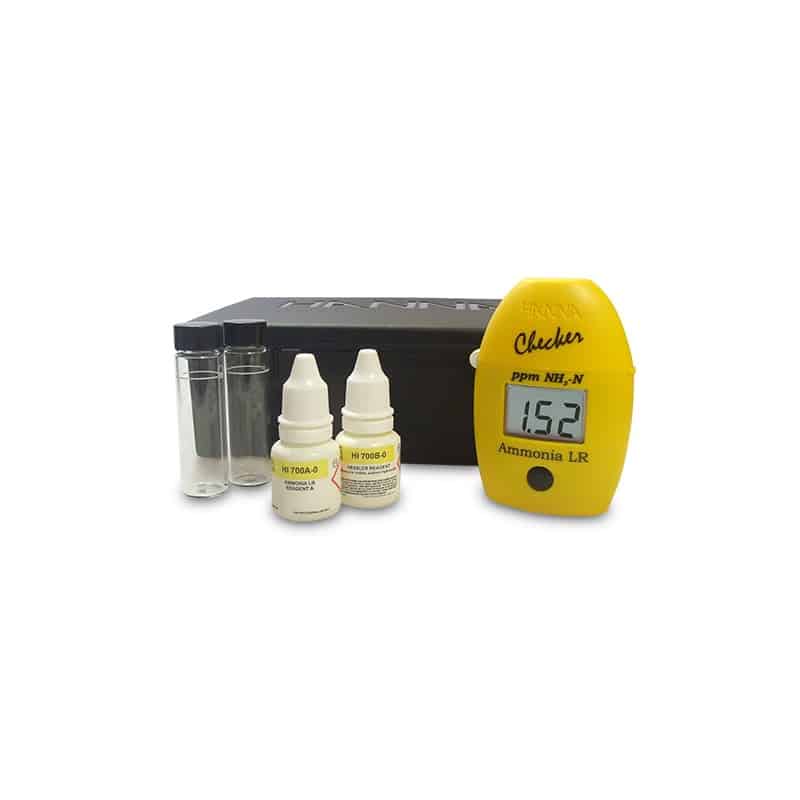
Hanna HI700 measures low-range ammonia-nitrogen. It is not a free-ammonia probe.
What to check when ammonia or nitrite is showing
If a test shows ammonia or nitrite, take it seriously even when the pond looks clear. Both can be present without changing the colour of the water. The aim is to protect the fish now, then find out why the system is not handling the waste.
That might follow a new filter, heavier feeding, a stopped air pump, a large clean or an unsuitable top-up. An established pond is not exempt. A fault can change conditions quickly, and the water result is often the first useful clue.
This guide is for koi-pond checks and recovery. If fish are struggling to breathe, losing balance or deteriorating quickly, provide suitable aeration and seek prompt specialist help while checking the water. Do not wait for a second symptom before acting.
What to do when a result is above zero
- Look at the fish. Note breathing, balance, appetite and whether one fish or the whole pond is affected.
- Check air and circulation. Confirm air reaches the diffusers and water passes through the intended filter stages. A running motor is not proof of delivery.
- Pause routine feeding while an elevated result is investigated. Adding more food adds more waste. Young fry, other species and prolonged interruptions need their own advice.
- Check the result and related tests. Repeat an unexpected test correctly and record ammonia, nitrite, pH, KH and water temperature with their units.
- Assess replacement water and a controlled water change. Check conditioning, temperature and the incoming chemistry before assuming a large change is harmless.
- Find the cause and keep checking. A temporary reduction does not prove the filter has recovered.
These checks can overlap. Restoring a failed air supply should not wait until a colour test has finished developing. Likewise, increasing air is sensible support, but does not tell you whether the cause was low dissolved oxygen, nitrite or a gill problem.
Have the pond’s verified volume, current results and recent treatment history ready when asking for help. If the volume is uncertain, see our pond-volume guide. A medicine or additive measured for an exaggerated pond size can create another problem.
Ammonia, ammonium, nitrite and nitrate are different things
Fish produce ammonia as part of normal metabolism; uneaten food and decaying material add to the load. Biological filtration converts ammonia through nitrite to nitrate. Mechanical filtration removes particles, while biological filtration deals with these dissolved waste products.
A drum screen therefore does not directly turn ammonia into harmless water. It removes solids before they break down further. A Combi system also has biological media, but the two jobs should not be confused. Our filtration guide explains the stages.
| Result | What it means | Important distinction |
|---|---|---|
| Ammonia / total ammonia | A combined measurement of ammonia forms, depending on the method. | It is not automatically a direct reading of free un-ionised NH₃. |
| Ammonia-nitrogen, NH₃-N or TAN as N | The result is expressed by the nitrogen part of the measured compounds. | Compare it with a reference using the same reporting basis. |
| Nitrite, NO₂⁻ | An intermediate waste product that can impair oxygen transport in fish. | Different from nitrate; a nitrate kit cannot substitute. |
| Nitrite-nitrogen, NO₂-N | Nitrite reported by its nitrogen content. | A different numerical result from the same amount reported as nitrite ion. |
| Nitrate, NO₃⁻ | A later product that can accumulate in a recirculating pond. | A nitrate reading does not prove that ammonia and nitrite are zero. |
Why pH and temperature matter to ammonia
Ammonia in water exists as un-ionised ammonia, NH₃, and ammonium, NH₄⁺. The proportion in the more harmful un-ionised form increases as pH and temperature rise. That is why the same total-ammonia result can have a different significance in different conditions.
The University of Florida’s ammonia guidance explains this relationship. Use a correctly matched calculation or professional interpretation if the free-ammonia fraction is needed. Multiplying a nitrogen-based result by a mass-conversion factor alone does not calculate that fraction.
Do not abruptly raise pH in a pond with accumulated ammonia without considering what happens to that balance. Equally, deliberately driving the pH down is not a substitute for restoring a stable, functioning pond. Read our pH troubleshooting guide and KH and GH guide alongside the ammonia result.
Why extra bubbles do not make nitrite harmless
Nitrite can interfere with the blood’s ability to carry oxygen. Fish may gasp even when the water contains reasonable dissolved oxygen. The Southern Regional Aquaculture Center’s nitrite factsheet explains the mechanism.
Keep appropriate aeration running, but investigate and reduce the nitrite problem too. Do not assume fish are safe simply because there is a strong stream of bubbles beside them.
Take a reading you can use
Use a clean sample tube or cuvette and the exact sample volume. Keep reagent bottles upright where instructed, count the drops carefully and use the stated mixing and development time. Old habits from another brand’s kit can produce an unreliable result.
Read colour tests in suitable light against the supplied chart. A coloured wall behind the tube, a phone’s automatic colour correction or a photograph taken under evening lighting can change the apparent match. Record a result between colours honestly rather than choosing the more reassuring one.
The NT Labs Pond Lab Multi-Test Kit covers ammonia, nitrite, nitrate, pH, KH and GH. The maker describes up to 200 tests combined, not 200 of every parameter. It does not include an oxygen or chlorine test.
NT Labs reports its ammonia, nitrite and nitrate results on a nitrogen basis. Its current kit page gives the conversions to the corresponding compounds. Keep the reporting basis beside your figures rather than compare two manufacturers’ numbers without checking.
Individual ammonia and nitrite tests are also useful when repeating one check more often. Follow the formulation actually in the pack: NT Labs has changed its ammonia test from three reagents to two.
Using the NT Labs ammonia test
For the current two-reagent NT Labs ammonia test, the manufacturer instructs a 5 ml sample, five drops of each reagent and a 10-minute wait. The separate nitrite test uses its own shorter reading time. These details show why the timer matters; check your own current instructions rather than apply the ammonia timing to every tube.
If a result is surprising, repeat it with clean equipment and check the expiry date. A second suitable method or professional water test can help resolve a discrepancy. Keep supporting distressed fish while doing that; confirmation is not a reason to delay an obvious equipment repair.
Using Hanna ammonia and nitrite Checkers
A digital display removes the need to choose a colour by eye. It does not remove sample preparation, reagent handling, reaction time or the instrument’s accuracy limit. Choose the model for the parameter and range you need.
| Model | Manufacturer range and basis | What to remember |
|---|---|---|
| Hanna HI700 | 0.00–3.00 ppm ammonia-nitrogen, NH₃-N. | Nessler method; check conditioner interference and the correct HI700 reagent. |
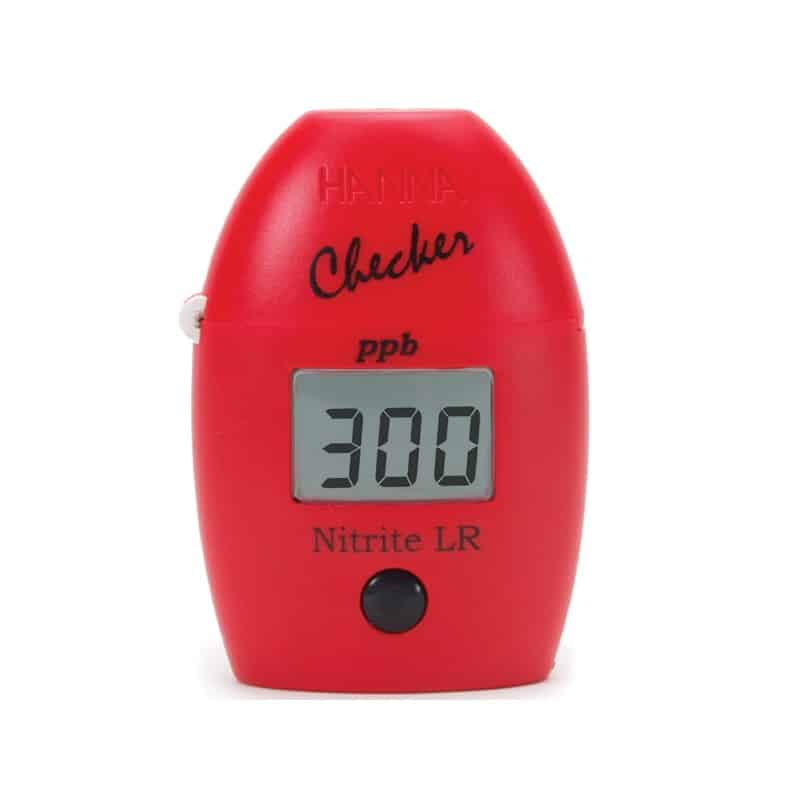
| Hanna HI707 | 0–600 ppb nitrite-nitrogen, NO₂-N. | ppb is not ppm; the result is not nitrate. |
The HI700 specification identifies its nitrogen reporting and Nessler method. The HI707 manual gives the nitrite basis, range and procedure. Use the exact manual if a web description mixes nitrite and nitrate wording.
To compare a HI707 result with a scale in mg/L of nitrite ion, first divide ppb by 1,000, then multiply by 3.29. For example, 100 ppb NO₂-N is 0.100 mg/L NO₂-N, equivalent to 0.329 mg/L NO₂⁻. This is a unit conversion, not a safe-level recommendation.
Keep the outside of the cuvette dry and clean and follow the instructions about bubbles and mixing. Use the correct reagent code and never pour a reacted test sample back into the pond. More decimal places on a display do not mean every tiny change is significant.
Conditioners and ammonia tests can interact
Some ammonia-binding products affect the way particular test methods read the sample. The HI700 uses a Nessler method, so ask about the exact conditioner and test combination rather than assuming a digital instrument avoids chemical interference.
Seachem’s AmGuard information, for example, explains why its binding treatment can conflict with traditional ammonia testing. That is product-specific information, not evidence that every positive result after any conditioner can be ignored. Give the manufacturer both product names when resolving a doubtful reading.
Water changes: check what is going in
A controlled water change can dilute a pollutant if the replacement water contains less of it. Test the source where needed, condition mains water correctly and consider temperature, pH and KH. Do not replace one problem with chlorine exposure or a sudden chemistry change.
Chloramine treatment can also leave an ammonia question that depends on the conditioner and biological filter. A product that neutralises chlorine is not automatically a permanent ammonia-removal system. Read what it actually does and what the test method will show afterwards.
Keep the refill supervised. Establish the volume removed, the volume added and the conditioning dose for that product. A hose left running overnight can cause a much bigger disturbance than the carefully planned change it was supposed to make.
What a 25% change can achieve
In an ideal fully mixed example, replacing 25% of water containing 1 mg/L of a pollutant with water containing none reduces the concentration to 0.75 mg/L. It does not reduce it to zero. Ongoing fish waste and the source water change the real result.
Retest after mixing and use the fish’s condition and the actual results to decide the next step. A fixed daily percentage is not suitable advice for every pond or emergency. Significant distress or a difficult source-water situation needs direct specialist input.
Find out why the filter is falling behind
Check the whole route from the pond through mechanical and biological stages to the return. Look for bypasses, blocked strainers, air locks and valves left in a cleaning position. The equipment can look switched on while the intended water route is not operating.
A new filter or extra food
A new biological filter needs time and appropriate conditions to establish. It is not mature because the water has stood for a week or a bacterial product has been added. Confirm its performance with water tests at the actual feeding load.
Adding fish and increasing feeding both increase the work required. Raise either carefully and test more often. A filter that handled the pond last year may not handle larger fish and a heavier summer feeding routine without adjustment.
Cleaning and replacement media
Remove captured waste using the filter’s proper cleaning method. Avoid stripping all biological media at the same time or rinsing established media in untreated chlorinated water. Replacing every foam or every bag of media in one go can remove much of the established biological surface.
Use model-specific guidance. Our ScreenMatic, Nexus and pressure-filter guides explain why one cleaning routine does not fit every design.
Air, alkalinity and recent treatments
Biological filtration needs oxygen and adequate alkalinity. Check whether a moving bed is moving as intended and whether the air route was restored after cleaning. Check KH if pH is falling or the filter seems to have stopped processing waste normally.
Do not add KH buffer blindly during a serious ammonia problem. The pH effect needs to be considered alongside total ammonia. Bring the results together and get advice if you are unsure how to correct a depleted buffer safely.
Record medication and other recent treatments. Some can affect the biological system, while others may affect the test reading. That history can explain a change which would otherwise look like a filter suddenly becoming too small.
Where bacteria products and zeolite can help
Using filter-start bacteria
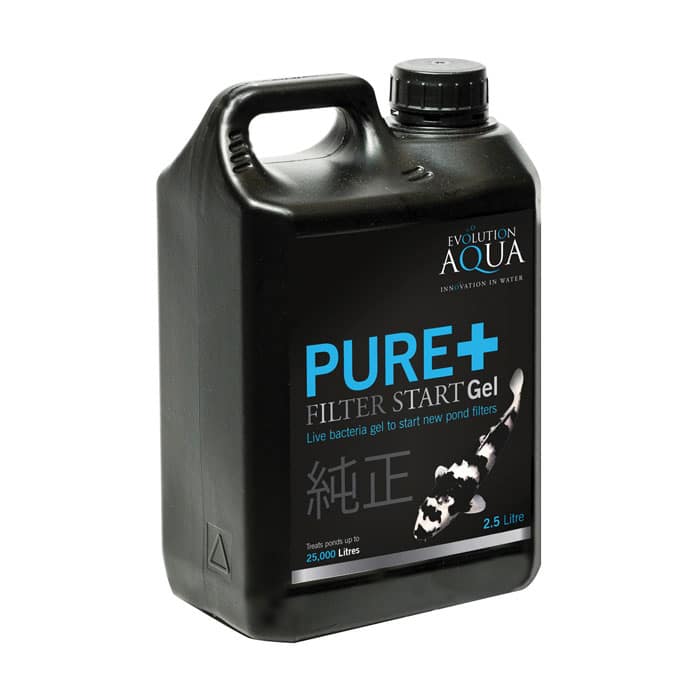
Evolution Aqua PURE+ Filter Start Gel is intended to help establish biological media. Its manufacturer explanation emphasises colonisation and oxygen. Follow its application and UV directions rather than borrow those of another bacterial product.
A starter is not permission to keep feeding through a high reading. It cannot repair a stopped pump or prove instant capacity for a full stock of fish. Continue the water checks and deal with the cause while the filter develops.
Using zeolite for ammonia
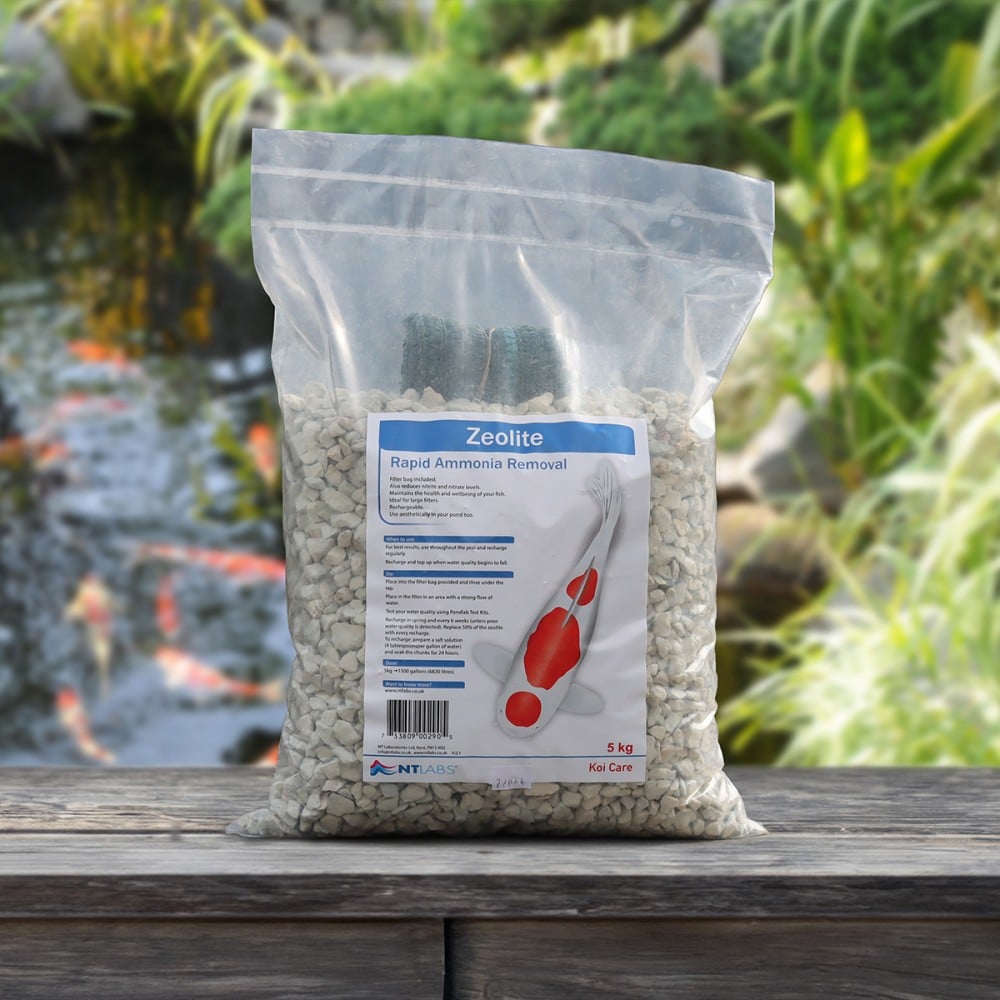
NT Labs Koi Care Zeolite is an ammonia-removing medium supplied with a media bag. The manufacturer gives placement and recharging instructions. Its capacity is finite, so test the water rather than assume the bag keeps working indefinitely.
Removing ammonia can reduce the amount available to become nitrite, but do not describe zeolite as an immediate direct nitrite cure. The nitrite already present needs its own assessment and recovery plan.
Check any proposed salt use with the zeolite manufacturer. Salt is used in zeolite recharging, so adding it to a system containing loaded media is not a casual combination. Recharge media outside the pond according to its instructions, not by adding a brine dose to the fish.
Salt needs a specific reason and a measured plan
Chloride can reduce nitrite uptake in some freshwater-fish settings. The University of Florida’s salt guidance explains the mechanism and the importance of the existing chloride concentration, with much of its evidence based on channel catfish.
That is not a universal koi salt dose. Species, plants, existing salinity, zeolite, medicines and verified volume all matter. Salt also remains until physically removed with water; topping up evaporation does not remove it. Do not use repeated unmeasured additions as a substitute for fixing filtration.
Questions about getting the readings back down
Why has ammonia fallen but nitrite is still high?
The filter’s two stages do not necessarily establish at the same rate. Ammonia can be converted while the next stage is still unable to handle all the nitrite being produced. Keep testing both and maintain the recovery plan rather than restart full feeding because the ammonia result improved.
Check the timing of products and water changes as well. A treatment that removes or binds ammonia does not demonstrate that the nitrite-processing part of the filter has matured. The evidence is in repeated results at a controlled feeding load.
How long will ammonia or nitrite take to go down?
There is no fixed answer that suits every pond. A correctly planned water change can dilute a reading promptly, while biological recovery takes time and depends on the cause. A stopped air supply, damaged media and a new system are different situations.
Judge progress from recorded results and the fish, not a promised number of days. If the reading rises again after each feed, the pond has not yet shown it can cope with that amount. Keep the portions controlled and investigate the capacity or operating problem.
Can fish recover from nitrite or ammonia exposure?
Fish may recover when the cause is corrected promptly, but the outcome depends on the exposure and damage. Improved water does not make a fish immediately well. Persistent breathing trouble, weakness or visible damage still needs professional assessment.
Keep a record of the highest measured results, their units and the time involved. That history helps a fish vet interpret signs that continue after the pond’s tests have improved. Do not add a general tonic just because recovery seems slow.
Can I keep feeding if I add bacteria?
A bacterial starter is support for biological filtration, not proof of instant waste-processing capacity. Keep the response tied to the actual readings. Adults being managed through a short interruption are different from young fry or a mixed pond containing species with different feeding needs.
Should I turn off the UV?
Follow the product actually being applied. Some live bacterial products specify a period with the UV off; an unrelated product may have different instructions. Turning off the UV does not mean stopping the circulation or air the biological filter and fish need.
If the system combines pump, UV and other controls, establish how to isolate the required part safely. Do not unplug the whole filtration system simply because one bottle says to switch off ultraviolet treatment.
Keep a recovery record until the pond is stable
One improved reading is encouraging, but check the trend. Ammonia may fall while nitrite rises as a filter establishes, and readings can change again when feeding resumes. Follow both parameters rather than declare success from the first zero.
Keep each intervention with its result. If a water change, binder and media addition happened together, write all three down. It is much harder to interpret a later test if the treatment history is only remembered approximately.
| Date and time | Results to record | Action and follow-up |
|---|---|---|
| First confirmed reading | Ammonia and basis, nitrite and basis, pH, KH, temperature; fish signs. | Check equipment and source water; record the chosen response. |
| After an intervention | Same tests and units, with time since water change or product use. | Note the volume changed, conditioner and actual dose. |
| During filter recovery | Trend for both ammonia and nitrite; appetite and air/flow. | Continue testing at a suitable frequency and avoid adding stock. |
| When feeding restarts | Small measured portion and subsequent water results. | Increase only as the fish and filter can support it. |
Resume feeding carefully once results and the fish’s condition support it. Use measured portions and watch the whole feed. Do not make up for paused meals with a large catch-up feed.
If results will not settle, review the system rather than keep buying additives. Our equipment guide covers how the pieces need to match. For continuing illness despite improved water, use the koi health guide and seek a fish vet.
A useful recovery ends with more than a reassuring colour in a tube. You should know what changed, how it was corrected and how the pond will handle the normal feeding routine again.
