







How Do Pressurised Pond Filters Work?
Clean and healthy pond water starts with effective filtration. While there are many different types of pond filters available, pressurised pond filters remain one of the most popular choices for garden ponds across the UK. They are compact, easy to hide and capable of delivering excellent water clarity when sized and maintained correctly.
One of the main reasons pond owners choose a pressurised filter is flexibility. Unlike gravity fed systems, a pressurised pond filter operates under pressure, meaning the cleaned water can be pumped uphill to a waterfall, stream or raised return without losing flow. This makes them particularly well suited to smaller and medium sized ponds where space is limited or where a neat and discreet installation is important.
Inside the filter, pond water passes through several stages of filtration designed to remove solid waste, improve water clarity and support the beneficial bacteria that keep the pond biologically balanced. Many modern systems also include a built in UV clarifier to help control green water algae.
In our experience, pressurised pond filters can work extremely well on properly stocked garden ponds and wildlife ponds. However, like any filtration system, they do have limitations. Choosing the correct size filter, maintaining it regularly and matching it to the right type of pond makes a huge difference to long term performance.
On this page, we’ll explain exactly how pressurised pond filters work, what happens inside them and how to choose the right setup for your pond. We’ll also cover some of the most common mistakes pond owners make when selecting a pressure filter, along with the situations where another type of filtration may be the better option.
You can browse our full range of pond filters including compact pressure filters, larger koi pond systems and premium filtration solutions from brands such as Oase.
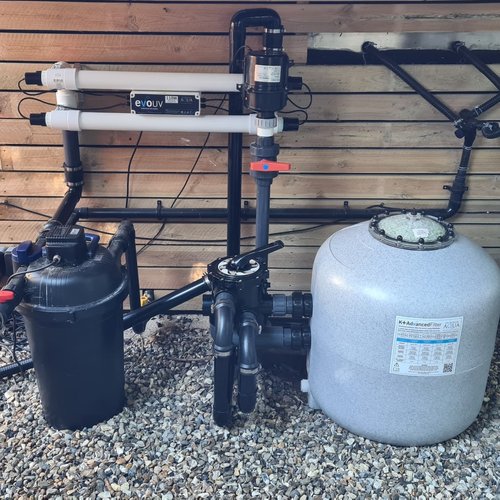
Evolution Aqua Advanced Bead Filter and Oase Filtoclear Pressure FIlter
Why Pressurised Pond Filters Are So Popular
Pressurised pond filters have become one of the most common filtration choices for garden ponds because they offer a good balance between performance, simplicity and discreet installation. For many pond owners, especially those with smaller or medium sized ponds, they provide an effective way to achieve clear and healthy water without needing a large separate filter bay or complex pipework.
One of the biggest advantages is their compact design. Most pressure filters can be partially buried beside the pond or hidden behind planting, helping keep the overall appearance of the pond natural and uncluttered. This is particularly important on modern garden ponds where space is limited or where equipment needs to remain out of sight.
Another major benefit is the ability to pump water uphill after it has passed through the filter. Because the filter body remains sealed and pressurised, the cleaned water can still feed waterfalls, streams and raised returns without needing additional pumps. This makes pressurised filters especially popular on ornamental ponds with decorative water features.
Many modern pressure filters are also designed to be much easier to clean than older systems. Models such as the Oase FiltoClear range use integrated cleaning handles and waste valves that allow the foams to be cleaned without dismantling the unit or getting your hands dirty. In real world use, this convenience often means pond owners are far more likely to keep up with maintenance, which has a direct impact on water quality.
For wildlife ponds and standard garden ponds with sensible fish stocking levels, a properly sized pressure filter can provide excellent results. They are also a very popular upgrade for older ponds that may currently rely on undersized box filters or basic all in one systems.
That said, pressure filters are not the perfect solution for every pond. Heavily stocked koi ponds, large ponds or systems with very high feeding rates will often benefit from larger gravity fed filtration systems such as drum filters or moving bed filters. One of the most common mistakes we see is pond owners choosing a pressure filter based purely on the advertised pond size rather than the actual fish load and maintenance expectations.
As a general rule, it is always better to slightly oversize a pressure filter where possible. A larger filter will usually require less cleaning, provide better biological stability and cope more effectively during warmer months when feeding levels and algae growth increase.

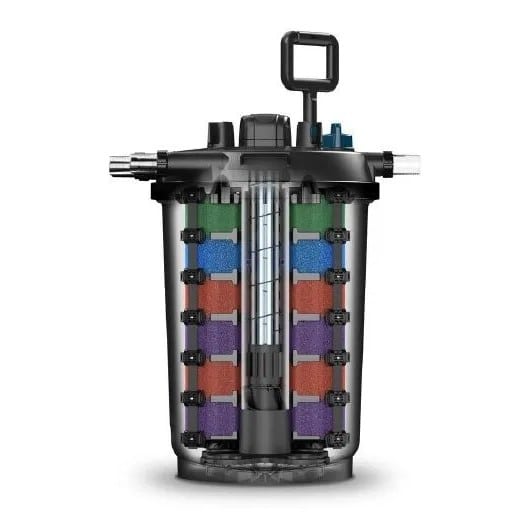
Layered mechanical sponge filtration inside the FiltoClear pressure filter
Can Pressurised Filters Run Waterfalls?
One of the biggest advantages of a pressurised pond filter is the ability to return water above pond level after filtration. Unlike traditional gravity fed box filters, a pressure filter remains fully sealed, allowing the pump to continue pushing water uphill even after it has passed through the filter itself.
This makes pressurised filters ideal for ponds with waterfalls, streams or raised return points where water needs to travel upwards before flowing back into the pond.
In many garden ponds, the waterfall is not just decorative. Moving water also helps improve circulation and oxygen levels throughout the pond, which can benefit both fish and biological filtration. Because of this, pressure filters are often used as part of a complete pond circulation system rather than simply a standalone filter unit.
However, this is also where choosing the correct pump becomes extremely important.
Every waterfall, stream or raised return creates additional resistance on the system. The higher the water needs to be lifted and the longer the pipe run becomes, the more flow is lost along the way. If the pump is undersized, the waterfall can end up with very weak flow, even if the filter itself is technically large enough for the pond.
This is something we see quite regularly on existing pond setups. Many ponds were originally installed with small pumps and undersized filters, often because the packaging claims can be misleading. A filter advertised for a certain pond size may only realistically achieve those figures under very light stocking levels and ideal conditions.
For this reason, we normally recommend looking at the entire system together rather than choosing a filter in isolation. The pond volume, fish stock, pipework, waterfall height and desired flow rate all need to be considered properly.
Modern systems such as the Oase FiltoClear filters are particularly popular for waterfall installations because they combine strong filtration performance with the ability to maintain good flow rates through elevated returns. When paired correctly with an efficient pump such as an Oase AquaMax Eco Premium pond pump, they can create a very reliable and energy efficient setup.
If your main priority is a large waterfall with high flow rates, there are situations where a larger gravity fed filtration system may still be the better option. Very large waterfalls or heavily stocked koi ponds can place significant demand on a pressurised system, especially during summer when feeding levels and waste production increase.
For most standard garden ponds though, a properly sized pressure filter and pump combination can provide an excellent balance between filtration, water clarity and attractive water movement.
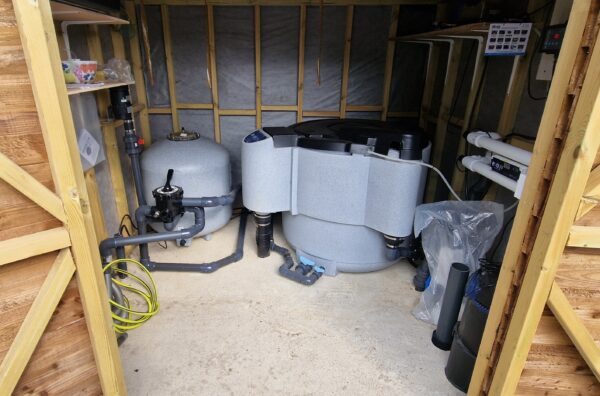
Inside the filter shed showing the Nexus 320 and Advanced bead filter system.
Are Pressurised Pond Filters Good For Koi Ponds?
This is one of the most common questions we get asked, and the honest answer is that it depends entirely on the size of the pond, the number of koi and the expectations for water quality and maintenance.
For smaller koi ponds with sensible stocking levels, a high quality pressurised filter can work very well. Many pond owners successfully run compact koi ponds using larger pressure filters paired with a properly sized pump and UV clarifier. In these situations, the system is often easy to maintain, discreet to install and capable of producing very clear water.
However, koi produce a huge amount of waste compared to most standard pond fish. They are large, constantly feeding fish that place heavy demand on filtration systems, especially during warmer months when feeding rates increase significantly. This is where many smaller pressure filters begin to struggle.
One of the biggest mistakes we see is pond owners relying too heavily on the manufacturer’s advertised pond size figures. A filter advertised for a 20,000 litre pond may realistically only be suitable for a lightly stocked ornamental pond, not a heavily stocked koi pond with large fish and high feeding levels.
As a general rule, koi ponds benefit from oversized filtration. Larger filters provide:
• greater biological capacity
• better waste handling
• more stable water quality
• reduced maintenance frequency
• improved long term clarity
This is exactly why manufacturers such as Oase have continued developing larger and more advanced pressure filters specifically aimed at koi pond applications.
The newer Oase FiltoClear range now includes the FiltoClear 60000 and FiltoClear 90000 models, which have been designed specifically with larger and more demanding ponds in mind. Unlike older generation pressure filters that were primarily targeted towards ornamental ponds, these newer models offer significantly increased biological capacity, larger foam volumes and much more powerful UV clarification systems.
The Oase FiltoClear 60000 is designed for koi ponds up to approximately 15,000 litres, while the FiltoClear 90000 is designed for koi ponds up to around 22,500 litres under sensible stocking levels. They are also suitable for much larger ornamental ponds with lower fish stocks.
One of the biggest improvements with these larger models is the substantial increase in filtration volume. More filter media means greater bacterial colonisation and improved biological stability, which is incredibly important on koi ponds where ammonia and waste levels can rise quickly during summer feeding periods.
The upgraded UV systems also make a noticeable difference to water clarity. Green water algae can become a major issue on koi ponds due to the combination of nutrient levels and sunlight exposure, so having a properly sized UV clarifier is critical.
In real world use, these larger FiltoClear units are capable of handling far more waste than traditional small pressure filters, while still offering the benefits that make pressure systems so popular:
• compact installation
• discreet appearance
• easy cleaning
• ability to run waterfalls and raised returns
• simple maintenance access
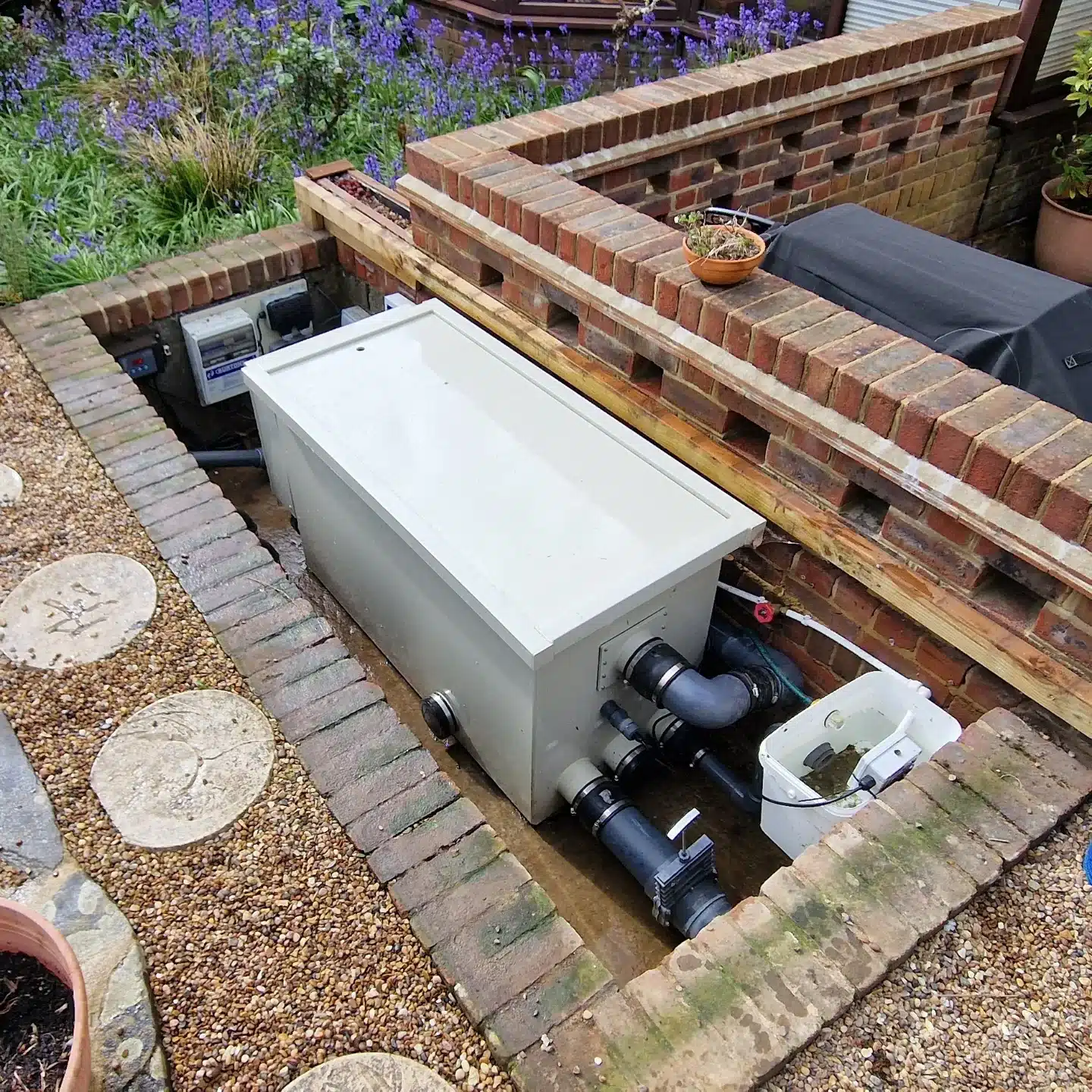
Burtons BD300 Combi Drum Filter Neatly Installed in a Filter Pit by That Pond Guy in Kent
The integrated cleaning mechanism is another major advantage. On many older pressure filters, cleaning could be awkward and messy. The larger FiltoClear models use Oase’s pull handle cleaning system and integrated waste outlet, allowing the foams to be cleaned far more quickly without dismantling the filter.
That said, once ponds become very large or heavily stocked with high value koi, gravity fed systems such as drum filters will still usually provide the best long term performance and lowest maintenance levels. Drum filters are specifically designed to continuously remove heavy solid waste loads before they break down in the system, making them ideal for serious koi keeping.
Between compact pressure filters and full drum systems, bead filters are also a very popular option on medium sized koi ponds. Systems such as the K+ Advanced Bead Filters and AquaForte EconoBead filters offer increased biological capacity and improved fine particle filtration while still operating as sealed pressurised systems.
Many pond owners also use bead filters on secondary pond circuits, particularly skimmer lines. This type of setup works extremely well because skimmers continuously remove floating debris, fine particles and dissolved organic waste from the pond surface before it has a chance to sink and break down. Using a bead filter on a skimmer line can dramatically improve overall water clarity, especially on koi ponds where surface debris and fine suspended particles are a constant issue. Because bead filters are sealed pressurised systems, there is also far more flexibility when positioning the filter compared to traditional gravity fed filtration.
Unlike gravity fed systems which usually need to sit at a very precise water level beside the pond, bead filters can often be positioned much more conveniently within filter bays, garages, sheds or pump rooms without the same installation limitations. This makes them particularly useful on ponds where available space or filter positioning is restricted.
Many larger koi ponds will actually use a combination of filtration systems working together, for example:
• a gravity fed drum filter handling the main bottom drain line
• a bead filter running the skimmer circuit
• polishing filtration such as a Tempest filter for ultra fine particles
This layered approach allows each part of the filtration system to focus on a specific type of waste removal, helping achieve extremely high water quality and excellent overall clarity.
More recently, compact hybrid systems such as the Evolution Aqua Tempest and Surge ranges have also become popular on smaller and medium sized koi ponds where pond owners want improved water clarity and fine particle removal without moving towards large drum filter installations.
This does not mean pressure filters are unsuitable for koi ponds. In fact, modern premium systems such as the larger Oase FiltoClear models have significantly narrowed the gap and can now provide a very capable solution for many domestic koi ponds where space, simplicity and discreet installation are priorities.
The key is always realistic sizing. In our experience, it is almost always better to choose a larger filter than you think you need, especially on koi ponds where fish growth and feeding levels increase over time.

Pump fed installation from skimmer to K+ Advanced bead filter
Common Mistakes When Choosing A Pressurised Pond Filter
Choosing the right pressurised pond filter is one of the most important decisions when setting up or upgrading a pond. Unfortunately, many filtration problems start long before the filter is even installed. In most cases, the issue is not that pressure filters are ineffective, but that the wrong system has been selected for the pond itself.
One of the biggest mistakes is relying purely on the manufacturer’s advertised pond size. While these figures can be useful as a rough guide, they are often based on lightly stocked ornamental ponds under ideal conditions. Real world ponds are usually far more demanding.
For example, a pond containing large koi, heavy feeding levels, direct sunlight and lots of organic debris will place far more strain on a filter than a lightly stocked wildlife pond of the same volume. This is why two ponds with identical water volumes can require completely different filtration systems.
In our experience, undersized filtration is by far the most common issue we encounter on existing ponds. The symptoms are usually very similar:
• cloudy water
• excessive algae growth
• poor water clarity
• blocked foams
• reduced flow rates
• constant cleaning requirements
Many pond owners also underestimate how much waste fish produce as they grow. A pond that initially seemed easy to maintain can become increasingly difficult to keep clear after a few years once the fish stock matures.
Another common mistake is choosing a filter without properly considering the pump and pipework. A pressure filter is only one part of the system. If the pump is too small, water circulation may be poor and waterfalls may struggle. If the pump is too powerful, water can pass through the filter too quickly, reducing filtration efficiency and potentially causing unnecessary cleaning cycles.
Pipework also makes a major difference. Long pipe runs, excessive bends and small diameter pipework all reduce flow and place extra strain on the pump. Even a good quality filter can perform badly if the overall system design is poor.
UV clarification is another area where mistakes are common. Many cheaper pressure filters include relatively small UV units that may cope initially but struggle during warmer weather or periods of increased algae growth. A properly sized UV clarifier is essential for maintaining good water clarity, particularly on fish ponds exposed to strong sunlight.
Maintenance expectations are also worth considering carefully. Smaller pressure filters generally require more regular cleaning because the foam capacity is lower. Many pond owners buy compact filters expecting low maintenance, only to find themselves cleaning the system constantly during summer.
This is why larger premium systems such as the Oase FiltoClear range often perform better over the long term. The increased filter volume, improved cleaning systems and more powerful UV units help reduce maintenance while improving overall stability.
Finally, it is important to be realistic about what a pressure filter is designed to do. Pressurised systems are excellent for many garden ponds and smaller koi ponds, especially where space is limited or waterfalls are required. However, very large or heavily stocked koi ponds may eventually require more advanced filtration systems such as drum filters or dedicated biological filtration chambers.
In most cases, investing slightly more into filtration at the beginning will save a huge amount of frustration later on. A properly sized and correctly installed filter system is far easier to maintain and will provide much better long term water quality for both fish and pond plants.
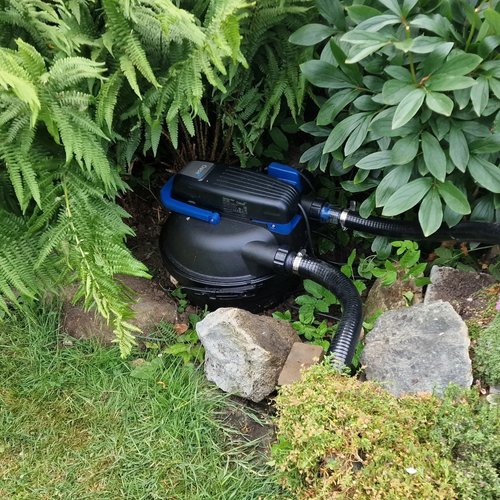
Oase FIltoclear Pressure Filter Buried in the Ground
How Often Do Pressurised Pond Filters Need Cleaning?
The honest answer is that cleaning frequency varies massively depending on the pond itself. Fish stock, feeding levels, sunlight, surrounding trees, water temperature and even the time of year all affect how quickly a pressure filter becomes dirty.
On lightly stocked wildlife ponds or ornamental ponds with minimal fish, some larger pressure filters may only need cleaning every few weeks during the warmer months. On heavily stocked koi ponds, especially during summer feeding periods, cleaning may be required much more frequently.
This is one of the reasons why oversizing filtration is usually such a good investment. Larger filters contain more foam and biological media, allowing them to handle greater amounts of waste before flow becomes restricted.
Most pressurised filters use foam sponges to trap solid debris. As these foams collect waste, water flow gradually reduces and pressure inside the filter increases. Eventually, if left too long, the filter can become heavily restricted which reduces overall filtration performance and places unnecessary strain on the pump.
Typical signs that a pressure filter needs cleaning include:
• reduced waterfall or return flow
• murky or cloudy water
• increased algae growth
• dirty filter indicator activation on some models
• pump sounding strained or noisier than normal

Internal view of the Oase Filtoclear 5000 pressure filter showing the foam media and built in Easy Clean system.
Modern pressure filters are significantly easier to maintain than older systems. Premium models such as the Oase FiltoClear filters include integrated cleaning systems which allow the foams to be compressed and rinsed without opening the filter itself. Waste water can then be discharged directly through a waste outlet, making routine maintenance far quicker and cleaner.
Another popular option for pond owners wanting simple maintenance is the PondXpert SpinClean range. These filters use an integrated cleaning handle system which helps agitate and clean the internal foams without needing to dismantle the filter. They have become particularly popular on standard garden ponds where ease of maintenance is a priority.
For pond owners wanting even lower maintenance, the PondXpert SpinClean Auto filters take things a step further by incorporating automated cleaning functionality. Systems like this are becoming increasingly popular as pond owners look for filtration setups that require less manual intervention while still maintaining good water quality.
This is a huge improvement compared to older generation filters where the entire unit often needed dismantling for cleaning. In reality, easier maintenance usually results in better pond health because pond owners are more likely to keep on top of cleaning when the process is simple.
One important point that is often overlooked is that pressure filters should not be cleaned too aggressively. The biological bacteria living inside the filter are essential for breaking down ammonia and maintaining stable water quality. Washing the media excessively with chlorinated tap water can damage these beneficial bacterial colonies and temporarily reduce filtration performance.
In most cases, cleaning should focus on removing excess debris while preserving as much beneficial bacteria as possible. Many pond owners simply use pond water or carry out shorter cleaning cycles rather than fully sterilising the filter media.
Cleaning frequency also changes throughout the year. During spring and summer, when fish are feeding heavily and algae growth increases, filters usually require more regular maintenance. During winter, feeding levels reduce and waste production drops significantly, so cleaning intervals can often be extended.
If a pressure filter constantly requires cleaning every few days, this is usually a sign that the system is undersized for the pond or fish load. In these situations, upgrading to a larger filter or moving towards a more advanced filtration system may dramatically reduce maintenance while improving overall water quality.
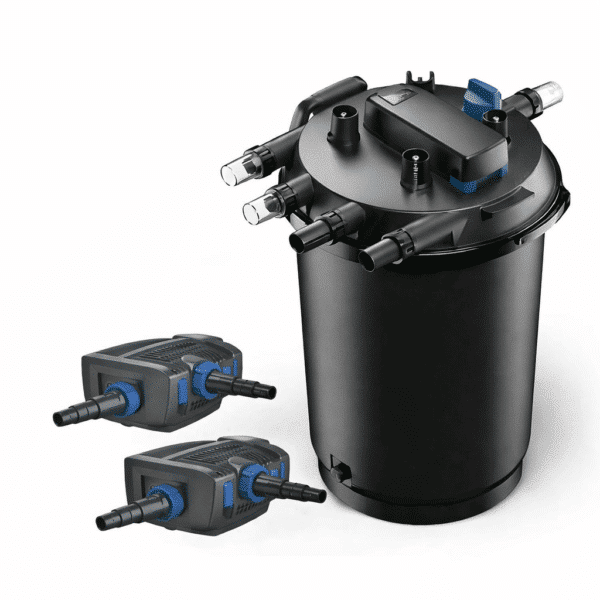
Oase FiltoClear 90000 Set OC pressure filter system with twin pumps and 120 watt UV suitable for ponds up to 90000 litres
Which Size Pressurised Pond Filter Do You Need?
Choosing the correct size pressurised pond filter is one of the most important factors when it comes to achieving clear and healthy pond water. In our experience, most filtration problems are not caused by poor quality filters, but simply by systems being far too small for the pond they are trying to manage.
This is especially common because manufacturer pond size ratings can often be misleading if taken at face value. Many advertised maximum pond sizes are based on lightly stocked ornamental ponds with minimal fish, low feeding levels and ideal conditions. Real world ponds are usually far more demanding.
For example, a heavily stocked koi pond will require significantly more filtration than a wildlife pond of the same size. Larger fish produce more waste, require more feeding and place far greater strain on both the biological filtration and the UV clarifier.
On larger koi ponds where waste production becomes much heavier, many pond owners eventually move towards larger pressurised bead filter systems such as the AquaForte EconoBead Complete Systems which combine high flow rates with increased biological and mechanical filtration capacity.
As a rough guide:
• wildlife ponds can usually operate with smaller filtration systems
• ornamental goldfish ponds require moderate filtration
• koi ponds require substantially larger filtration capacity
This is why we nearly always recommend oversizing filtration wherever possible. A larger filter will generally:
• maintain clearer water
• cope better during summer
• require less cleaning
• provide more biological stability
• handle future fish growth more effectively
One of the biggest mistakes pond owners make is buying a filter that only just matches their pond volume on paper. While it may initially seem to work, the system often struggles once fish grow larger, feeding levels increase or algae becomes more active during warmer weather.
Sunlight exposure also plays a major role. Ponds in full sun typically require stronger UV clarification because green water algae develops much more aggressively. Likewise, ponds surrounded by trees often receive large amounts of organic debris which increases maintenance requirements and places extra strain on the mechanical filtration stage.
Waterfalls and streams should also be considered carefully when sizing a system. Pumping water uphill reduces flow rates, sometimes far more than pond owners expect. This means the pump and filter need to be matched correctly to maintain proper circulation and filtration performance.
Modern premium systems such as the Oase FiltoClear range are available in much larger sizes than older generation pressure filters, including the newer FiltoClear 60000 and 90000 models designed specifically for koi ponds. These larger units provide significantly more biological media, larger foam capacity and more powerful UV systems, making them far more capable of handling demanding pond conditions.
The PondXpert SpinClean filters and PondXpert SpinClean Auto range also offer a wide range of sizes suitable for everything from compact garden ponds through to larger fish ponds where easier maintenance is a priority.
If you are between two filter sizes, it is almost always worth choosing the larger option. The initial cost difference is usually relatively small compared to the long term improvement in water quality, reduced maintenance and overall reliability.
A properly sized pressure filter should not feel like a constant battle to maintain. When matched correctly to the pond, fish stock and pump system, a good quality pressure filter can provide years of reliable and efficient filtration with relatively straightforward maintenance.

EconoBead Bead Filter – Durable Pond Filtration
Are Bead Filters The Same As Pressurised Pond Filters?
Not all pressurised pond filters use foam sponges as their primary filtration media. Larger and more advanced pressure systems often use specialised bead media instead, particularly on koi ponds where higher waste handling capacity and improved biological filtration are required.
Bead filters work slightly differently to traditional compact pressure filters. Instead of passing water through foam cartridges, the water is pushed through thousands of small plastic beads inside a sealed pressure vessel. These beads provide a huge surface area for beneficial bacteria while also trapping fine suspended waste particles.
Because of this, bead filters are capable of producing exceptionally clear water when installed and maintained correctly. They are especially popular on dedicated koi ponds where fish stocking levels and feeding rates are much higher than standard ornamental ponds.
Compared to smaller compact pressure filters, bead filters generally offer:
• increased biological filtration
• improved fine particle removal
• larger waste handling capacity
• better long term stability on koi ponds
• reduced cleaning frequency on properly designed systems
However, they also tend to require more powerful pumps and are usually installed on larger pond systems where higher flow rates are needed.
One popular option is the K+ Advanced Bead Filter range, which combines mechanical and biological filtration in a compact pressurised unit designed specifically for koi ponds and heavily stocked fish systems.
Another well regarded option is the AquaForte EconoBead range. These systems are designed to deliver high performance biological and mechanical filtration while remaining relatively compact compared to larger multi chamber filtration setups.
For pond owners looking for a more complete filtration package, the AquaForte EconoBead Complete Systems combine bead filtration with integrated components to provide a more comprehensive filtration solution for larger koi ponds.
In real world use, bead filters tend to sit somewhere between compact pressure filters and full gravity fed drum systems. They can provide excellent water clarity and strong biological performance, particularly on medium sized koi ponds where space is limited but filtration demands are still relatively high.

Integrated UV clarifier assembly being removed from the Oase FiltoClear 60000 and 90000 for servicing
Why Choose A Pressurised Filter Instead Of A Box Filter?
Both pressurised filters and traditional box filters can provide effective pond filtration when installed correctly, but they work very differently and are suited to different types of ponds.
For many modern garden ponds, pressurised filters have become the more popular option because they are compact, easier to hide and far more flexible when it comes to waterfall and stream installations.
A traditional box filter usually sits above pond level and relies on gravity to return the cleaned water back into the pond. This means the outlet water cannot normally be pushed uphill after filtration without adding additional pumps or complex pipework arrangements.
By comparison, a pressurised pond filter remains sealed under pressure, allowing the cleaned water to continue flowing upwards towards waterfalls, raised returns and streams. This makes them ideal for ponds where decorative water movement is an important part of the overall design.
Another major advantage is appearance. Box filters are often physically larger and can be difficult to conceal neatly, especially in smaller gardens. Pressurised filters can usually be partially buried beside the pond or hidden behind planting, helping create a much cleaner and more discreet installation.
Maintenance is another area where modern pressure filters have improved significantly. Older box filters often required lifting foam cartridges out manually and dealing with messy cleaning processes. Many newer pressurised systems now feature integrated cleaning handles and waste outlets which make routine maintenance far quicker and easier.
Systems such as the Oase FiltoClear range and PondXpert SpinClean filters are good examples of how modern pressure filter technology has evolved to make cleaning far more user friendly.
That said, traditional box filters still have their place and can work extremely well on certain ponds. Because they are not sealed pressure vessels, larger box filters can sometimes offer increased biological capacity for the price, particularly on lightly stocked wildlife or ornamental ponds where space is not an issue.
For heavily stocked koi ponds, larger gravity fed systems such as drum filters or advanced bead filtration systems like the K+ Advanced Bead Filters may ultimately provide better long term waste handling and reduced maintenance.
In reality, there is no single “best” filter for every pond. The right choice depends on:
• pond size
• fish stock
• available space
• desired appearance
• maintenance expectations
• whether waterfalls or streams are being used
For many domestic garden ponds though, pressurised filters offer one of the best balances between filtration performance, discreet installation and ease of maintenance
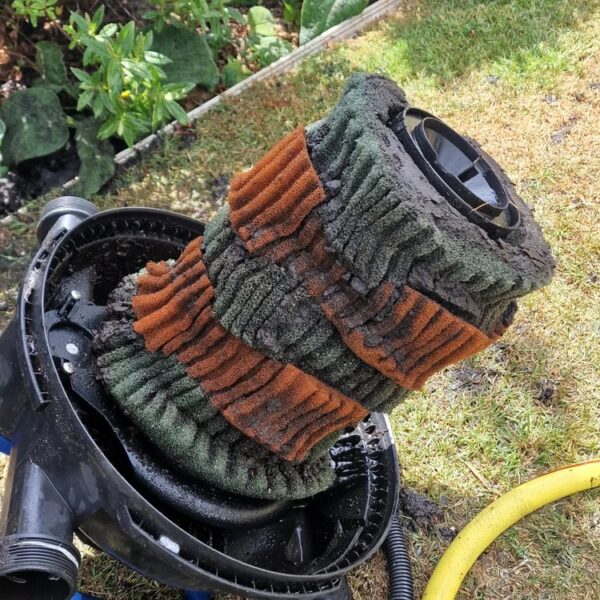
Routine pond maintenance including filter cleaning and system checks
Common Signs Your Pond Filter Is Too Small
A pond filter does not usually fail overnight. In most cases, the warning signs appear gradually as the system struggles to keep up with the demands being placed on it.
One of the most common issues we see on existing ponds is undersized filtration. Very often the pond itself has evolved over time, with larger fish, increased feeding levels or additional waterfalls being added, while the original filter system has remained unchanged.
At first, the pond may still look reasonably healthy. However, as waste levels increase, the filter gradually becomes overwhelmed and water quality starts to decline.
Typical signs that a pressurised pond filter may be too small include:
• green water that constantly returns
• cloudy or murky water
• excessive sludge build up
• blanketweed problems
• poor water clarity during summer
• reduced waterfall flow
• constantly blocked foams
• needing to clean the filter every few days
• fish appearing stressed during warmer weather
Green water and blanketweed are often some of the earliest warning signs. While UV clarification plays an important role in algae control, excessive nutrients caused by insufficient filtration can quickly fuel ongoing algae problems.
If blanketweed is becoming a regular issue, our blanketweed treatment guide explains some of the most effective ways to control and prevent it long term.
Flow reduction is another major indicator. As undersized filters become overloaded with waste, the mechanical foams clog more quickly and water circulation drops significantly. This not only affects water clarity but can also reduce oxygen levels and overall pond health.
Many pond owners assume that simply cleaning the filter more often will solve the problem. While regular maintenance is important, a filter that constantly requires attention is often a sign that the system simply lacks the capacity needed for the pond.
This becomes especially noticeable on koi ponds where fish growth and feeding levels increase year after year. A filter that initially seemed adequate can quickly become undersized once the koi mature.
Modern larger pressure filters such as the Oase FiltoClear range, alongside advanced bead systems including the AquaForte pressure filter range and Evolution Aqua filtration systems, are designed to provide significantly greater biological and mechanical filtration capacity for more demanding ponds.
In some cases, upgrading the filtration system can completely transform a pond that has struggled with clarity and maintenance for years.
This is something we regularly help customers with through our pond filter, pump and upgrade services. Many older ponds were originally installed with basic or undersized filtration systems, and upgrading to a more modern setup can dramatically improve water quality, reduce maintenance and create a much healthier environment for fish.
If a pond constantly feels difficult to maintain despite regular cleaning and ongoing treatments, the filtration system itself is often the root cause. In many cases, investing in properly sized filtration will solve far more problems than repeatedly treating the symptoms.

Internal view of the Oase Filtoclear 31000 pressure filter showing the foam media and Easy Clean system.
Which Pressurised Pond Filter Is Best?
There is no single pressurised pond filter that is perfect for every pond. The best system depends on the size of the pond, the type of fish being kept, available space, maintenance expectations and how heavily stocked the pond is.
In our experience, choosing the right type of filter is often more important than simply choosing the most expensive model. A properly matched filtration system will normally outperform a poorly sized premium system every time.
For smaller ornamental ponds and wildlife ponds, compact pressure filters are often the ideal solution. They are easy to install, simple to hide and capable of maintaining excellent water clarity when paired with the correct pump and UV clarifier.
The Oase FiltoClear range remains one of the most popular premium pressure filter systems available. They are particularly well known for their strong build quality, efficient cleaning system and powerful integrated UV clarification. The newer larger FiltoClear 60000 and 90000 models have also made them a far more capable option for medium sized koi ponds than previous generations of pressure filters.
For pond owners wanting straightforward maintenance and good value, the PondXpert SpinClean filters are another very popular choice. Their integrated cleaning handles make routine maintenance much easier than many older style pressure filters.
The PondXpert SpinClean Auto range is particularly appealing for pond owners wanting lower maintenance systems with more automated cleaning functionality.
As ponds become larger or more heavily stocked with koi, many pond owners begin moving towards larger bead filter systems. Filters such as the K+ Advanced Bead Filters and AquaForte EconoBead systems provide increased biological capacity and much stronger fine particle filtration compared to smaller compact pressure filters.
For larger koi ponds where higher flow rates and increased waste handling are required, the AquaForte EconoBead Complete Systems can provide a much more comprehensive filtration solution while still operating as sealed pressurised systems.
Brands such as Evolution Aqua and AquaForte have also helped bridge the gap between compact garden pond filtration and more advanced koi pond systems, offering solutions suitable for a wide range of pond types and stocking levels.
That said, once ponds become very large or heavily stocked with high value koi, gravity fed filtration systems such as drum filters will often provide the best long term performance and lowest maintenance requirements.
The important thing is choosing filtration that realistically matches the demands of the pond both now and in the future. Fish grow, feeding levels increase and ponds naturally become more demanding over time.
A good quality pressure filter should provide:
• reliable water clarity
• stable biological filtration
• manageable maintenance
• good circulation
• long term reliability
When selected correctly, modern pressurised pond filters can provide an excellent balance between performance, convenience and discreet installation for many years.
For pond owners wanting advanced filtration in a more compact format, hybrid systems such as the Evolution Aqua Tempest and Surge filters are becoming increasingly popular. These systems use the same K1 Micro media found in larger K+ Advanced Bead Filters while offering a more compact wall mounted design better suited to many domestic koi ponds.
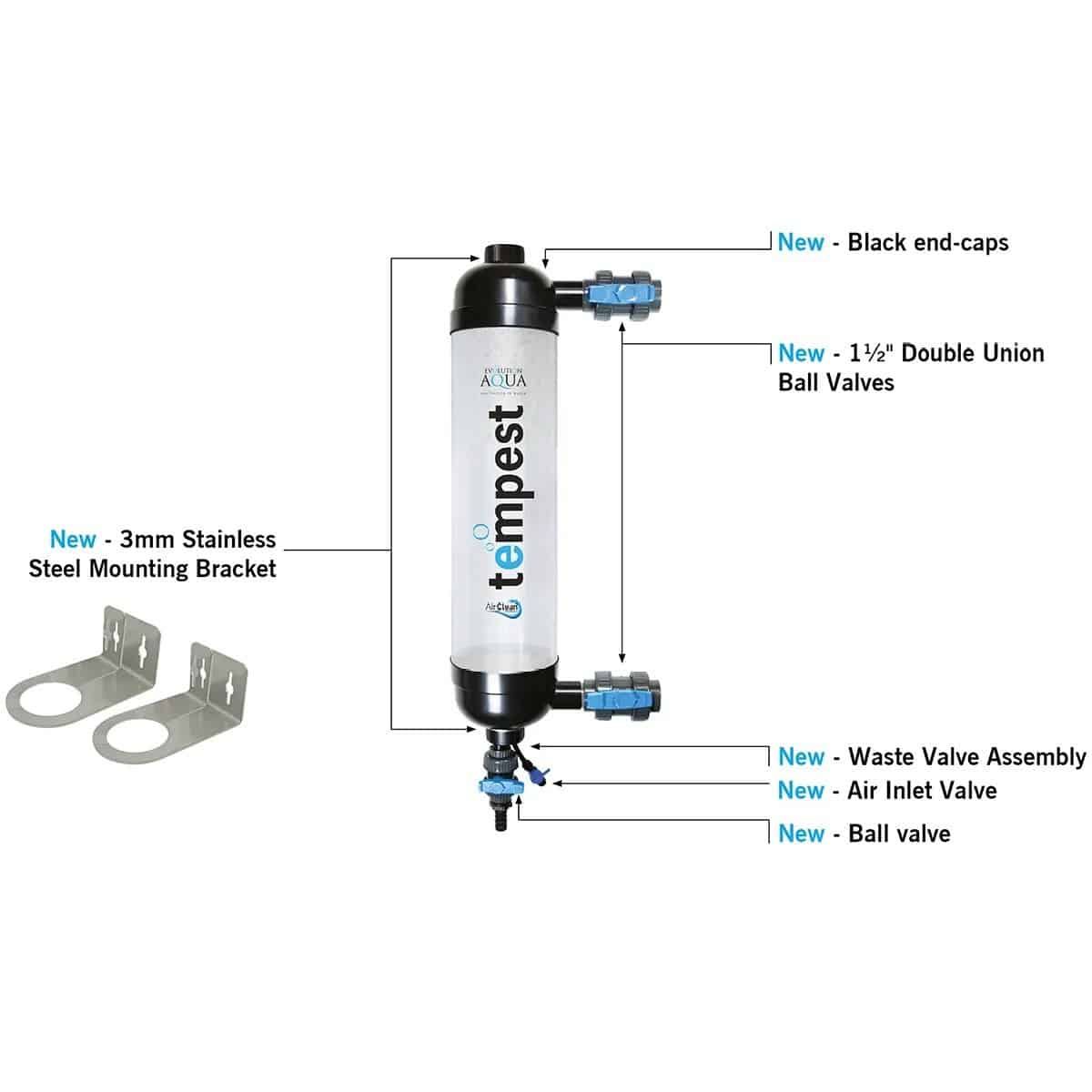
Evolution Aqua Tempest Filter Diagram
Advanced Pressurised Filtration Systems
Modern pond filtration has evolved significantly over the past few years, particularly within the koi pond market where water clarity, waste handling and low maintenance are becoming increasingly important. While traditional foam based pressure filters still work extremely well on many ponds, newer hybrid systems are helping bridge the gap between compact garden pond filtration and large gravity fed drum filter systems.
These newer generation filters are designed to improve fine particle removal, increase biological efficiency and reduce maintenance while still remaining relatively compact and straightforward to install.
Evolution Aqua Tempest Filters
One of the most interesting developments in modern pond filtration is the Evolution Aqua Tempest.
Unlike traditional pressure filters which primarily rely on foam sponges to trap debris, the Tempest uses advanced mechanical separation to remove extremely fine suspended waste particles from the water column before they begin breaking down inside the pond.
In real world use, many pond owners actually install Tempest filters as a dedicated “polishing” filter alongside their main filtration system. This is because even very good filtration systems can still allow ultra fine suspended particles to remain in the water, slightly dulling overall clarity.
The Tempest is specifically designed to target these fine particles that many standard filters struggle to capture. The result is noticeably cleaner and sharper water clarity, particularly on koi ponds where crystal clear water is often a major priority.
This has made the Tempest especially popular on:
• koi ponds
• high clarity display ponds
• upgraded filtration systems
• ponds with persistent fine suspended particles
• systems where additional polishing filtration is required
Another major advantage of the Tempest range is the compact installation footprint. The filters are supplied with mounting brackets which allow them to be fixed directly onto a wall, helping free up valuable floor space within filter bays and pump rooms. On many koi pond installations where space is limited, this can make the overall setup much cleaner and easier to work around compared to large floor standing filtration systems.
The Tempest range also shares many similarities with the larger K+ Advanced Bead Filters. Both systems use the same K1 Micro bead media which provides extremely effective fine particle capture and excellent biological surface area for beneficial bacteria.
The main difference is really the intended application. K+ Advanced Bead Filters are designed for much larger ponds and heavily stocked koi systems where very high flow rates and larger filtration volumes are required. Many of these systems are installed on serious koi ponds where water quality demands are extremely high.
The Tempest, on the other hand, offers many of the same filtration principles but in a smaller, more compact and more convenient format. This makes it particularly appealing for domestic koi ponds where space is limited but exceptional water clarity is still desired.
For pond owners who already have decent primary filtration but still feel the water lacks that final level of clarity, polishing filters such as the Tempest can make a very noticeable difference.
Evolution Aqua Surge Filters
The Evolution Aqua Surge Filter takes a slightly different approach by combining advanced filtration with integrated UV clarification within a single compact system.
One of the major advantages of the Surge is that it includes a built in UV clarifier, allowing it to operate as a much more complete standalone filtration system compared to many other advanced filters which require separate UV units to be installed externally.
This makes the Surge a particularly attractive option for pond owners wanting:
• advanced filtration performance
• compact installation
• integrated algae control
• simplified pipework
• lower maintenance filtration
Like the Tempest range, Surge filters are also supplied with wall mounting brackets, allowing them to be mounted neatly off the ground rather than taking up valuable floor space. This can be particularly useful within compact filter bays where access and organisation are important.
The Surge also uses the same K1 Micro media found within the larger K+ Advanced Bead Filters, helping provide strong mechanical and biological filtration within a far more compact unit. In many ways, systems such as the Tempest and Surge can be viewed as smaller and more convenient versions of larger bead filtration systems, designed to bring advanced filtration technology into a more manageable format for domestic pond installations.
Surge systems are also designed to improve oxygenation and biological efficiency by delivering highly oxygenated water throughout the filtration process. Healthy oxygen levels are extremely important for beneficial bacteria, especially on heavily stocked ponds where biological filtration is working hard to process fish waste and excess nutrients.
Compared to many traditional compact pressure filters, systems such as the Surge and Tempest demonstrate how modern filtration technology is continuing to evolve beyond simple foam based filtration alone.
For many pond owners, these types of advanced systems help provide a middle ground between standard pressurised filters and much larger gravity fed drum filter installations, offering improved water quality and clarity while still remaining manageable for domestic pond setups.

Evolution Aqua Surge Filter
Our Real World Experience With Pressurised Pond Filters
Over the years we’ve worked on a huge range of ponds, from small wildlife ponds and decorative garden features through to heavily stocked koi ponds with complex filtration systems. One thing we’ve learned very quickly is that there is no “one size fits all” approach when it comes to filtration.
Pressurised pond filters can work extremely well when they are matched correctly to the pond. In fact, for many domestic garden ponds they are often one of the best all round solutions available. They are compact, discreet, relatively easy to maintain and ideal for running waterfalls and streams.
However, we also regularly see ponds where the filtration system has simply been undersized from the beginning. This is especially common on older ponds where fish have gradually grown larger over time or where additional fish have been added without upgrading the filtration.
Many pond owners assume that green water, blanketweed or cloudy water are simply part of owning a pond. In reality, the root cause is often insufficient filtration, poor circulation or a UV clarifier that is far too small for the pond conditions.
One of the biggest misconceptions we encounter is that cleaning a filter more frequently will always solve the issue. While maintenance is important, a pressure filter that needs cleaning every few days is often a sign that the system is struggling to cope with the waste load being produced.
We also find that premium filtration systems generally do make a noticeable difference over the long term. Better build quality, improved cleaning mechanisms, larger biological capacity and stronger UV clarification all help create a more stable and easier to manage pond.
Systems such as the Oase FiltoClear filters are particularly popular because they combine strong filtration performance with genuinely user friendly maintenance. Likewise, bead filter systems such as the K+ Advanced Bead Filters and AquaForte EconoBead systems can produce exceptionally clear water on larger koi ponds where compact pressure filters may begin to struggle.
At the same time, we always try to be realistic with customers about limitations. Compact pressure filters are excellent for many ponds, but they are not magic boxes that can handle unlimited fish stocks with minimal maintenance forever. The more heavily stocked and demanding the pond becomes, the more important proper filtration design becomes.
Good circulation, correctly sized pumps, sensible fish stocking, adequate UV clarification and ongoing maintenance all work together as part of the same system. Even the best filter available will struggle if the overall setup is poorly designed.
This is why we often recommend looking at the pond as a whole rather than simply replacing one individual component. In many cases, upgrading the filter, pump and UV system together can completely transform water quality and dramatically reduce maintenance requirements.
If you are unsure whether your current system is suitable, our pond filtration upgrade services can help assess your existing setup and recommend realistic long term solutions based on your pond, fish stock and maintenance expectations.
You can also browse all of our pond care services including pond cleaning, filtration upgrades, koi pond builds and ongoing maintenance support.
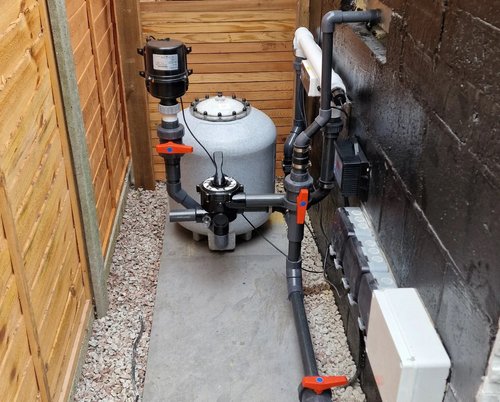
Evolution Aqua Advanced Bead Filter Install
Frequently Asked Questions About Pressurised Pond Filters
Can a pressurised pond filter clear green water?
Yes, most modern pressurised pond filters include a built in UV clarifier which is specifically designed to control green water algae. As pond water passes the UV lamp, microscopic algae cells are damaged and clump together so they can be removed by the mechanical filtration stage.
However, the UV needs to be correctly sized for the pond and matched to the correct flow rate. Undersized UV systems are one of the most common reasons ponds remain green despite having filtration installed.
Are pressurised pond filters good for koi ponds?
They can be, especially on smaller and medium sized koi ponds with sensible stocking levels. Larger modern systems such as the Oase FiltoClear 60000 and 90000 filters are specifically designed for more demanding koi pond applications.
For larger or heavily stocked koi ponds, advanced bead filters such as the K+ Advanced Bead Filters, AquaForte EconoBead systems or full drum filter systems may provide better long term waste handling and reduced maintenance.
Can you bury a pressurised pond filter?
Yes. One of the main advantages of pressure filters is that they can usually be partially buried beside the pond or hidden behind planting. This makes them far easier to conceal than many traditional box filters.
Always follow the manufacturer’s installation guidelines regarding maximum burial depth and ventilation requirements.
How often should a pressure filter be cleaned?
This depends entirely on the pond, fish stock and time of year. Lightly stocked wildlife ponds may only require occasional cleaning, while heavily stocked koi ponds may need more regular maintenance during summer feeding periods.
If a filter constantly requires cleaning every few days, it is often a sign that the system is undersized for the pond.
Why does my pressure filter keep clogging?
The most common causes are:
• undersized filtration
• excessive fish stock
• overfeeding
• poor circulation
• too much organic debris entering the pond
• inadequate pre filtration
Blocked foams usually indicate that the filter is struggling to cope with the amount of waste being produced.
Do pressure filters remove blanketweed?
Not directly. Pressure filters and UV clarifiers mainly help control suspended green water algae rather than string algae or blanketweed attached to pond surfaces.
However, improving filtration and reducing excess nutrients can still help reduce blanketweed growth over time. Our blanketweed treatment guide explains this in much more detail.
Are pressure filters better than box filters?
Neither is automatically “better”. It depends on the pond itself.
Pressurised filters are usually:
• easier to hide
• better for waterfalls and streams
• more compact
• easier to install on smaller ponds
Box filters can sometimes provide larger biological capacity for the price, particularly where space is not an issue.
Can a pressure filter run a waterfall?
Yes, this is one of the main advantages of a pressurised pond filter. Because the system remains sealed under pressure, the cleaned water can continue flowing uphill towards waterfalls, streams and raised returns after leaving the filter.
How long do pressurised pond filters last?
A good quality pressure filter can last many years when maintained correctly. Premium systems with strong UV housings, durable seals and quality internal components tend to provide much longer service life than cheaper entry level filters.
Regular cleaning, replacing UV bulbs annually and protecting pumps from blockages all help extend the lifespan of the system.
Should I leave my pond filter running in winter?
In most cases, yes. Keeping water circulating and maintaining biological filtration throughout winter helps preserve water quality and beneficial bacteria.
However, feeding levels should normally be reduced as water temperatures fall, especially on koi ponds.
What size pressure filter do I need?
As a general rule, it is almost always better to oversize filtration rather than choosing the smallest possible system.
Factors that affect filter sizing include:
• pond volume
• fish stock
• koi vs ornamental fish
• sunlight exposure
• feeding levels
• waterfalls and streams
• surrounding trees and debris
Manufacturer pond size ratings should only be treated as rough guidelines rather than exact figures.
What is the difference between a bead filter and a standard pressure filter?
Traditional pressure filters normally use foam sponges for mechanical and biological filtration, while bead filters use thousands of small plastic beads inside a sealed pressure vessel.
Bead filters are often used on larger koi ponds because they provide increased biological capacity and improved fine particle filtration. Systems such as the AquaForte EconoBead Complete Systems are designed specifically for more demanding koi pond applications.
Can a pond filter be too big for a pond?
In most cases, slightly oversized filtration is actually beneficial. Larger filters provide greater biological capacity, improved water stability and usually require less frequent cleaning.
The main thing that still needs to be matched correctly is the pump flow rate. Water should pass through the filter at the correct speed to allow effective mechanical and biological filtration.
Why is my pond still cloudy after installing a filter?
Cloudy water can be caused by several different issues including:
• immature biological filtration
• undersized filtration
• poor circulation
• excessive fish stock
• overfeeding
• insufficient cleaning
• fine suspended particles
Newly installed filters also take time to mature biologically. Beneficial bacteria need time to establish properly before the system reaches full efficiency.
How long does it take for a pressure filter to clear a pond?
Green water can sometimes begin improving within a few days if the UV clarifier is working correctly. However, full pond clarity may take several weeks depending on:
• pond size
• algae levels
• fish stock
• water temperature
• filtration maturity
• UV strength
Very dirty ponds may also require cleaning or sludge removal before filtration can fully stabilise the water quality.
Do pressure filters use a lot of electricity?
The filter itself uses very little electricity. The main electrical consumption comes from the pond pump and UV clarifier.
Modern energy efficient pumps such as the Oase AquaMax Eco pumps can dramatically reduce running costs compared to older style pond pumps.
Can I turn my pond filter off at night?
In most cases, no. Pond filtration systems are designed to run continuously 24 hours a day.
Turning the system off regularly reduces oxygen levels and can damage the beneficial bacteria living inside the filter media. Consistent circulation is extremely important for maintaining stable water quality.
Do UV clarifiers need replacing?
The UV unit itself normally lasts many years, but the UV bulb should usually be replaced annually even if it still lights up.
Over time, UV bulbs gradually lose effectiveness, meaning algae control performance drops even though the bulb appears to be functioning normally.
Why does my pond go green every spring?
Spring green water is extremely common because increasing sunlight and rising water temperatures encourage rapid algae growth before the pond filtration has fully become biologically active again after winter.
This is especially noticeable on ponds with undersized UV clarifiers or high nutrient levels.
What pump works best with a pressure filter?
The best pump depends on:
• pond volume
• filter size
• pipework length
• waterfall height
• desired circulation rate
Energy efficient filter pumps such as the Oase AquaMax Eco Premium range are particularly popular because they combine strong flow rates with low running costs.
Can pressure filters handle fish waste?
Yes, provided they are correctly sized for the pond and fish stock. Mechanical filtration removes solid waste while biological filtration breaks down harmful pollutants produced by fish.
However, heavily stocked koi ponds may eventually require larger bead filter or drum filter systems to cope with increasing waste loads.
Are pressure filters noisy?
Most modern pressure filters themselves are virtually silent. Noise usually comes from the pond pump, waterfalls or air pumps rather than the filter body.
Poorly maintained pumps or partially blocked systems can sometimes create additional vibration or flow noise.
How do you clean a pressure filter without killing beneficial bacteria?
Most routine cleaning should focus on removing excess debris rather than completely sterilising the filter media.
Many pond owners clean the foams using pond water or shorter cleaning cycles to preserve as much beneficial bacteria as possible. Excessive cleaning with chlorinated tap water can temporarily damage the biological filtration.
Can you use a pressure filter without a UV clarifier?
Yes, but green water algae can become much harder to control, especially during warmer months or on ponds in direct sunlight.
For most fish ponds and ornamental ponds, a UV clarifier is strongly recommended as part of the overall filtration system.
Which is better, a bead filter or drum filter?
Both have advantages depending on the pond.
Bead filters such as the AquaForte EconoBead systems provide strong biological and fine particle filtration in a compact sealed system.
Drum filters are generally better suited to heavily stocked koi ponds where automatic waste removal and reduced maintenance are priorities.
Do pressure filters work on swimming ponds?
They can work on smaller natural swimming ponds and ornamental swimming ponds, although larger dedicated swimming ponds often require specialist biological filtration systems designed specifically for swimming applications.
The filtration requirements are usually very different compared to standard fish ponds.
Why does my waterfall lose flow over time?
Reduced waterfall flow is often caused by:
• blocked filter foams
• dirty pump cages
• undersized pipework
• algae build up inside pipework
• worn pump impellers
• excessive head height
In many cases, gradual flow reduction is simply a sign that the filter system requires cleaning or upgrading.
What is a polishing filter on a koi pond?
A polishing filter is designed to remove ultra fine suspended particles that standard filtration systems may struggle to capture. These filters are commonly used on koi ponds where exceptional water clarity is a priority. Systems such as the Evolution Aqua Tempest filters are often installed alongside the main filtration system to help produce noticeably clearer water.
