





Blanketweed Treatment: Removal, Products and Prevention
Removing blanketweed without making more work for yourself
Pull a handful of long green strands from a waterfall and you can usually see what the problem is. The difficult part is keeping it under control after you have pulled it out. A tub of treatment may help, but it will not empty a full pump strainer, remove a season’s worth of leaves or stop food drifting into a corner.
We would start with the pond in front of us: what is growing, where it is collecting, how the fish are behaving and whether the equipment is working properly. Then choose an approach that suits the fish, plants and wildlife actually living there. There is no single best blanketweed treatment for every pond.
This guide explains the practical removal, the differences between some treatments we sell and the checks that help prevent another outbreak. If your water is green but you cannot lift out strands, start with our pond algae guide instead.
Is it blanketweed, green water or a pond plant?
Blanketweed is the familiar name for filamentous algae: growth you can lift, wind around a suitable tool or see trailing from a liner, stone or stream. It may be attached below the surface, gathering around a return or floating in mats. Colour alone is not enough to identify it.
| What you can see | What to check | Where to begin |
|---|---|---|
| Long threads or tangled green mats | Can you lift out strands? Is growth attached to the edge or waterfall? | Remove accessible growth and check the conditions encouraging it. |
| Green water throughout the pond | A clear container of pond water stays green; there may be little attached weed. | Check the UV, water flow and filtration; a string-algae treatment is not automatically the answer. |
| Separate tiny floating leaves | Look closely for individual plants and small roots. | Identify duckweed before choosing a control method. |
| Rooted stems or feathery submerged plants | Check leaves and stems before pulling. | These may be useful pond plants rather than algae. |
| An unusual paint-like surface scum | Keep people and pets away while it is identified. | Do not assume every surface bloom is harmless blanketweed. |
A thin coating of algae on the pond wall is also different from a thick mass blocking the pump. Trying to scrub every surface bare can create unnecessary disturbance. Concentrate on growth obstructing equipment, smothering planting or spreading into heavy mats, and judge the pond as a whole.
Use a photograph taken close to the growth, as well as a wider view, if you need help identifying it. A distant photograph of a green pond rarely shows whether the problem is suspended algae, floating plants or strands caught below the water.
Remove the heavy weed first
Physical removal gets the weed out of the water immediately. That matters because a large amount of dying algae is still organic material that has to go somewhere. Leaving it to break down in the pond can add to the load on the filter and increase oxygen demand.
Work from a secure position at the edge with a suitable net or pond tool. Lift small amounts steadily. Avoid dragging a sharp rake across a liner, pulling hard around electrical cables or tearing submerged plants out with the weed. Do not lean over a deep pond to reach a patch that needs proper access.
Clear accessible pump cages, skimmer baskets and return channels as well as the visible surface. Follow the equipment instructions before opening or handling anything powered. A waterfall can still make a reassuring noise while the actual flow has fallen because the inlet is clogged.
Inspect lifted material for small animals and return any you find carefully. In a wildlife pond, remove growth selectively, leaving undisturbed areas and checking for spawn and tadpoles. Do not empty the whole habitat to make it look tidy. Our wildlife pond maintenance guide explains that more restrained approach.
Keep removed weed where rain cannot wash it straight back into the pond. Inspect it before composting, and do not move pond plants, water or weed into a natural watercourse. If you are unsure whether a plant mixed into the growth is invasive, identify it before moving it elsewhere.
A pond vacuum can help with loose waste left on the bottom, but it is not a reason to suck at firmly attached strands until the pond has lost a large volume of water. Take the heavy weed out by hand or tool first, then use the vacuum for the job it handles well. Compare practical options in our pond vacuum guide.
What we would check before opening a treatment
Watch the fish and check the air
If fish are gasping, gathering around a return or behaving unusually, deal with that before the appearance of the pond. Check the air pump, water movement and water tests. A blanketweed treatment is not a remedy for fish struggling to breathe.
Plants and algae use oxygen in darkness, while fish and bacteria need it around the clock. A pond that looks lively and bright in the afternoon can have a different oxygen picture towards dawn. Heavy growth and decomposing weed make it particularly important to keep suitable aeration working.
Air pump output is usually stated in litres of air per minute; dissolved oxygen is measured in milligrams per litre of water. Those are different measurements. A large number on the pump box does not prove the pond has enough dissolved oxygen, particularly with deep diffusers or restricted airline. Our air pump and diffuser guide covers those checks.
Test the water and measure the temperature
Check ammonia, nitrite and pH, and investigate KH where pH stability or the chosen treatment calls for it. The NT Labs Pond Lab Multi-Test Kit covers pH, KH, GH, ammonia, nitrite and nitrate. It does not measure oxygen or phosphate, so an apparently complete set of results may still leave a relevant question unanswered.
Measure pond water temperature rather than using the day’s air temperature. The effective temperature range and application restrictions vary between products. Do not compensate for cold water by increasing a dose yourself.
Check the recent history
Write down the names and dates of anything already added: fish medication, another algae treatment, a water conditioner or a mineral product. Similar-looking powders are not automatically interchangeable or compatible. If a treatment is already in progress, ask about the exact combination before adding another.
Look at recent changes too. More food, new fish, a stopped filter, a dose measured for the wrong volume or a large top-up can explain why a previously manageable pond has changed. The useful question is what has altered, not simply which stronger product to buy.
Comparing blanketweed treatments we sell
The names on the tubs can sound very similar. Read the full product name and the instructions for that formula, including any All Season wording. The table below is a starting point for choosing; the current pack is what you use to check the dose, timing and restrictions before application.
| Product | Useful difference | Check before choosing |
|---|---|---|
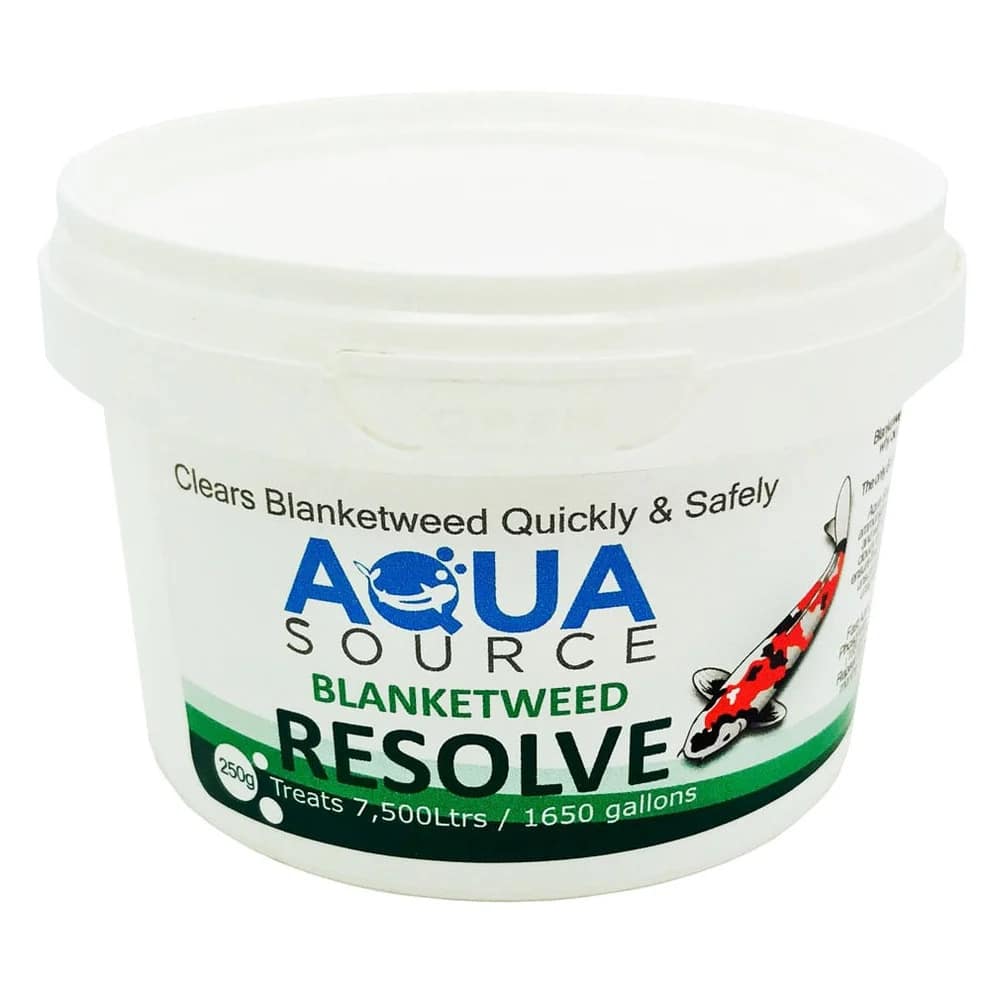
| Aqua Source Blanketweed Resolve | The maker instructs direct sprinkling around the pond, rather than pre-mixing. | Measured volume, aeration, species and the water-balance advice on the current pack. |
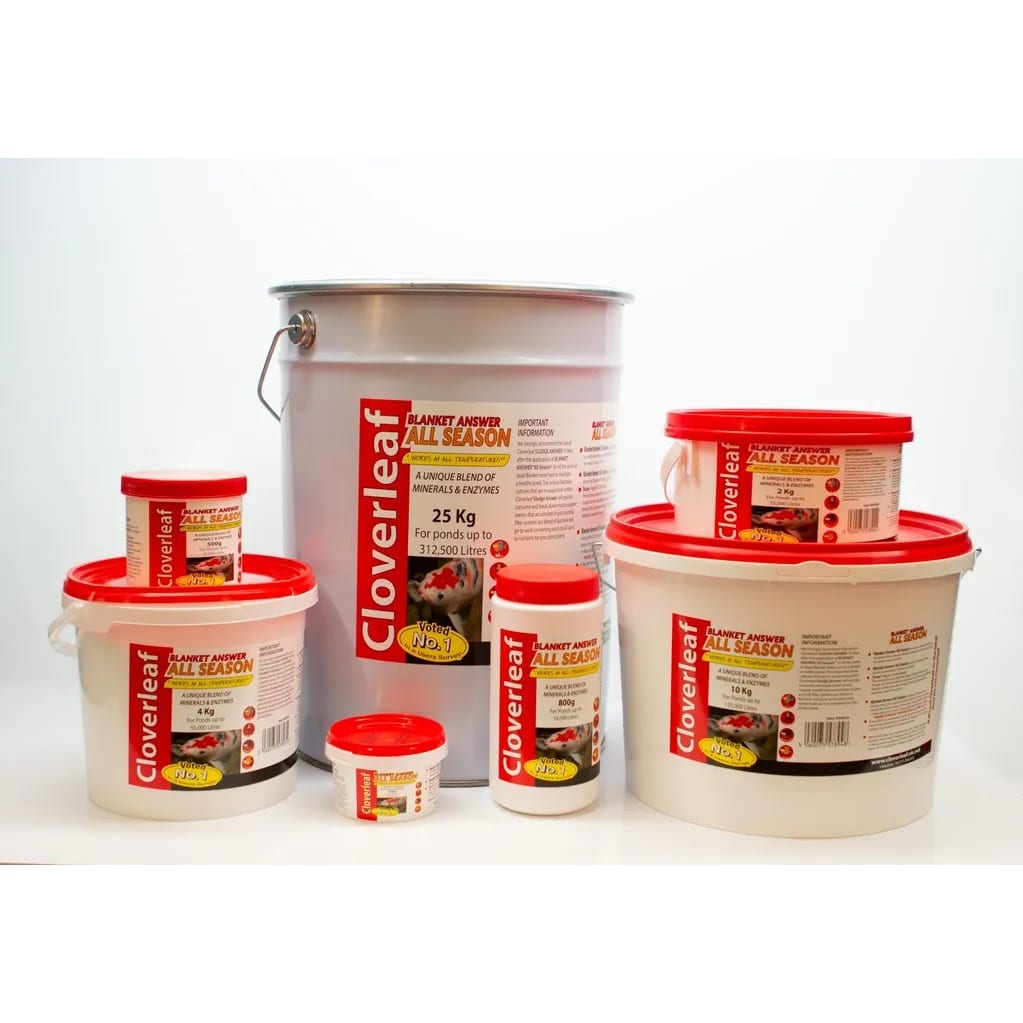
| Cloverleaf Blanket Answer | The standard product is mixed with pond water before distribution. | Do not borrow the temperature claims or instructions from a different version. |
| Cloverleaf Blanket Answer All Season | A separately named range promoted by Cloverleaf for lower-temperature use. | Match the All Season pack and its directions; a familiar brand name is not enough. |
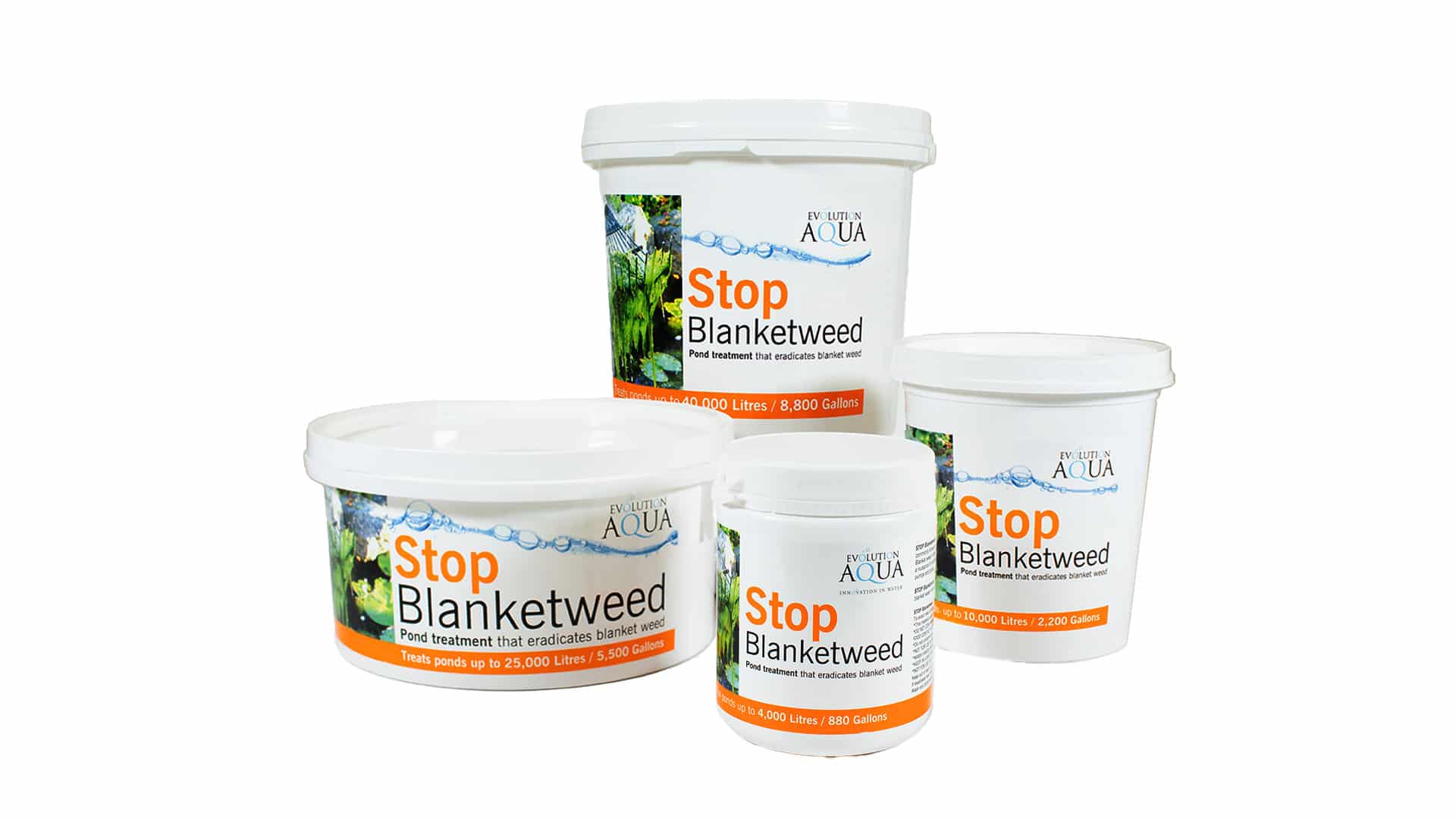
| Evolution Aqua Stop Blanketweed | A repeat-treatment programme rather than the same routine as EA’s natural formula. | The maker advises against use while frogs and newts are spawning. |
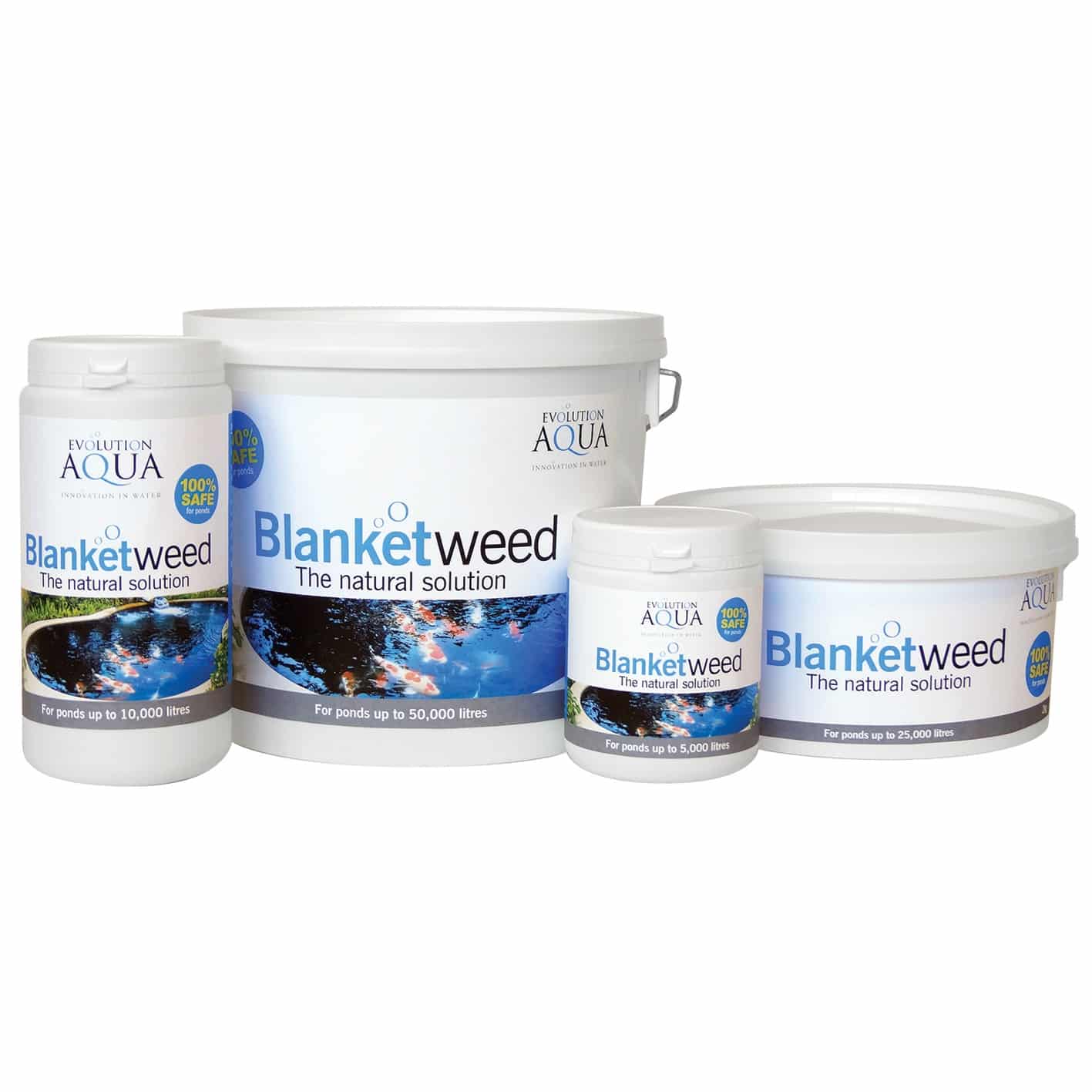
| Evolution Aqua Blanketweed — The Natural Solution | A different EA product with its own mixing and repeat instructions. | Expect temporary cloudiness; check the exact pack rather than using Stop Blanketweed’s dose. |
| NT Labs Blanketweed Balance | A powder positioned by NT Labs around remineralising and rebalancing pond water. | NT Labs gives specific low-oxygen, feeding and fish-health restrictions. |
Aqua Source Blanketweed Resolve
Aqua Source’s instructions state 25 g per 750 litres, sprinkled directly around the pond edges. They say the UV can remain on and stress good oxygenation. The manufacturer’s stated first-dose coverage is 15,000 litres for a 500 g tub and 30,000 litres for 1 kg.
Think about whether you are buying for one application or an ongoing course. Those are different quantities. We would also check the current label’s KH advice against the units on your test kit rather than copy a bare number from a web page. Our pH, KH and GH guide explains those measurements.
Cloverleaf Blanket Answer and All Season
Cloverleaf’s standard Blanket Answer page describes mixing the powder with pond water and spreading it over the surface. It gives 10 g per 125 litres and says the temporary milky appearance can take around five days to clear. Its optimum-temperature advice is above 10 °C.
Cloverleaf now also promotes Blanket Answer All Season for use at temperatures as low as 2 °C. That does not make the standard and All Season instructions interchangeable. Match the name and directions on your tub, especially if you have an older pack in the shed.
Use a measured weight where the directions specify grams. A scoop supplied with another treatment is not a substitute: its volume, the powder density and the required dose may all differ.
The two Evolution Aqua products
Stop Blanketweed uses a repeated weekly programme. Its official material describes treatment over several weeks, followed by maintenance applications. Check the exact course on your current pack rather than shortening the gap because weed is still visible.
Evolution Aqua’s wildlife advice for Stop Blanketweed says not to use it when frogs and newts are spawning. Its separate sturgeon answer says it can be used with sturgeon. Those statements should stay attached to this product and its directions, rather than becoming a promise about every treatment in the shop.
EA Blanketweed — The Natural Solution has a different routine: the manufacturer describes mixing the supplied scoop with pond water and repeating after 14 days if required. It also advises strong water movement or aeration. Treat the two tubs as separate products, even though both carry Evolution Aqua’s name.
NT Labs Blanketweed Balance and Aquaclear
NT Labs’ Blanketweed Balance directions call for water tests and good aeration before the mixed powder is distributed. They specifically say not to use it with poor water quality, unwell fish or potentially low oxygen, including daybreak, hot humid weather and within three hours of feeding. The UV can remain on.
NT Labs Blanketweed & Algae Control, also called Aquaclear, is different again. The manufacturer describes a blue dye that restricts light penetration. It is not the same product as Blanketweed Balance and should not be dosed as if it were.
Get the volume and the dose right
A pond’s surface area is not its water volume. A shallow shelf and a deep centre can look deceptively similar from above, while an outside wall measurement may include blockwork and a freeboard gap. Use the actual water dimensions and allow properly for the shape.
If you have a reliable meter reading from filling the system, keep it with the equipment records. For an irregular pond, divide it into sections rather than choose a convenient round number. Our pond volume guide explains the calculations and their limits.
To calculate a dose stated as a weight per water volume, divide your treated volume by the label’s reference volume, then multiply by its reference weight. Keep the units together throughout. Do not mix litres, UK gallons and US gallons in the same calculation.
A 9,000-litre calculation
If a current product label states 25 g for 750 litres, 9,000 ÷ 750 = 12. Twelve lots of 25 g gives 300 g for that application. This demonstrates the calculation for that stated instruction; it is not a dose for other products.
Do not round the volume up to “be on the safe side”. Too much is still too much. If you cannot establish the volume confidently, resolve that before treatment. Check whether the instructions refer to the pond alone or the total circulating system, and ask the manufacturer if the layout makes that unclear.
Use clean measuring equipment reserved for the pond. Keep the original container, take a photograph of the label and record the weight or volume actually added. That makes a later conversation about fish behaviour, cloudy water or a repeat dose much more useful.
What to do after treatment
Stay around to observe the pond after application. Do not add a new treatment immediately before going away for the weekend. Watch the fish, confirm the air is still working and look for loose weed collecting around the equipment.
Follow the product’s stated timing for removing loosened material. Empty accessible waste baskets and clean mechanical stages as required by their instructions. A filter can clog more quickly while weed is coming away, even if it normally runs for much longer between cleans.
Protect the biological filter while doing this. Removing captured waste is useful; aggressively sterilising all the filter media at the same time creates a separate water-quality risk. For the differences between filter stages, see our koi pond filtration guide.
Some powdered treatments make the water temporarily cloudy. That expected appearance is not permission to ignore fish distress, nor proof that another dose is needed. Compare what you see with the exact product instructions, the time since application and the fish’s behaviour.
If fish become distressed, improve aeration, check the equipment and water results, and seek advice with the product name, dose, pond volume and application time ready. Do not try to correct an uncertain situation by adding another chemical to cancel out the first one.
Why does blanketweed keep coming back?
Removing strands takes material out of the pond, but the conditions supporting new growth may remain. Sunlight, nutrients, feeding, plant growth and the amount of waste retained in the system all matter. A repeat outbreak does not automatically mean the previous tub was faulty.
Check where food ends up. Watch a complete feed, including the pellets carried behind a basket or towards a skimmer. Matt’s practical five-minute check is useful here: food left uneaten after that period tells you the portion was too generous. Do not keep topping up simply because some fish are still asking.
Inspect leaf traps, settlement areas and awkward corners. A clear-looking surface does not tell you how much waste is sitting below it. Remove accumulated material in a way that suits the pond rather than scheduling a complete drain every spring.
In planted ponds, suitable lilies and other aquatic plants can provide shade and take up nutrients while growing. Choose species for the depth and space, and maintain them before dead growth becomes another source of waste. See our water lily guide and oxygenating plant guide. Plants are not a guaranteed substitute for koi aeration.
Also check what enters from outside: lawn feed, soil washed from borders, leaf litter and the nutrients in replacement water. The RHS’s algae advice discusses light and nutrient control alongside physical removal. Its garden-pond planting advice should not be copied wholesale into a heavily stocked koi system.
For fish ponds, choose safe replacement water and suitable conditioning rather than automatically using whatever water source seems lowest in nutrients. Rainwater collection, source-water chemistry and fish requirements need their own checks. A top-up is not the same job as a planned water change.
Questions we are asked about blanketweed
Will a UV get rid of blanketweed?
A UV clarifier treats water passing through it and is principally useful against suspended green-water algae. Strands attached to the pond wall do not pass through the UV as a whole. Check the UV if the water is green, but do not expect a new lamp to remove every attached strand.
Can I leave the filter and air pump running?
Maintain the circulation and aeration the pond needs. Check the chosen treatment for specific UV, media or equipment directions. “Turn the UV off for all pond treatments” is an unreliable rule; several products discussed here expressly allow it to remain on.
Does barley straw remove an established mat?
Barley-based products are intended to discourage algae over time, not physically lift a heavy mat out today. Compare the instructions and expected period of use. Start with removal where growth is already obstructing the pond, and do not put an uncontrolled pile of rotting straw into the water.
Can I treat a wildlife pond?
Start with selective removal and the reasons for the growth. Check species, spawn and the exact product restrictions before considering treatment. A statement about adult ornamental fish is not evidence that a product is suitable for spawning amphibians or every pond invertebrate.
How quickly should it work?
Follow the product’s stated course and compare photographs taken from the same place. Temperature, the amount of growth and the pond conditions affect what you see. There is no useful universal promise that every pond will be clear in a fixed number of days.
Should I buy a bigger filter?
Perhaps, if the existing system cannot handle the fish and food, but blanketweed alone does not prove that. First check actual flow, waste removal, feeding and the filter’s condition. Describe the pond and the problem before buying equipment around a headline maximum pond size.
Choosing an approach for your pond
If you are comparing blanketweed and algae treatments, have the pond volume, fish species, water results and recent treatment history beside you. Those details are more useful than choosing the tub with the strongest promise.
For a pond that needs more than routine removal, we can discuss the cleaning and equipment work with you. Send a clear view of the growth and the wider pond through our contact page. We can then help distinguish a maintenance problem from one that needs a different investigation.
