





Pond Safety Guide for Families, Visitors and Fish
A garden pond combines open water, slippery edges, electricity, chemicals, tools and living animals. None of those risks makes a pond a bad idea, but they do require deliberate design and a clear routine. This UK-focused guide explains how to protect children, visitors, pets, pond owners and fish without relying on vague advice to “be careful”.
Start with a written risk assessment
Walk around the pond as though you were a visiting child, delivery driver or person carrying a heavy filter lid. Note every access route, step, trip edge, low wall, climbable feature, cable, open chamber and slippery surface. Then consider routine jobs: where does the owner stand to empty a basket, lift a pump or open a valve?
Risk changes with season and use. Leaves hide edges, frost creates slippery paving, summer gatherings bring unfamiliar children, and maintenance leaves covers open. Review safety after construction changes, new equipment, a house move, or any near miss.
Child safety around ponds
Children can drown quickly and in shallow water. Supervision is essential, but supervision alone is not a permanent control. Gloucestershire Fire and Rescue advises positioning ponds where they can be seen, using gently sloping edges where appropriate, fitting a heavy-duty mesh or safety grid to smaller ponds and fencing larger ponds so children cannot reach the water.
Use a physical barrier
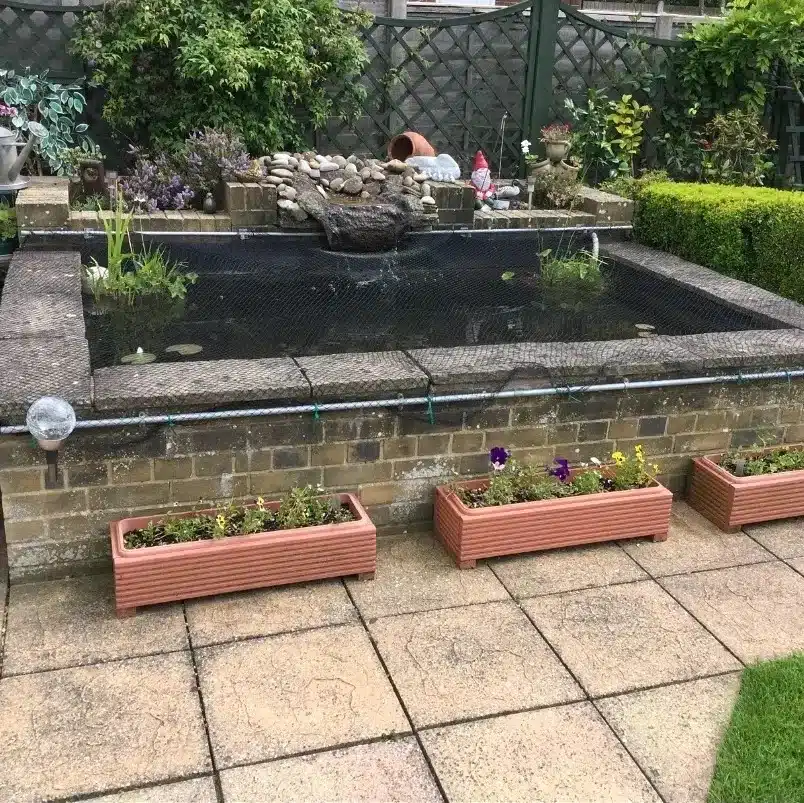
A barrier should prevent access, not merely look discouraging. Options include a properly fixed load-bearing grid close to the surface, a secure fence with a self-closing gate, or a certified pond cover. Chicken wire, loose netting and decorative trellis that collapses under weight are not safety covers.
Inspect fixings, corrosion and load capacity regularly. A grid installed when a pond was small may no longer fit after edging or planting changes. Do not place chairs, planters or filter boxes where they create a climbing route over a fence.
Design safer edges
Provide a clear visual boundary, non-slip paving and enough room to walk without stepping backwards into water. Avoid concealed sudden drops in areas a child or pet can reach. If the pond is raised, remember the wall may become a seat or climbing platform.
Supervise actively
An adult supervising water should not be using a phone, drinking heavily or assuming another adult is watching. Establish one responsible person during parties. Teach children the rule that they approach the pond only with an adult, but never treat a rule as a substitute for a barrier.
Electrical safety in a wet garden
Water and electricity require professional care. The UK Health and Safety Executive recommends RCD protection particularly for outdoor or wet locations and notes that devices rated at no more than 30 mA provide an additional level of protection. Test RCDs using the manufacturer’s test button at the stated interval.
Use a competent electrician
Fixed outdoor circuits, armoured cable, consumer-unit protection, bonding decisions and equipment enclosures should be assessed and installed to current UK requirements by a competent electrician. Do not improvise with indoor extension leads, domestic multiway adaptors, plugs lying on the ground or joints wrapped in tape.
Choose equipment for the environment
- Use pond equipment with an appropriate IP rating and follow the installation manual.
- Mount sockets and controls above likely flood level in a secure enclosure.
- Route cables where spades, mowers, animals and sharp edging cannot damage them.
- Provide labelled isolation for pumps, air pumps, UV, heating and automatic systems.
- Keep drip loops where suitable so water cannot track down a cable into a connection.
- Do not operate a UV lamp outside its closed housing or look at an exposed operating lamp.
Isolate before maintenance
Switch off and isolate relevant circuits before reaching into water, opening pumps, moving UV equipment or entering the pond. Verify that rotating equipment has stopped. If a device trips an RCD, do not repeatedly reset it; isolate the fault and obtain competent inspection.
Our koi equipment guide explains how to plan safe access and isolation into the original system.
Safe access for maintenance
Falls often happen during ordinary jobs. Keep paths level, provide lighting, clear hoses and cables, and use non-slip footwear. Do not balance across a pond edge to reach equipment; create permanent access or use the correct platform.
Heavy filter lids, pumps and wet media can strain backs and trap fingers. Know component weights, use two people or lifting assistance and avoid twisting in confined plant rooms. Guard open filter chambers and replace every cover before leaving the area.
Never enter a deep pond alone. Isolate electrics, provide a safe way out, avoid work in cold water and have another adult present. A purpose-built koi pond with smooth walls can be difficult to climb out of.
Water hygiene and personal protection
Pond water can contain microorganisms harmful to people. Cover cuts with waterproof dressings, wear suitable gloves for dirty work and wash hands thoroughly afterwards. Do not eat, drink or smoke while handling filter waste, dead fish or chemicals. Seek medical advice for a wound that becomes red, swollen, painful or produces discharge, and tell the clinician about pond-water exposure.
Keep a dedicated set of nets, bowls and cleaning tools. Disinfect appropriately between quarantine and the main pond, then rinse and dry as required. Do not use household detergent on equipment that returns to the pond.
Chemical and treatment safety
Pond treatments are active chemicals. Store them in original labelled containers, locked away from children and pets, dry and within the stated temperature range. Keep safety information and expiry dates. Never decant treatment into a drinks bottle.
- Calculate the true water volume before dosing.
- Test water and maximise aeration before treatment.
- Read the full label, including incompatibilities and withdrawal intervals.
- Do not mix treatments or add salt unless compatibility is explicit.
- Measure with dedicated equipment and avoid inhaling powders.
- Dispose of containers and medicated water according to the label; never discharge to a natural watercourse.
Our koi health guide explains why diagnosis should come before medication. Browse pond treatments only after the cause and volume are understood.
Safe fish handling
Handling stresses koi and can damage skin, fins and the protective mucus layer. Prepare everything before netting: a suitable koi pan or inspection bowl, water, cover, wet hands or gloves, sock net and any examination equipment. Keep the fish supported in water and minimise air exposure.
Use a large pan net to guide rather than chase. Transfer larger fish with a wetted sock net designed for the job. Cover inspection bowls because koi jump, and never leave a contained fish in direct sun or poorly oxygenated water. Sedation should only be used by someone competent with the product, fish, water temperature and recovery procedure.
Do not lift koi by the tail, gill covers or a dry landing net. If a fish must be moved for treatment, monitor breathing continuously and return it only when it can maintain normal balance.
Protect fish from predators and escape
Herons, cats, foxes and otters present different risks. Steep accessible edges can trap wildlife while also giving predators a fishing platform. Use secure netting or rigid protection where needed, tensioned so fish and birds cannot become entangled. An otter risk needs robust perimeter protection, not a decorative heron deterrent.
Fit guards to skimmers, overflows and suction points. Cover quarantine systems because koi can jump. After heavy rain, confirm the pond cannot overflow into a route that carries fish away or allows untreated pond water into a natural stream.
Explore pond predator protection selected for practical garden use.
Pump, drain and suction safety
Intakes must not create an entrapment hazard for fish, pets or people. Use correctly designed bottom drains, screens and pump cages. Do not remove guards to gain flow. Isolate pumps before clearing a blockage and close valves in a sequence that cannot drain the pond or flood the plant room.
Automatic top-up should have safe isolation and overflow. A stuck valve can waste water, alter chemistry and hide a leak. Check the water meter or add an independent leak alarm where consequences are high. See automatic water top-up equipment.
Slips, trips and winter hazards
Algae, splash and frost make paving slippery. Choose textured materials, keep splash zones clean and do not run loose airline or hose across paths. Provide subtle lighting without glare that hides the water edge.
Do not walk on pond ice or encourage children or pets to do so. Never smash ice with force because shock waves can harm fish and the broken surface is hazardous. Maintain gas exchange with a safe pond heater or appropriate aeration positioned for the system. Read our seasonal pond care guide.
Visitors, contractors and holiday care
Show anyone working near the pond where cables, drains and pipework run. Builders and gardeners should know which valves and switches must not be moved. Keep a labelled system diagram and an emergency sheet in the plant room.
A holiday carer needs precise feeding portions, test instructions, emergency contacts and a rule not to add chemicals. Pre-measure food or use a reliable feeder; “a handful” is not a measurement. Ask the carer to send a short video if fish behaviour changes.
Create an emergency plan
- Label the main electrical isolator and water shut-off.
- Keep a charged phone and the site address accessible.
- Know how to provide temporary aeration during a pump failure.
- Store nets, a covered koi bowl, dechlorinator and test kit where they can be reached quickly.
- Write down pond volume, normal readings, equipment models and the contact for an aquatic vet or experienced specialist.
- For human danger, call emergency services first; equipment and fish come second.
For fish distress, increase aeration, test water and follow the common pond problems checklist.
Pond safety inspection checklist
- Child barrier secure, complete and unclimbable.
- No furniture or planters creating access over it.
- Edges visible, non-slip and well lit.
- RCD test current and electrical enclosures dry and intact.
- Cables protected and no temporary indoor connections outdoors.
- Filter, skimmer and plant-room covers locked or secured.
- Valves labelled and drains routed safely.
- Chemicals locked in original containers.
- Nets and fish-handling equipment clean and serviceable.
- Emergency contacts and system details up to date.
Frequently asked questions
Is a pond safe for young children?
Open water always presents risk. Constant supervision plus an effective physical barrier or secure fence is the minimum sensible approach; obtain specialist advice for the site.
Can pond netting act as a safety cover?
Ordinary leaf or heron netting is not load-bearing. Use a purpose-designed, correctly supported safety grid or cover.
Do pond pumps need an RCD?
Outdoor and wet-location equipment should have suitable additional protection; HSE guidance highlights RCDs rated no more than 30 mA. A competent electrician should assess the installation.
Can I use an extension lead for a pond pump?
Do not treat a domestic indoor extension as a permanent outdoor installation. Use correctly rated, protected connections and professional advice.
Is pond water dangerous to touch?
Normal contact is not automatically harmful, but microorganisms can infect cuts. Cover wounds, wear gloves for dirty work and wash thoroughly.
Can I enter the pond to clean it?
Only after electrical isolation and with safe access, suitable clothing and another adult present. Deep smooth-sided ponds present a serious exit risk.
How should pond chemicals be stored?
Locked away, dry, in original labelled containers and within the manufacturer’s temperature guidance, separate from food and children’s areas.
What should I do if a fish jumps out?
Return it gently with wet hands or a suitable wet net, maximise aeration and monitor for injury. Investigate water quality, chasing or inadequate covers.
Are raised ponds safer?
They can reduce accidental access but walls may become seats or climbing aids. Height, adjacent furniture, edge width and child behaviour all matter.
How often should safety be reviewed?
At least seasonally and after building work, new equipment, household changes or any near miss.
Professional, not alarmist
A safe pond can still look attractive and feel welcoming. The aim is to remove foreseeable hazards without turning the garden into an industrial site. That Pond Guy can identify maintenance and equipment-access problems during pond service visits. For structural or electrical concerns, use the appropriately qualified professional and contact us for pond-specific context.
